|
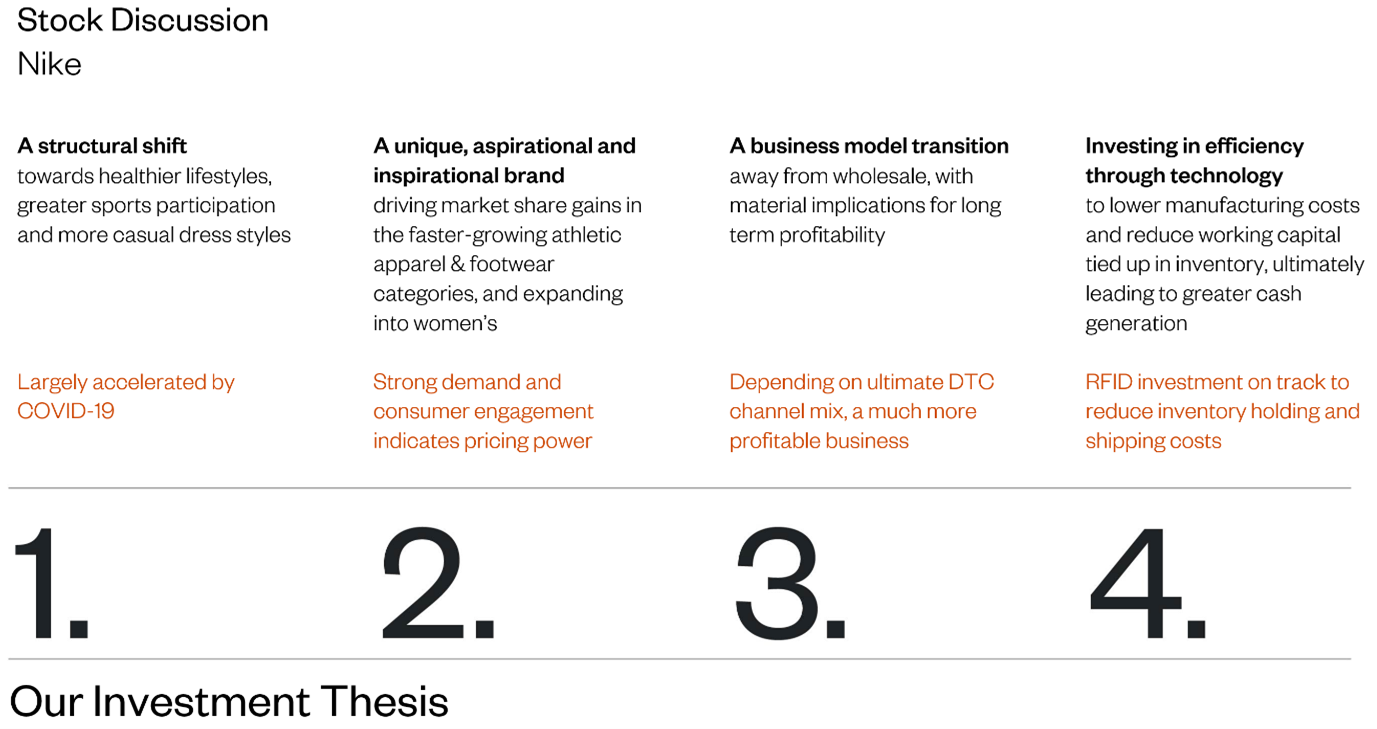
Nike: Pulling Ahead of the Pack Charlie Aitken, AIM June 2021 Approximately nine months ago, we provided a review of our investment case for Nike in 'A Marathon, Not A Sprint'. With the benefit of time, vaccines, additional data points illuminating how consumer behaviour has shifted as a result of the pandemic, and further clarity on Nike's operational performance, it is a good time to take stock and revisit the business again. The slide below is taken from our investor update presented in October 2020, and summarizes the key points underpinning our initial investment thesis for Nike back in August of 2019.
While the narrative around Nike for much of the last 18 months has been 'work-from-and-stay-at-home-winner', our view was always that this misses a much more pertinent fact: that the company is undergoing a structural change in its business model that would mean its margin profile would materially increase over the next three to five years. From our October 2020 note:
The valuation impact of this margin uplift is material. In theory, by simply shifting the destination where consumers choose to purchase goods from Nike, the business could end up selling the same number of products at the same retail price but end up dramatically increasing profits. By vertically integrating its distribution to be more in-house, Nike is effectively reclaiming margin back from the wholesale channel. Pulling Ahead of the Pack Last week, Nike reported quarterly results for the period ended 31 May 2021, where management discussed many of the key drivers of performance for the businesses over the next several years. We were happy to hear that an increased focus on Women's shoes and apparel is bearing fruit, as this was a market Nike has historically underserved. (Turns out there's money to be made in specifically catering to the needs of ~50% of the population!) As this trend matures, we expect it to drive faster organic revenue growth for several years, underpinning market share gains. Of further interest was the fact that Nike sees the changing positive attitude towards healthier lifestyles coming out of the pandemic as an opportunity to grow the overall market by promoting sports participation, particularly among younger consumers. The combination of greater insight into consumer preferences is driving not only more targeted product development, but also more targeted (and effective) marketing spend. The interaction of these factors (a structural shift towards healthier lifestyles, expanding into underserved market segments, the shift towards a DTC-business model, and other efficiency gains from investing in technology over the past several years) lead to management issuing the following medium-term (2025) guidance:
Of late, the market has been focused on short-term issues, such as port disruptions in the US (meaning inventory was not able to be timeously distributed to consumers for a period), or a consumer boycott of Nike product in China (which seems to be dissipating already). Historically, such short-term 'glitches' are when long-term investors have the opportunity to purchase great businesses with a margin of safety. (Our initial investment in August 2019 was made at the height of the US/China trade war rhetoric; buying a US brand with a meaningful percentage of sales into China was not exactly the flavour of the month.) By focusing on the longer-term developments that were not yet obvious in the reported numbers - specifically, the change in profitability enabled by the channel mix shift - and understanding the benefits of Nike's 'portfolio' approach to its business (across regions, categories, brands, and sporting codes), the long-term investor would have found much to like. As the margin uplift driven by the DTC shift is now better understood by the market at large, the market valuation has begun to reflect this; in fact, it rallied by nearly 15% on the day following its most recent result as the market capitalised the long-term margin structure into the valuation today. To us, Nike is a case in point where short-term market volatility can benefit the patient investor in buying a quality business at a margin of safety. While we are sure there are still many unforeseen and unexpected challenges Nike will have to navigate out to 2025, the combination of its strong competitive advantages in brand (and, we believe, in execution), strong cash generation, a conservative balance sheet and a high-quality management team steering the ship gives us comfort that the business is a high-quality compounder, and will be for many years to come. Funds operated by this manager: |