|
Hedge Clippings | Friday, 26 March 2021
This time last year we had just experienced the bottom of the market, in what was (in hindsight) the sharpest and most extraordinary selloff, and the shortest subsequent recession, in history.
Looking back 12 months to the 27 March 2020 edition of Hedge Clippings clearly tells you three things as shown by the closing comments:
Firstly, the mood at the time:
"In 1987 the ASX fell 50%. In 2008 it fell by 54%. 2020 is shaping as being much more serious as it affects every sector massively (perhaps excluding medical).... So the economy in Australia has, depending on one's view, stopped, or is stopping, or will stop dead in the water. As much as the government supports businesses and households, the six-month lockdown as envisaged can only be reflected in company earnings, which are tied to equity prices."
Secondly, how wrong we were.
And thirdly, and most importantly, how effective the measures introduced at the federal, and in most cases, state government level were in avoiding an impending disaster. Medically we have been spared the levels of infection and mortality that affected - and continue to affect - the rest of the world, partly thanks to geography, but significantly due to Scomo's decision to close the borders, for which in certain quarters he was vilified at the time.
12 months on and the ASX200, which had fallen 27%, had by the end of February 2021 recovered all that and has now risen 6.48% over the ensuing 12 months. While many companies have suffered, others, significantly aided by government support, have produced record results.
Market pullbacks, or downturns, offer significant opportunities for smart investors and fund managers. The greater the fall, the greater the opportunity, and the smarter the investor, or fund manager, the greater the reward.
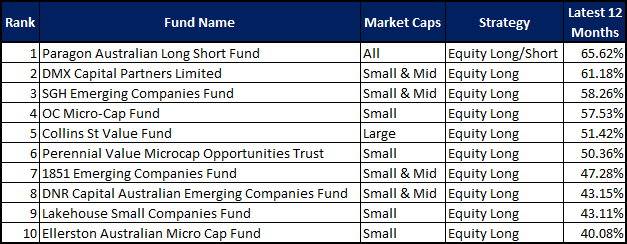
And while not universal, there have been some smart fund managers around: 42% of AFM's database of ~600 funds have outperformed the ASX200 Accumulation Index's 12 month gain of 6.48%, with the average equity based manager returning almost three times that amount at 17.41%.
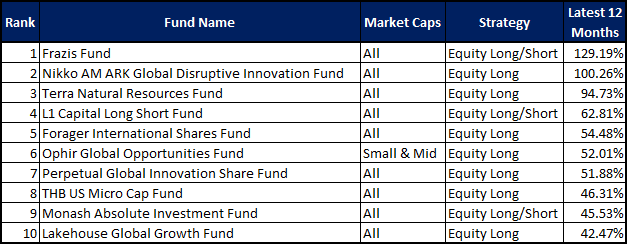
Within that broad equity group there are standouts. The returns of the top 10 funds investing in Australian Equities ranged from 40% through to 65%, and unsurprisingly those investing in the small and mid cap space, and therefore more likely to be "long only", featured heavily.
Broadening the scope to include global funds - or funds investing globally - including those that invest in Australia and overseas, and the results are equally impressive, although no doubt assisted by the fact that the S&P500 rose 31% over the 12 months to the end of February, outperforming the ASX200 by 25%.

Singling out top performing funds can be dangerous as returns over the longer term can vary, and simply looking at returns, without analysing risk factors and KPI's such as volatility, Sharpe and Sortino ratios, up and down capture etc., doesn't tell the whole picture. Follow this link to be able to see all those numbers - and more - for almost 600 managed funds, courtesy of our current "no obligation" free trial.
What is interesting is to see the dominance of long only funds amongst the top performing tables. Hedge funds (equity long short, market neutral, etc.) have, with notable exceptions, found conditions more difficult in recent times. And even more recently - over the past two months - markets have at least paused or fallen, as the rotation from growth into value has taken hold.
It may well be that in 12 months' time we'll see some different names in the lists - or strategies - with Crypto emerging as a mainstream alternative that even the conservative end of town is starting to take interest in.
Watch this space.
News & Insights
China's 14th Five Year Plan by Arminius Capital
Are Cyclicals the New Defensives? by Platinum Asset Management
Policing the platforms by Fidelity International
|