|
Hedge Clippings | Friday, 16 October 2020
For those readers of Hedge Clippings who recall the pre-Covid days when we could be a little more light-hearted in our weekly comments, join the club! Life seemed less tedious then, when even the Donald's latest missive or tweet, while still raising eyebrows, sometimes made for interesting reactions. Now we're subjected to daily statistics - be they counting cases and testing, or the trillions being spent to overcome the effects.
Not to be outdone, a couple of weeks ago Hedge Clippings included the comment that Active Equity Managers (be they long-only, long-short, or other alternative strategies) would be under pressure to justify their fee structure compared with the apparent attraction of low cost ETF's or Index funds. At that time it was too early in the month to provide the necessary statistics for the 12 months to September.
The fee debate is one that is regularly raised, not only relating to managed funds, but also when considering superannuation funds. While it is justifiable to consider fees, whether in total, or as a percentage of cost, the real test investors and advisors should also be considering is "value for money". Of course, in the case of managed funds this comes down to relative performance and risk - or at least avoidance or reduction of risk - which one would assume are what the investor is looking for, and the manager is hoping to provide.
There are some who object to high fees in principle (in spite of those same people owning or coveting expensive cars, or happily paying for quality elsewhere) but this ignores the value for money argument. Would you rather invest in an ETF which replicates the ASX or ASX200 with fees close to 0.5 or 0.10%, or an Active Equity Manager charging say 1 or 1.5% plus a performance fee of say 15%?
The answer of course is "it all depends on the performance - or the risk/reward ratio" - assuming that when comparing performances one looks at net performance after fees. That allows the investor or their advisor to make an informed decision about value for money - in conjunction of course with the myriad of other evaluation factors to take into consideration.
So is it worth paying the various fees charged by "Active Managers"? In some cases the answer is a resounding YES, in others, sadly NOT as the charts below clearly show:
Firstly, let's take the last 12 months (to the end of September) when the ASX200 Accumulation Index (ASX200 AI) returned -10.21% vs. Active Funds -0.94%. Over that period 76% of Active Equity Funds outperformed, with the "outperformers" returning on average 4.16% - or over 14% against the ASX - and by implication, an Index ETF.
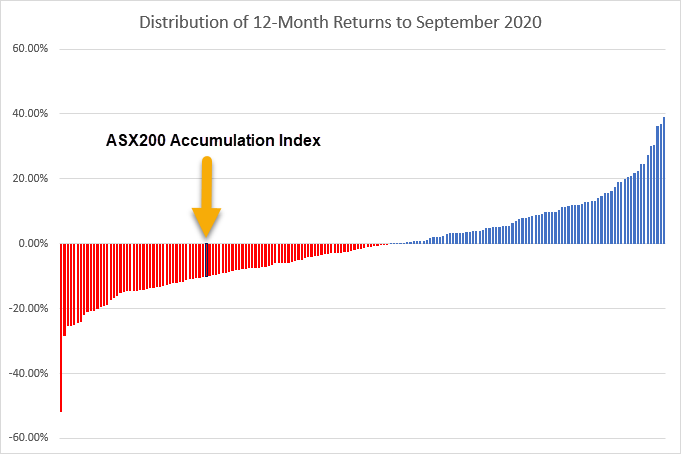
But within that group there was widespread divergence or distribution of returns - negative -10.03% through to +39.13%. One would assume that a manager returning -10.03% charging 1.3% management and 15% performance (obviously not paid as it was negative) would not qualify as good value for money, whilst the one returning +39.13% was well worth their higher management fee of 1.6% and 20% of performance.
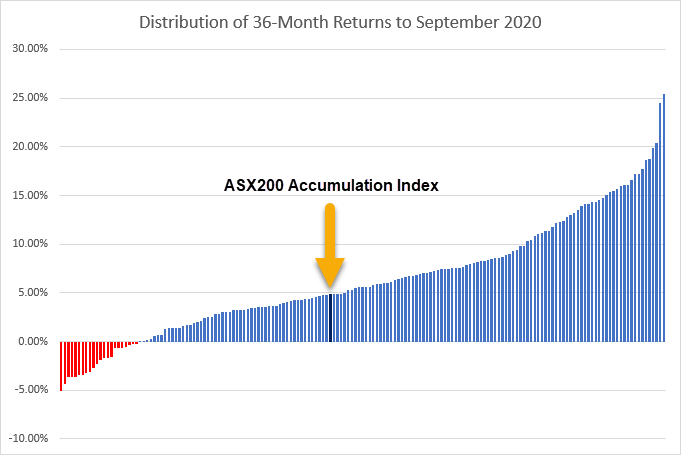
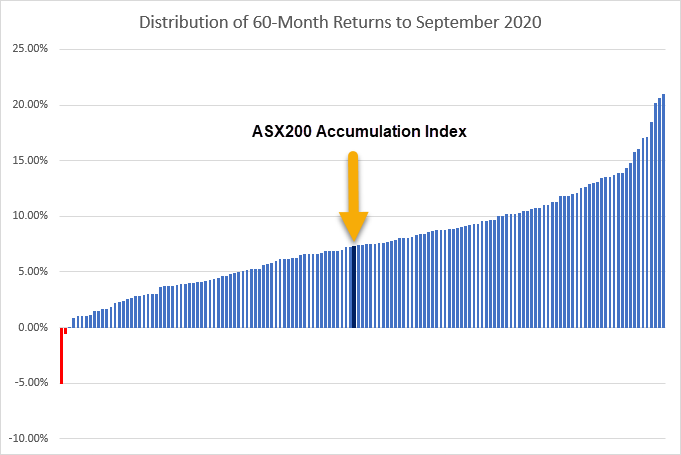
Over 3 and 5 years the numbers for the ASX200 AI have been better (but not stellar thanks to the past 12 months) but Active Managers on average have still outperformed, but not to the same extent, perhaps strengthening the argument that they don't provide value for money. Once again however, this is dependent on selecting the right fund, as the charts below show.
And for those who prefer the numbers rather than the picture, below is the data for 12, 36 and 60 months to September 2020, or for details of all funds visit www.fundmonitors.com.
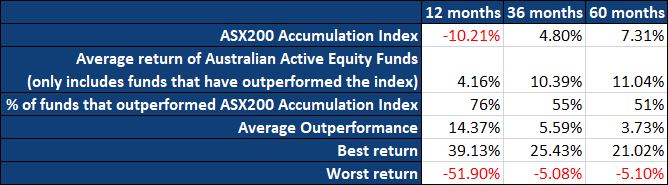
The graphs and table above only considered funds on the www.fundmonitors.com database that invest in Australian equities.
|