|
Hedge Clippings | Friday, 25 September 2020
Touch wood - that should make all the difference - it seems that there's some light at the end of the COVID tunnel, such that hopefully the worst of the lock down restrictions might be behind us. Hopefully - there's that word again, and we were always taught that "hope is not a reliable strategy" - the easing is not too much too soon, and we don't slip back into rising case numbers.
No such luck in the UK, Europe (France in particular), the USA and many other countries as well, including Israel and Canada. Trump continues to maintain what a great job he's done in restricting US deaths to 200,000 (and counting), while in the UK Boris, who is eating humble pie (not) and facing threats of 50,000 cases a day within a month, is instituting a 10PM curfew, presumably because the virus, like the werewolves, only comes out at night.
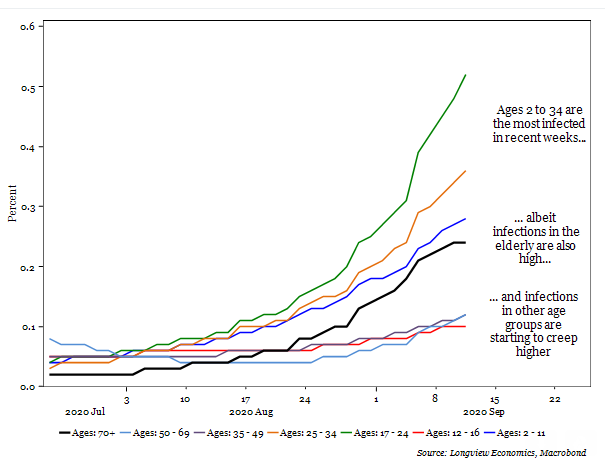
What is of concern, based on the chart below from Longview Economics, is that the highest number of new infections in the UK in recent weeks has been amongst the 2 - 34 year old age group.
But Wuhan, China, where it all began, has reopened for international flights. Meanwhile, this week at the UN Chinese President Xi refused to accept any responsibility for the economic and medical carnage COVID-19 has wrought on the world.
Thank our lucky stars we're in Australia, with hope (again) we're heading in the right direction. While on the subject of direction, and Australia, there's good and bad news today on the economic front depending on one's point of view: The Federal budget surplus forecast just a few months ago to come in at $5 billion has now settled to a deficit of $85.3 billion or 4.3% of GDP for 2019-2020. So what's "good" about that?
Well for a start there was virtually no debt to speak of to start with, leaving the government with plenty of fiscal room to move. And while there's still a huge task ahead, one would assume that the budget due to be handed down by Treasurer Josh Frydenberg on Tuesday week will contain a mix of ongoing support where needed, while weaning others off the welfare nozzle where it's not.
Turning to markets, and equity markets in particular, and not surprisingly volatility remains elevated. Not at the record levels of over 80% in early March, although it spikes from day to day, but roughly double its average of less than 15% during 2017 - 2019. Maybe markets are turning their collective minds to the outcome of the US election on November 4?
News & Insights
The US senate result could reverberate for decades if under Democrat control the filibuster goes by Magellan Asset Management
|