|
Active Beta vs Active Alpha: "Oils ain't Oils"
This is part of a larger insights article due to be published next week containing additional tables of top performing funds over the past 12 months.
An article published in the UK's FT last week highlights an ongoing issue in the debate between Active and Passive investing. When it comes to analysing managed fund, and active funds in particular, it is worth remembering the old Castrol advertising line: "Oils ain't Oils".
Put simply what is often misunderstood about so-called Active Managers is that some are what we could term "Active Beta" while others - what we'd describe as truly active - are "Active Alpha".
Before the emergence of "absolute return" hedge funds utilising long/short or market neutral strategies, and in fact before the rise of Passive investing, most managed funds were "Active Beta". In other words, they tried to provide broad equity market exposure, but by adjusting the weighting of individual stocks in the index, or by being over or underweight a particular sector, they sought to outperform the market.
Frequently the objective was to be in the top or second quartile of their peers, and thus qualify for a chance at approval from asset consultants, and thus receive large institutional mandates. Making it to the top quartile in their peer group didn't mean they needed to outperform the market by much, or at all. They just needed to be better than the rest.
A problem with Active Beta, either by design or otherwise, is that marginally adjusting the weighting of, say, the top 100 stocks in the ASX100 still leaves the portfolio heavily reliant on the direction or performance of the overall market.
For instance, in the banking sector an Active Beta manager might still hold all four banks, but be over or underweight in one or more of them. Alternatively, they may be overweight the banking sector but still retain significant exposure, because not to do so would create the risk that they could underperform the market, or more importantly, their peers.
Ironically, by not wanting to take that risk they created the overall risk of moving broadly in line with - give or take 2-3 percent over the long term - the overall market's performance. In other words, they weren't paid to take risk, but paradoxically were doing just that because the market itself, as we know, is a volatile beast.
There are literally thousands of Active Beta funds both in Australia and overseas, as shown by Morningstar's extensive list. Most of them, on average as per the FT's article, fail to outperform the market - and therefore passive funds - over time.
So, what about Active Alpha funds?
As we define it, Active funds are those which aren't index constrained, and therefore don't allocate to stocks based on being over or underweight their index weighting. They might, for instance, have only 20 or 25 stocks in the entire portfolio out of over 2,000 in the ASX All Ordinaries. They might be able to adjust their cash weighting to 40, 50 or even 100% - and therefore their exposure to the market as a whole - given their view of the market's risk.
They might avoid sectors as a whole, or only invest outside the top 200 stocks. And of course, some - the hedge funds - are able to short stocks or the market as a whole, use derivatives or borrow to add leverage, either to avoid risk or to improve returns.
Others are "true" alternatives, managing futures, commodities or volatility.
Overall the prime objective of Active Alpha funds is to provide an "absolute return" - in other words, positive performance in both rising and falling markets over time - and generally with the a focus on protecting capital, or being less correlated to the market when it falls.
Of course, not all Active funds achieve their objective. Some do, some don't. As the Castrol add says, "Oils ain't Oils". But on average, unlike Active Beta funds, they do outperform the underlying market, and some will provide that elusive ability to provide positive performance across various market conditions.
The performance of these "Active Alpha" funds varies widely - as does their investment mandate - not only between the good and the bad ones, but from year to year. Hence the necessity of research and careful analysis.
For the record, AFM avoids including Active Beta funds on the fundmonitors.com database, because frequently they're all much the same. AFM only includes Active Alpha, some good, some not so good. We provide the facts, and let you be the judge.
See below for the best performers on our database sorted by 12-month return after fees:
Top 10 - All Funds
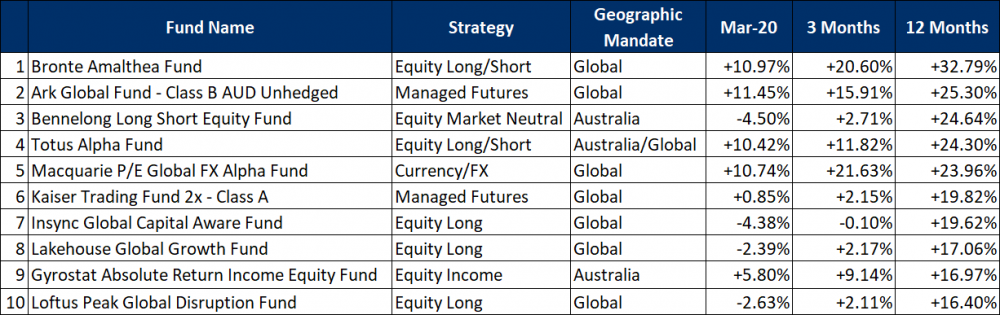
Geographic mandate: All
Strategy: All
Top 10 - All Australian Equities Funds
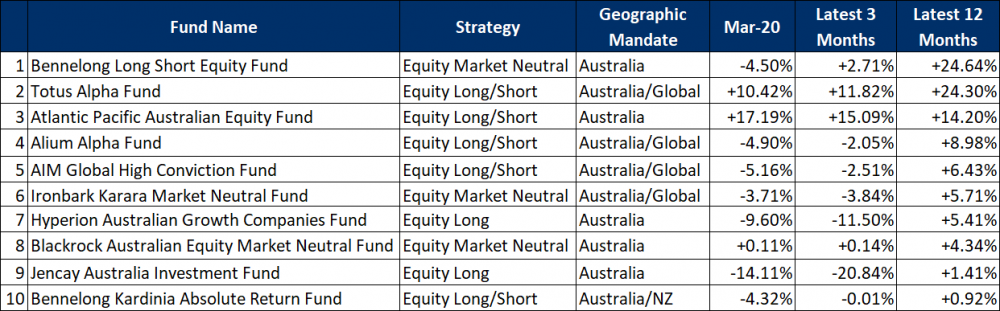
Geographic mandate: Australia, Australia/NZ, Australia/Global
Strategy: All equity-based strategies
To view any of these funds' profiles, you can do so by searching for them via the Fund Selector on the fundmonitors.com homepage.
|