|
Hedge Clippings | Friday 31 January, 2020
With scarcely a month gone in 2020, the year is shaping up to be tumultuous for all the wrong reasons - fossil fuels/climate change/global warming, widespread bushfires across the length and breadth of Australia, and now the World Health Organisation declares China's coronavirus a global health emergency. Retaining a positive outlook and a "glass half full" approach is becoming more difficult by the day, even before we've received another lecture from a disgruntled Scandinavian teenager.
Hedge Clippings had hoped that thanks to his advancing years, the days of having to endure the opinions of disgruntled teenagers over the breakfast or the dinner table were long gone, but apparently that's not to be. At least there's now the option of on/off, mute or volume switch, rather than packing them off to school in the morning or doing their homework while reaching for (another) glass of pinot.
But we digress...
One issue for us Aussies is that we've been used to being in the limelight on the world stage for all the right reasons for so long. Whether it has been for our natural resources such as sun-soaked beaches, wide-open spaces and unique and quirky wildlife, or our sporting prowess as demonstrated in the 2000 Olympics and elsewhere where we've always fought way above our weight. We were used to being envied and were justifiably proud of that. Instead this summer of bushfires, not yet over, has well and truly put us on the world stage for all the wrong reasons, and not only are we not used to it, but we're also not enjoying the experience.
Individually there's little, if anything, we can do to fix it. Collectively there's much more, but that involves a collective agreement, not only of the problem, but also the solution. Unfortunately, while we only hear the views of the noisy minority via both the traditional and social media, the alternative solutions being proposed don't get much of an airing.
Today the Federal and NSW Governments announced that they have agreed to a significant expansion of NSW's gas reserves to reduce the reliance on coal as a primary energy source, but the last time we checked gas was a still fossil fuel, so presumably still emits CO2, albeit possibly at a lower, or cleaner, rate than coal.
But there's still not a whisper in the media (at least not the in left-leaning ABC, Fairfax, or online via Crikey or The Guardian) even mentioning the potential for Small Scale Nuclear reactors. Looking at the website of the Union of Concerned Scientists, their only concern (apart from Donald Trump) is nuclear weapons (which most share) rather than any mention of using nuclear power to resolve the world's unhealthy dependence on coal and other fossil fuels.
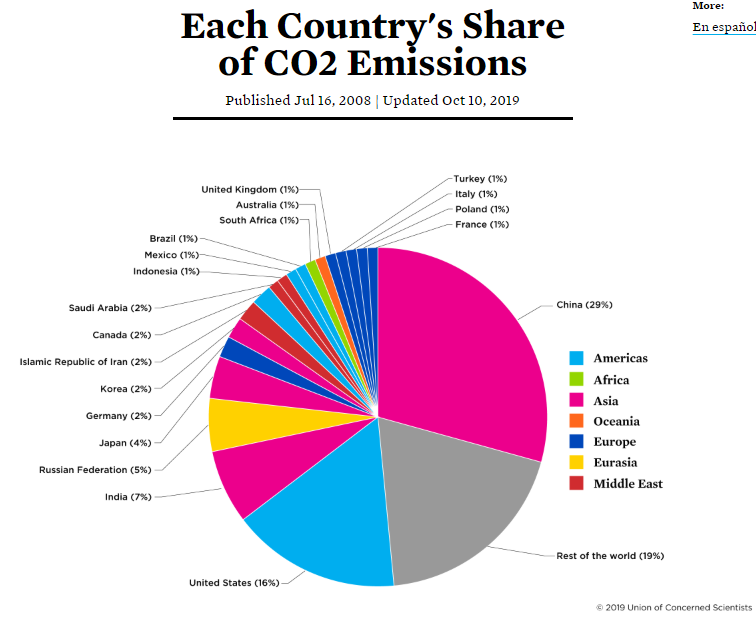
Australia by the way, based on data available as at October 2019 as shown in the chart below, is only responsible for 1% of global CO2 emissions, way behind China (29%), the USA (16%) and India 7%.
|
Some believe this to be an incorrect way to explain the problem. For instance, as of 2016 on a per capita basis, Australia is the 2nd highest CO2 emitter behind Saudi Arabia.
This ignores our exports of coal which is what really upsets the noisy minority, the media and the aforementioned disgruntled teenager. We, and the world, certainly need to adjust and address the issue, and no doubt should have been doing so for the past decade or more, but an immediate or rushed decision to "ban coal" as advocated by some would plunge the world (and particularly the existing and emerging economic powerhouses of the USA, China and India) into an immediate and disastrous depression which would cause more problems than it would solve.
All of the above issues are going to make for an interesting year not only for every individual, but particularly for investors and fund managers trying to navigate an unpredictable and challenging environment.
|
|