|
Hedge Clippings | Friday 19 July, 2019
There has been plenty in the media recently regarding the difficulties facing active fund managers, mainly focusing on the negative side of things, and possibly with good reason. Performance has suffered following a period of one of the more challenging market conditions that most active fund managers we have reviewed can remember - including during the GFC and immediately afterwards.
Naturally with sub-par performance relative to the market (even if not actually negative) comes the difficulty of attracting investors and raising FUM. The rise of passive investing and ETF's with ultra-low fees, particularly with an equity market buoyed by extreme interest rates, makes it hard for the average active manager to build a business.
Diminishing or static FUM has also been accentuated by the move by many institutions and industry super funds to revoke mandates and take them back in-house as they continually attempt to reduce their own fee structure. Once again, the market conditions of the past five years have made low-cost index investing ultra-attractive. As a result, there has been a surge in the number of fund and manager consolidations, whilst others have simply elected to close and return the cash to investors. By and large in Australia there has been limited shuttering of funds, unlike in the UK where a large and previously successful manager has had to "gate" the fund to protect positions and investors in the short-term, but in doing so has inevitably inflicted terminal damage on the management company, or at least its reputation.
In the short to medium term it is hard to argue against this move to index funds. The ASX 200 total return index is up 19.73% year-to-date since January, 11.55% over the past 12 months to 30th June, outperforming even the S&P500's total return, 18.54% YTD and 10.42% over 12 months. In the medium to long-term investors that have taken this path will need to understand that volatility will return at some stage.
In this environment, while 95% of the funds tracked on www.fundmonitors.com have provided positive returns year-to-date, this number drops to 70% over 12 months. More concerning, from both investors' and fund managers' perspective, is the fact that less than 10% of funds have outperformed the ASX200, both year-to-date and over the past 12 months.
Of course, there is a danger in looking at returns over six or 12 months. All the disclaimers and warnings clearly state that investors should have at least a three and preferably a five year investment horizon. We would add that they should carefully evaluate not only the fund and the investment manager, but also invest across multiple funds and look carefully at how closely each fund's returns are correlated. Even a portfolio of five funds, carefully selected, can provide significantly lower volatility and frequently a higher return than its component parts.
While the chart below shows an unusually high correlation between AFM's index of equity funds and the ASX200 over the past 12 months, over the longer terms it also shows both a higher cumulative result, with lower volatility, principally by avoiding the market drawdowns of 2008, 2001 and 2015.
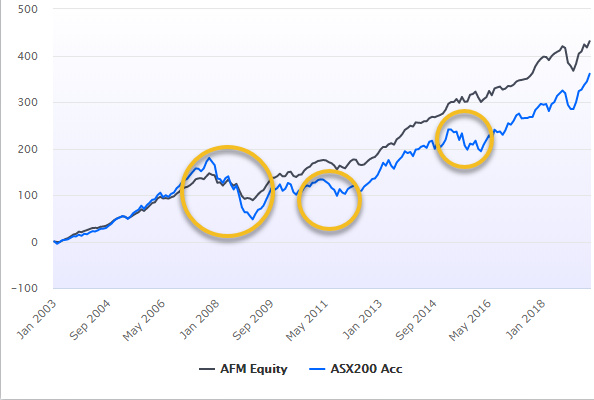
When the current interest rate cycle ends, even though that doesn't appear to be close by, so that volatility will return.
|