|
Hedge Clippings | Friday 07 June, 2019
When the RBA's decision to cut the official cash rate came through this week it was somewhat of an anti-climax given it had been well flagged by the RBA themselves. In addition, nearly every economist had factored it into their models, and they have now moved on to when the next cut may be, and how low rates may eventually go.
At 1.25% it took the RBA Governor to point out that there was a limit to how much monetary policy can do to stimulate the economy, employment or inflation, correctly indicating that fiscal policy must play a part as well. There's still an element of doubt about the certainty of the tax cuts due in July once Parliament returns, but along with the reduction in loan repayments for those homeowners with a mortgage, they'll help consumer spending - provided the additional income doesn't go towards debt reduction.
One option is an increase in spending through increased infrastructure projects, but the government will be loath to not deliver a surplus, although with a further three years in power this may be a better - or more politically acceptable - solution. Hedge Clippings has repeatedly called for an allocation of a portion of all superannuation into infrastructure given the alignment of interests and the similarity of the investment requirement and life cycle of each.
Looking further afield, although it will potentially impact the Australian economy to a significant degree, the US/China trade spat - not quite a war, but getting mighty close to becoming one - appears to show no sign of diminishing. We were reminded on the 30th anniversary of the Tiananmen Square massacres that the Chinese government is not fond of losing face - or control.
One economic issue for China is their current account balance as a share of GDP. According to an excellent piece of analysis by the UK's Longview Economics this showed a surplus of just 0.4% in 2018, whereas as recently as 2007 it was just shy of 10%. As Longview's chart below shows the IMF is forecasting a modest continued surplus through to 2021 before moving to a deficit.
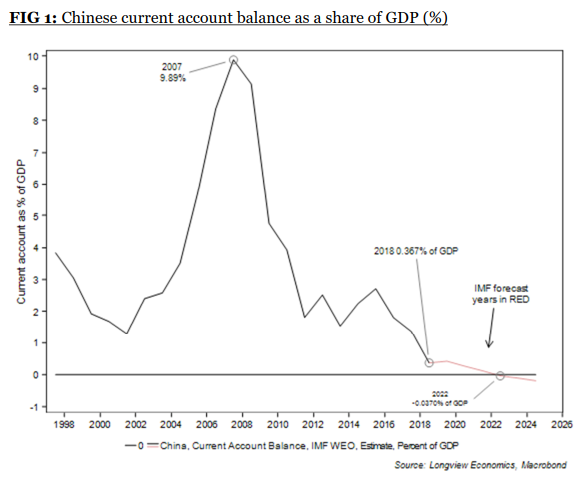
However Longview believe that it is more realistic to expect a deficit this year as the underlying dynamics of the Chinese economy continue to deteriorate due to a range of factors, including the US induced trade war, increased credit fuelled consumption and a shrinking of their working age population and employment. The above reference is just a snippet of Longview's in-depth analysis, and if you are not familiar with their work, or their founder and CEO Chris Watling, it is well worth taking a look.
But back to Trump: Last week after we dispatched Hedge Clippings Trump upped the overall threat of a global trade spat by taking a shot at Mexico's tariffs as well, before setting off to the UK and Europe for the D-Day commemorations, where generally he actually seemed to present "presidentially" - but only after giving London's Lord Mayor a verbal serve.
One thing you can say about the Tweeting Donald, he's not short of an opinion.
|