|
Hedge Clippings | Friday 29 March, 2019
Yield inversion and the "R" word.
Everyone's talking about the "R" word, based on an inverted yield curve as Treasury yields tank and bond markets soar following the US Fed's recent policy about-turn - even to the extent that Germany issued more negative yield bonds this week. While the generally accepted opinion is that as in the past, and under normal circumstances, inverted yield curves tend to precede recessions in most instances, one has to wonder if these are "normal circumstances".
For instance, many of the macro issues that are shaping the world's largest economies at present have not been experienced before, even if inverted yield curves have - think 10 years of global QE post the GFC; Trump's arm wrestle with Xi; China's inevitable slowdown after 30+ years of tearaway growth; Brexit's shambles and its inevitable drag on both the UK and EU's economic outlook.
Given the cause of an inverted yield curve is arguably that investors are concerned about the economic future, and thus are therefore seeking a safe haven in 10-year Treasury bonds, it is not surprising that yields are so low - or in Germany's case, negative.
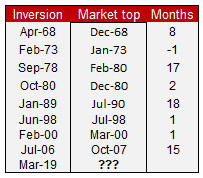
Of course, it could easily be argued that these issues themselves are setting the global economy up for a slowdown, if not a full-blown recession, were it not for the changing economic world thanks to technology in all its forms in the era of the great Technological Revolution. However, if history is to be a guide, then we have 14 months to wait and see, as that's the average time lag between the first inversion date and the onset of the following recession, although take care - it normally only takes 8 months for markets to top out.
As we often warn, averages can be dangerous. According to https://seekingalpha.com, following the last 8 instances of inversion, ranging from April 1968 through to July 2006, the lag before the market topped out ranged from -1 month (February 1973 - January 1973) to 18 months (January 1989 - July 1990):
Meanwhile, exceptionally low yields are spawning the usual range of high yielding debt and credit offers promising overly generous returns, which must by default come with overly heightened risk - not so much of not being able to deliver on the promised returns, but with a potential loss of capital to boot. Our advice is to read the offer document very, very carefully, particularly to understand what the underlying investment is, as outlined here by Tim McGowan of Informed Investor.
Next week is budget time, so expect a bout of generosity from the current treasurer, likely to be reversed by the next one if there's a change of government come the forthcoming election.
|