


It seems fund rankings are in the news in the past couple of days, whether it be super funds, or managed funds available outside super.
Taking super funds first, there seem to be two schools of thought, each not surprisingly probably dependent where the self-interest of the thinker lies.
Super Ratings tables clearly show that industry super funds have outperformed the bank and for-profit sector funds, and while they will understandably promote their performance and claim that it is due to lower fees, they will also rightly claim that asset allocation plays a significant part in their success.
On the other hand Colonial has argued that it is not a simple comparison and the options available, along with the demographics of the fund members, are significant. What is relevant is that the massive number of options and alternatives available make it incredibly difficult not only to compare funds and the returns, but also for the investor to choose the appropriate option.
Whatever the arguments the logic and argument from the Productivity Commission that across the board fees be reduced to match those available in comparable products and jurisdictions overseas, but that there should be a simple default option of the top 10 performing funds.
The complexity of the current array of choices simply makes it impossible for the average person to make an informed choice.
Moving on to managed funds outside superannuation, the tables in today's Financial Review, supplied by Mercer, make interesting reading and will equally no doubt be promoted by each of the relevant funds.
What is interesting is that when Australian Fund Monitors analyses results to the end of June (bearing in mind not all funds have reported as yet) for the past one, three and five years, there are some significantly interesting trends:
Finally, in a rising market, with the exception of Newgate and Smallco, Long Only funds dominated.
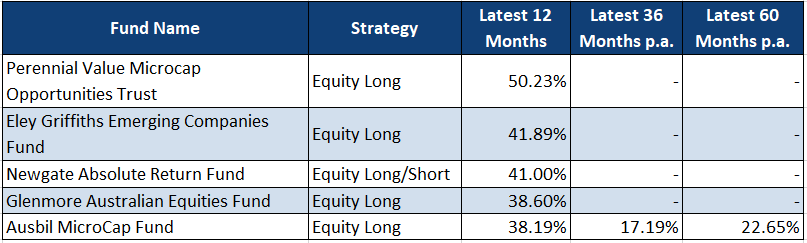
Taking the top five performing funds over three years, the table looks like this:
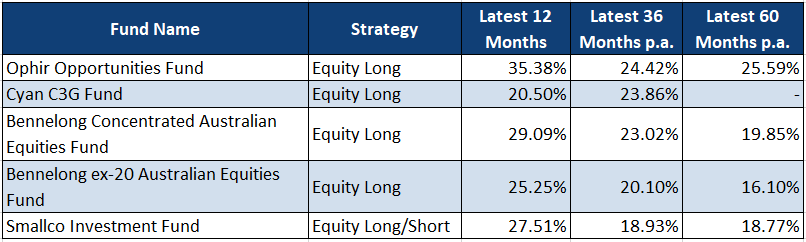
Then taking the best performers over five years, the results are as follows:
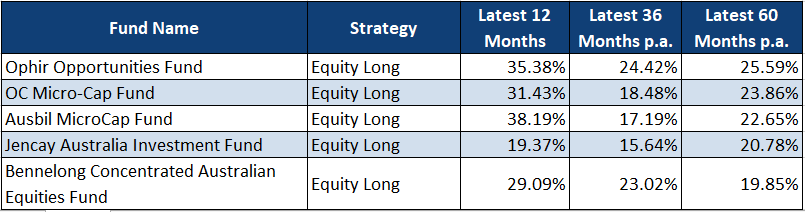
Before we receive a raft of complaints from those managers with better returns in a specific year than those listed, we applied a consistency filter, which with the exception of the earlier stage funds in the one and three year tables, took out any fund with a performance of less than 15% over either one, three or five years. Equally, the above tables only include equity based funds with a geographic mandate of Australia and New Zealand, so Asian and Global funds were excluded.
Methodology is always important when ranking and filtering funds, and purely selecting the top performing funds based on returns is always risky, simply because looking at returns, without looking at risk factors such as volatility , Sharpe ratios, draw downs and up and down capture ratios, doesn't tell the whole picture.
And of course the overall disclaimer that "past performance is no guarantee of future returns" applies - although we consider it to be highly relevant.
