


NEWS

13 Mar 2025 - Performance Report: Bennelong Long Short Equity Fund
[Current Manager Report if available]

13 Mar 2025 - The state of the energy transition: Where are we now?
|
The state of the energy transition: Where are we now? Janus Henderson Investors February 2025 While the politics of climate are changing, the prevailing trends continue to reveal significant investment opportunities in the energy transition, as outlined by Tal Lomnitzer.
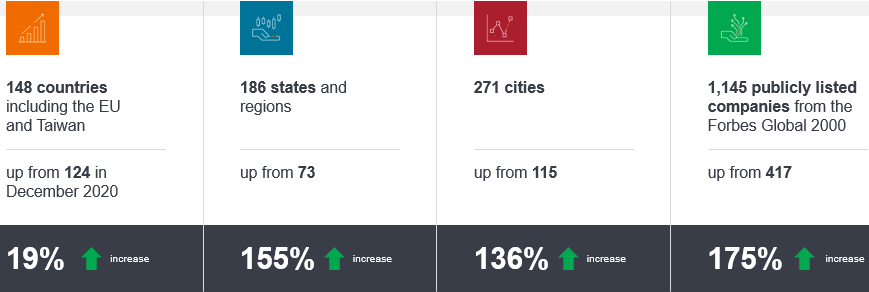
The victory of Donald Trump in the US presidential election, coupled with a lacklustre COP29 climate conference in Baku, has prompted concerns about the state of the energy transition, with some fearing progress may slow or even reverse. Such concerns are underscored by the 2024 average global temperature reaching 1.8°C above pre-industrial levels in 2024 - marking it as the first year to surpass the 1.5°C target limit. Despite rising global temperatures and the Trump administration withdrawing the US from the Paris Agreement for the second time, we still see opportunity for investors to profit from the prevailing trends underlying the energy transition. Rising corporate commitment to net zeroExhibit 1 offers a snapshot of how net zero commitments have grown over the past five years. What stands out is the notable surge in Forbes Global 2000 corporations committing to net zero over the past few years. This is significant, since these 2000 companies are responsible for approximately 20% of global embodied emissions, considering both their operations (scope 1 and 2) and supply chains (scope 3) emissions. Exhibit 1: Commitments to net zero have grown since 2020
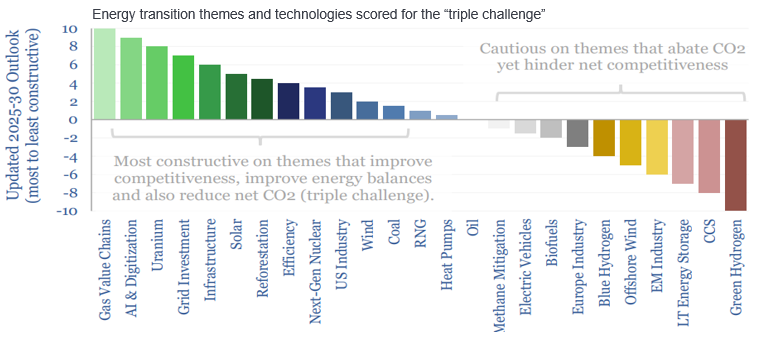
Source: Net Zero Tracker, as at September 2024. While the nature of these companies' net zero commitments varies widely, with some aiming for carbon neutrality, some for zero emissions, and others focusing on Scope 1 (direct) and 2 (indirect) emissions but not Scope 3 (value chain), the overall trend is one of growth, both in the number of commitments and the entities making them. Further, there has been a significant rise in targets enshrined in national policy in the past few years, with 88% of global emissions, 89% of the global population and 90% of global GDP covered by some form of national commitment or net zero target. The 'glass half full' perspective is a significantly higher level of ambition, but with the average global temperature in 2024 already 1.8°C above pre-industrial levels, the need for countries to address greenhouse gas (GHG) emissions faster and deeper is mounting. As it stands the race against time to net zero is arguably being lost if we want to keep below 2°C, and many entities still lack emissions reduction targets. The triple challengeWhen we examine the state of the energy transition from both a pragmatic and investment perspective, the three axes of the 'triple challenge' need to be considered. This encompasses the challenge of enhancing competitiveness by providing cheap energy, improving the energy balance by providing more energy, and simultaneously addressing the GHG emissions present in our atmosphere. A useful analysis from Thunder Said Energy (Exhibit 2) of various energy technologies and themes within the context of decarbonisation, ranks them by how much they address the triple challenge, with those on the left side improving competitiveness and those on the right side reducing competitiveness based on current economics. Exhibit 2: Triple challenge framework
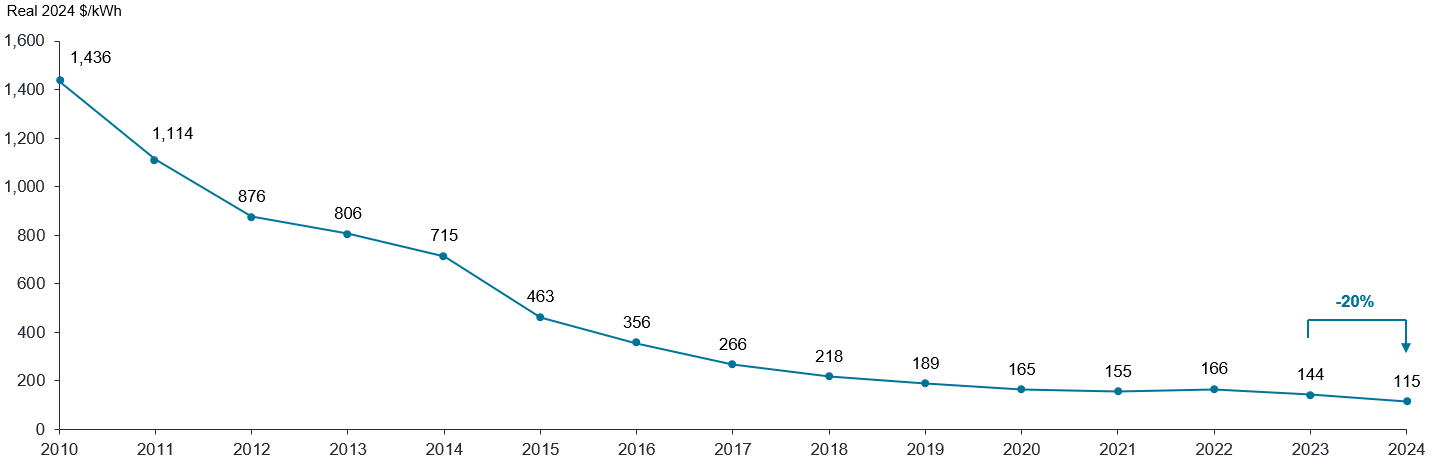
Source: Thunder Said Energy. The public statements from the Trump administration regarding renewable energy in our eyes seem less about being against decarbonisation per se and more about being pro-competitiveness. In this context, competitiveness equates to affordable energy, whereas anti-competitiveness is synonymous with expensive energy. Therefore, our investment focus favours companies that offer inexpensive energy solutions and contribute to lowering carbon emissions, such as the value chain of gas, including LNG, gas storage, and transport, along with AI, digitisation, and nuclear energy. Nuclear energy, in particular, is seen as a significant advantage for those seeking base load power with a minimal carbon footprint and self-sufficiency, especially considering that the US and Canada have abundant uranium resources or the potential for it, thus reducing dependence on potentially unfriendly suppliers such as Russia. Our investments are also directed towards grid investment, solar, energy efficiency, reforestation and other areas where we see strong returns and growth prospects that address the challenges of the energy transition. Conversely, we are currently avoiding sectors that, while potentially reducing carbon emissions, could impede competitiveness. These include green hydrogen, carbon capture storage, offshore wind, and blue hydrogen. These areas represent the more costly segments of the energy market, which we are deliberately choosing not to focus on, pivoting instead towards investments that align with improving competitiveness whilst also delivering more sustainable energy solutions. The economic case for solar energyWe were surprised to discover that during the first Trump presidency, the US experienced its fastest pace of solar installation, with Texas, an oil and gas stronghold, surpassing California in solar installations. This surge is attributed to the declining costs of solar photovoltaic (PV) systems with storage, making solar energy increasingly competitive against natural gas in the US, and even cheaper than coal-fired power in India and China on a levelised cost of energy (LCOE) basis. The reason for this cost reduction is twofold: the virtually inexhaustible nature of solar energy and the semiconductor technology it employs, which has historically seen efficiency gains and cost reductions over time. Currently, solar panels have achieved 25% efficiency in converting sunlight to electricity, a significant improvement from 5% two decades ago, with the potential to reach 50% efficiency. This improvement, alongside increased production volume, has driven down costs to approximately four to five cents per kilowatt-hour, with projections suggesting a future decrease to between one and two cents. As a result, solar energy has become the lowest-cost form of generating electrons globally. In Europe, solar production capacity is expected to triple between 2020 and 2024, outpacing both onshore and offshore wind, due to superior economics. Similarly, cost reductions are observed globally, driven by technological advancements and increased efficiency, not solely by low-cost Chinese production. The imposition of tariffs on imported solar panels could significantly benefit US solar companies that produce panels domestically by increasing their profitability due to higher margins. We anticipate further production expansion in the US as a result of these tariffs and view any additional tariffs as a highly positive development for domestic solar panel producers. Similarly domestic producers of key materials such as steel stand to benefit in a world of higher tariffs. Energy storage costs continue to fallAs utility scale solar installations increase the intermittent nature of the electricity causes power price volatility which necessitates effective energy storage solutions. The economic case for energy storage which enables energy price arbitrage becomes increasingly compelling as price volatility rises, while the costs associated with developing and deploying these technologies have significantly declined. For instance, the price of lithium-ion battery packs has plummeted from US$1,436 per kWh in 2010 to US$144 in 2023, marking a 90% decrease over approximately 13 years (Exhibit 3). Exhibit 3: Lithium-ion battery pack prices
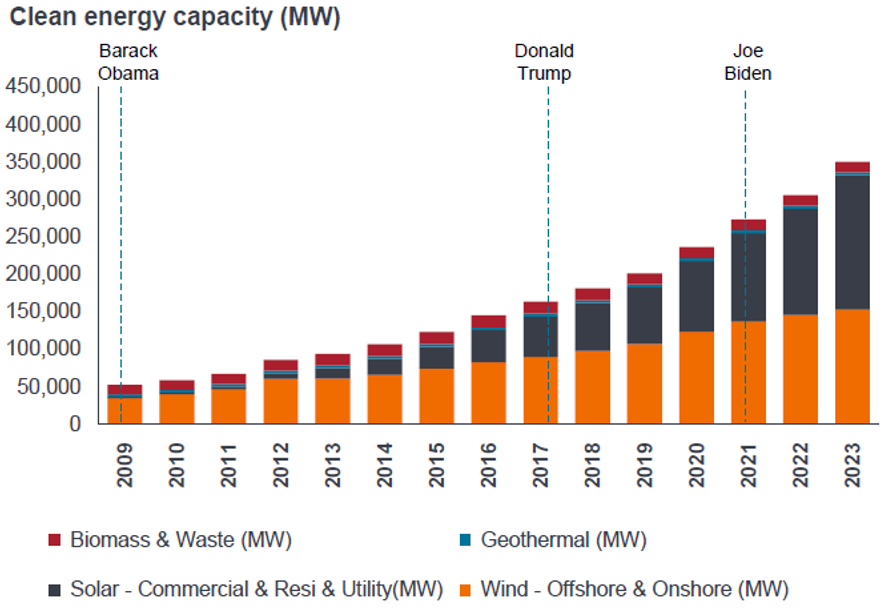
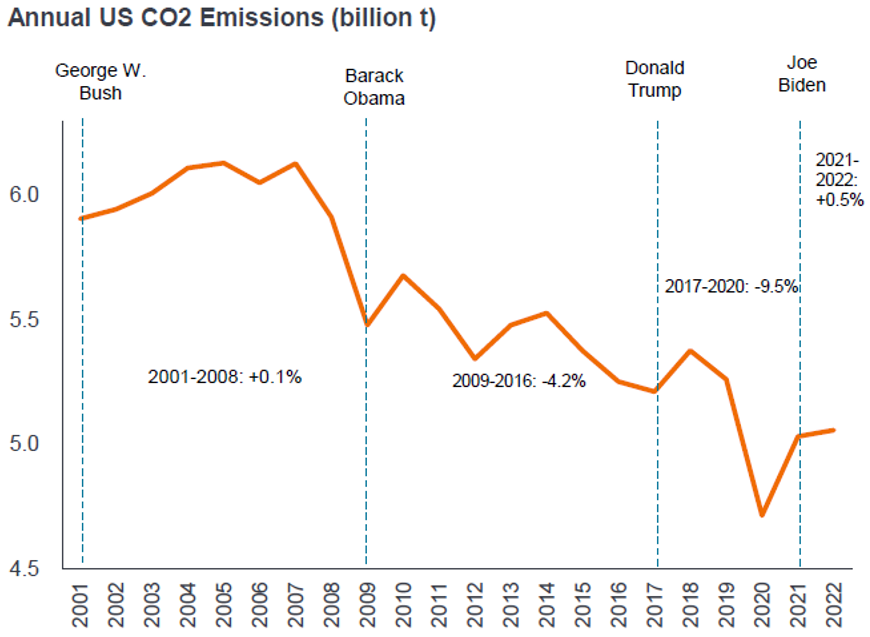
Source: Bloomberg New Energy Finance (BNEF), as at 10 December 2024. Past performance does not predict future returns. Despite a seeming plateau in battery prices on the chart, prices continued to fall by 20% last year, with expectations for ongoing reductions. This cost reduction has catalysed a surge in battery storage installations. In 2023 alone, 60 gigawatts of energy storage were installed, enough to power 60 million homes representing a 120% increase year-on-year. Projections for 2024 estimate over 100 gigawatts of installations, with future expectations reaching up to 1 terawatt annually by 2030 and three terawatt-hours annually by 2050. By then, solar power with associated storage could contribute 43,000 terawatt-hours to the grid, driven primarily by economic feasibility rather than regulatory enforcement. Notably, in 2023, China led the world in energy storage installations, accounting for almost 50% of global capacity, with the US and the rest of the world trailing significantly. This highlights China's leadership in energy storage and underscores the need for other countries to accelerate their efforts in this domain. However, even this fast pace of energy storage deployment is arguably insufficient. To maintain alignment with the 1.5°C target, approximately 1,300 gigawatts of battery storage will be needed by 2030 according to the IEA, a goal that current estimates suggest we are unlikely to meet. Present trajectories indicate a potential global temperature increase of 2-3°C. Trump does not necessarily put a spanner in the worksWe believe that it is highly unlikely that businesses will abandon their decarbonisation efforts, as these initiatives extend beyond any single presidential term. The trend of directly sourcing clean energy is established and enduring, propelled by the economic benefits of large-scale wind and solar projects and the rising costs of grid-supplied electricity, with an added push from investments into Artificial Intelligence. Despite news of the US once again exiting the Paris Agreement and reducing subsidies, the momentum towards electrification, digitalisation, and decarbonisation is likely to continue in areas that support growth and competitiveness. As Exhibit 4 shows, clean energy capacity has grown and annual carbon emissions have fallen under both Democrat and Republican administrations in the US. Exhibit 4: US clean energy capacity vs. annual CO2 emissions
Source: ARNnet; IEA; World Economic Forum; Dean H. Barrett and Aderemi Haruna, Molecular Sciences Institute, School of Chemistry, University of the Witwatersrand; US Department of Energy; Jefferies Research, as at 30 November 2024. An increasing role for nuclear powerWe firmly believe in nuclear energy as a technology capable of providing low carbon base load power. Our current exposure to nuclear energy via uranium producers exceeds that of solar, although we plan to increase our investments in solar. However, timing is crucial, especially considering the potential negative headlines associated with solar under certain political climates. Interestingly, major corporations like Microsoft have engaged in substantial agreements with nuclear energy providers, such as the deal with Constellation Energy to restart Three Mile Island, at prices significantly higher than those of solar energy. This indicates a willingness among the world's wealthiest corporations to invest in reliable low carbon energy sources. Bottlenecks for growthFrom an investment perspective, we focus on identifying bottlenecks in energy supply chains, as these areas tend to offer excess economic returns, leading to high returns on investment and positive share price performance. One such bottleneck is the increased demand for critical metals required by nuclear and solar technologies, as well as electric vehicles, compared to traditional energy sources like coal and natural gas. This demand encompasses a variety of metals essential for the transition to green energy, including rare earth metals, zinc, graphite, nickel, lithium, and copper (Exhibit 5). Exhibit 5: Critical Minerals used in selected clean energy technologies
Source: IEA Critical Miners Report, as at December 2023. The Role of Critical Minerals in Clean Energy Transitions, IEA, Paris https://www.iea.org/reports/the-role-of-critical-minerals-in-clean-energy-transitions, License: CC BY 4.0 Further, several factors contribute to the rising demand for these metals, including the shift towards de-globalisation (onshoring) and localisation of supply chains, changes in consumer behavior, increased military spending, and the expansion of data center capacity, which alone requires significant amounts of copper. However, the mining industry is likely to face challenges in meeting this demand, unless real investment increases significantly. This suggests a need for higher commodity prices to incentivise increased production. Historical data on commodity price cycles indicate potential for significant growth in the coming decades, offering an attractive investment opportunity in the resources sector. This sector not only provides diversification and inflation protection but also trades at a valuation below the historic average compared to the broader market. Navigating the complexities of the energy transitionOur responsible resources strategy focuses on the critical enablers of the energy transition, but we also have a climate transition strategy that takes a diversified approach to capitalising on these growth dynamics, focusing on green solutions, enablers of these solutions, and improvers who apply these solutions to enhance their operations. By investing in this manner, we aim to generate returns for our investors alongside a positive impact for the planet. The journey toward net zero presents a dynamic and evolving landscape filled with opportunities for investors to contribute to a sustainable future while seeking profitable returns. By understanding the complexities of the energy transition and strategically navigating its risks and opportunities, we believe that investors can position themselves to benefit from the shift toward a cleaner, more sustainable global economy and generate good returns. |
|
Funds operated by this manager: Janus Henderson Australian Fixed Interest Fund, Janus Henderson Australian Fixed Interest Fund - Institutional, Janus Henderson Cash Fund - Institutional, Janus Henderson Conservative Fixed Interest Fund, Janus Henderson Conservative Fixed Interest Fund - Institutional, Janus Henderson Diversified Credit Fund, Janus Henderson Global Equity Income Fund, Janus Henderson Global Multi-Strategy Fund, Janus Henderson Global Natural Resources Fund, Janus Henderson Tactical Income Fund All opinions and estimates in this information are subject to change without notice and are the views of the author at the time of publication. Janus Henderson is not under any obligation to update this information to the extent that it is or becomes out of date or incorrect. The information herein shall not in any way constitute advice or an invitation to invest. It is solely for information purposes and subject to change without notice. This information does not purport to be a comprehensive statement or description of any markets or securities referred to within. Any references to individual securities do not constitute a securities recommendation. Past performance is not indicative of future performance. The value of an investment and the income from it can fall as well as rise and you may not get back the amount originally invested. Whilst Janus Henderson believe that the information is correct at the date of publication, no warranty or representation is given to this effect and no responsibility can be accepted by Janus Henderson to any end users for any action taken on the basis of this information. |


12 Mar 2025 - Performance Report: Airlie Australian Share Fund
[Current Manager Report if available]

12 Mar 2025 - Performance Report: Bennelong Concentrated Australian Equities Fund
[Current Manager Report if available]

12 Mar 2025 - Fun and games in macro markets
|
Fun and games in macro markets abrdn February 2025 If you were to judge the year so far by absolute yield moves, 2025 would seem quite a sedate affair. In bond markets, we're roughly where we started in terms of yields. However, scratch beneath the surface and you'll find a whole lot of headline-driven volatility. As expected, the Bank of England (BoE) and European Central Bank (ECB) cut base rates this year, while the US Federal Reserve (Fed) stayed on hold. No prizes for getting that right. But congratulations if you also had a 12-hour UK gilt mini-crisis and then an A.I.-led risk-off rally on your 2025 bingo card. One man has been playing all the cards: US President Donald Trump. He's back to what he does best - driving the narrative. In a blizzard of executive orders, policy hints, and off-the-cuff comments, Trump has covered an array of topics in just a few weeks. The two subjects that have markets most captivated? Tariffs and Ukraine. Tariffs started off slow with Colombia in the firing line, before Mexico and Canada came hurtling into view. After giving the US's closest trading partners a one-month stay of execution, Trump moved onto a sector-specific approach targeting aluminium and steel. We've since moved onto 'reciprocal tariffs' but will have to wait until April to learn the rules of that particular Trump tariff game. What is clear is that Trump hasn't changed from his first term. He likes to play games with his rivals. However, what's less clear is how Trump solves his own US economic puzzle. It won't be easy. US - Rubik's CubeTrump's economic strategy is a lot like a Rubik's Cube. The goal of the Hungarian 3D puzzle is to align all the blocks so that each side shows the same colour. The tricky part is that each layer turns independently, so focusing on one side can throw the others out of whack. Trump's goal is to 'Make America Great Again' and oversee a thriving US economy as he heads into the 2026 mid-term elections. To achieve this, inflation needs to be under control. This was the key problem for President Biden, who saw US growth and job creation accelerate but prices outpace wages. Inflation peaked at 9.1% in the summer of 2022. Trump has two years to make the average American feel richer. Back to the Rubik's Cube. To prioritise American jobs for American people, Trump is applying tariffs and slashing immigration. That's one side of his policy cube looking complete. However, these polices, combined with mooted tax cuts, are potentially inflationary - pushing the other side of the cube out of line. Price pressures are not like they were during Trump's first term. The most recent Consumer Price Index read 3% year on year, and consumers still feel the pinch of much higher price levels. It wouldn't take much for inflation to move back into uncomfortable territory. The prospect of rate hikes would move yet another side of the Trump Rubik's Cube in the wrong direction. Keeping inflation in check is possible. Trump wants to pursue lower energy prices and, with Elon Musk's help, drastically cut government spending. But again, how will aggressive government spending cuts affect the growth side of the cube? We'll watch the data with interest. On the tariff front, we should hear what 'reciprocal tariffs' look like at the start of April. On tax cuts, we await more details and substance. Research shows that any Rubik's Cube can be solved in 20 moves. We think it will take a lot more than this to complete Trump's economic puzzle. US yields have the potential to head higher as a result. UK - dodging snakes and climbing laddersThe UK faces a game of snakes and ladders. The ultimate prize is lower interest rates. The BoE cut rates in February with the message of 'gradual and careful'. Inflation is likely to move higher in 2025, but the BoE seems comfortable with its long-term forecasts. The Bank believes any near-term rise in inflation will be temporary and that it can continue to cut base rates. The BoE's first possible ladder up the board is the continued loosening of the labour market. Most indicators show the jobs markets rapidly cooling. This will embolden the BoE to speed up rate cuts when this feeds through to the official wage data. A smaller ladder comes in March: we might see more aggressive government spending cuts if the Office of Budget Responsibility review shows Chancellor Reeves is close to breaking her own fiscal rules. Reduced government outlays would likely to inhibit growth and increase the probability of cuts. The largest, fiercest snake is inflation. Increases to the national living wage and national insurance contributions kick in from April. There's a risk many firms will pass these costs onto consumers. The BoE expects only a modest price increase as a result, yet there's still scope for an inflationary surprise. The way these policy changes feed through to the real world will determine how quickly the BoE can get to the top of the snakes and ladders board. Our view for some time has been that the BoE gets there quicker than the market expects. We think labour market weakening will outweigh the risk of inflation. We are, as a result, happy to remain long gilts. Europe - GAAAAAMBLE?!Europe, and Germany in particular, face a classic gameshow dilemma: stick with what they've won or gamble for the star prize and risk walking away with nothing? Cue the slick gameshow host turning to the crowd for advice. In Europe, the answer is gaaaamble. Former ECB Chairman Mario Draghi's recent report argued for further European investment. French President Macron said that Europe cannot remain herbivores (see our last article Fixed income: Eat meat or die...). As we write, the new Trump administration is making it abundantly clear that Europe needs to step up, particularly in defence spending. The German election might offer the opportunity for one of Europe's core economies to reset its relationship with borrowing. This would have far reaching implications for the Eurozone's future direction. From an investment perspective, we think it's inevitable that Europe will start spending, despite the previous efforts at fiscal restraint. Leading figures in the European establishment have even called for some relaxation of fiscal rules via exceptions for defence spending. This will be uncomfortable for the likes of Italy and France with their high debt-to-GDP ratios. For Germany, this could mean a new government revisiting the 'debt brake'. The ECB might prefer that Europe plays it safe. With an unclear outlook and a challenging balance between growth and inflation, the ECB is noticeably hesitant. It may well signal a slowing of rate cuts. For these reasons, we think European yields can head higher, with a bias for the yield curve to steepen. Playing the game in today's marketsMarkets are so far brushing off the policy noise. We'll need details before yields start to move in either direction on a sustained basis. For now, we expect key participants to continue playing without fully revealing their hand. In this environment, investors can see the value in actively managed funds. Making the most of short-term mispricing and careful position management offers plenty of opportunities for the nimble active investment manager. Like all games: you have to be in it to potentially win it. |
|
Funds operated by this manager: abrdn Sustainable Asian Opportunities Fund, abrdn Emerging Opportunities Fund, abrdn Global Corporate Bond Fund (Class A), abrdn International Equity Fund, abrdn Multi-Asset Income Fund, abrdn Multi-Asset Real Return Fund, abrdn Sustainable International Equities Fund |

11 Mar 2025 - Performance Report: 4D Global Infrastructure Fund (Unhedged)
[Current Manager Report if available]
11 Mar 2025 - Performance Report: Bennelong Australian Equities Fund
[Current Manager Report if available]

11 Mar 2025 - Performance Report: ECCM Systematic Trend Fund
[Current Manager Report if available]

11 Mar 2025 - DeepSeek R-1: A Game-Changer?
|
DeepSeek R-1: A Game-Changer? Insync Fund Managers February 2025 Relatively unknown Chinese Quant Fund Manager - High Flyer Capital Management's chatbot, DeepSeek, has shaken the AI industry with its new reasoning model, R-1. This open-source breakthrough delivers ChatGPT-level performance at a purported 90% lower cost, using far fewer and less powerful GPUs. The Impact: A fundamental shift in AI economics--lowering costs, reducing hardware dependency, and making AI more accessible to new entrants. Investors took note, with at one stage $1.2 trillion wiped off U.S. markets, led by Nvidia's sharp decline. Why This Matters: Historically, AI has been dominated by capital-intensive models requiring massive computational power. DeepSeek's efficiency-driven approach challenges this, showing that AI can be developed at a lower cost and lower energy consumption. This opens the market to smaller players, accelerates innovation, and could curb the dominance of AI giants like OpenAI, Google, and Meta. Three large investment implications arise; Big Tech's AI Moat Narrows. Open-source models threaten pricing power and market dominance. AI Costs Plummet & Adoption Accelerates. Expect new applications and broader AI integration. Capex Strategy Shift. Firms like Meta and Microsoft will likely double down on efficiency, and may scale back on AI investments. Funds operated by this manager: Insync Global Capital Aware Fund, Insync Global Quality Equity Fund Disclaimer |

10 Mar 2025 - Performance Report: Seed Funds Management Hybrid Income Fund
[Current Manager Report if available]
