


NEWS

24 Nov 2025 - Performance Report: Argonaut Natural Resources Fund
[Current Manager Report if available]

24 Nov 2025 - Manager Insights | Magellan Investment Partners
|
Chris Gosselin speaks with Alan Pullen from Magellan Investment Partners about the philosophy behind the Magellan Global Opportunities Fund. Alan explains how the team focuses on high-quality global businesses, disciplined valuation, and long-term investing-especially important amid today's AI-driven market volatility.
Funds operated by this manager: Vinva Global Alpha Fund - Active ETF (ASX: V1AC) , Vinva Australian Equity Fund , Vinva Global Equity Fund , Vinva Australian Alpha Extension Fund , Vinva Global Alpha Extension Fund - Class A , Magellan Infrastructure Fund , Magellan Global Opportunities Fund No.2 , Magellan Infrastructure Fund (Unhedged) , Magellan Core Infrastructure Fund , Magellan Global Opportunities Fund Active ETF (ASX:OPPT) |

21 Nov 2025 - Hedge Clippings |21 November 2025
|
|
|
|
Hedge Clippings | 21 November 2025 Reflecting on last week's edition of Hedge Clippings we're struck by the fact that we could simply reproduce the commentary of the chances of a rate cut both here and in the US, but with some small adjustments to the actual numbers. In the case of the RBA's next meeting, due on the 8th and 9th of December, we'd suggest the decision to hold has pretty much been set in stone, with the only chance of a cut being next Wednesday's release of October CPI numbers. While the RBA's minutes of the November meeting showed the decision to hold was unanimous, there were plenty of variables and possibilities about how inflation and the labour market might influence monetary policy. Hedging of bets (appropriate, given the meeting was held on Cup Day) was covered by consideration of multiple factors, uncertainties, resulting in "on the one hand" and then in the next sentence (or paragraph) "on the other hand". At least we know the Board explored all the options! Meanwhile, over in the US, last week we noted that the market's near overwhelming certainty (97%) of a rate cut just a month ago, had dropped to 50/50 based on a FactSet poll of market economists. This has now slipped further to being an outside chance at 22%, in spite of Trump's rhetoric and abuse directed at Jerome Powell, and the pressure he's trying to put him under. From what we've observed, Powell, to use the phrase coined by Maggie Thatcher way back in 1980, "is not for turning." As it is, Powell's term ends next May, so he probably feels he has a point to make regarding his independence, and the likelihood of his appointment for another (third) term is zilch, at least while Donald is in the White House. He might as well tough it out. The US Fed's next FOMC meeting is also in the second week of December, so on current projections, there'll be plenty of discussion and opinion, but not much action. Where there is action is in equity markets, with increasing calls from various well-known parties that the stretched valuations in the tech sector can't continue forever. Others of course maintain the usual mantra that "this boom is different" - and while it may be, the signs and psychology seem very similar. The following chart, courtesy of Callum Thomas of The Weekly Chartstorm, paints an eerie picture: News | Insights Manager Insights Video | Magellan Investment Partner The Housing Squeeze | Airlie Funds Management Staying the course | Canopy Investors October 2025 Performance News Glenmore Australian Equities Fund Bennelong Concentrated Australian Equities Fund 4D Global Infrastructure Fund (Unhedged) Bennelong Australian Equities Fund |
|
|
If you'd like to receive Hedge Clippings direct to your inbox each Friday |

21 Nov 2025 - Performance Report: Insync Global Capital Aware Fund
[Current Manager Report if available]

21 Nov 2025 - Unlocking Indonesia's growth potential: low leverage, rich in resources, and market inflection in 20
|
Unlocking Indonesia's growth potential: low leverage, rich in resources, and market inflection in 20 Pendal November 2025 (5 min read) |
|
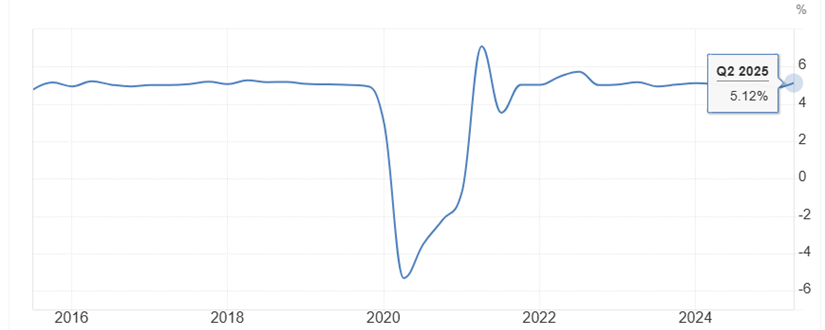
This article was originally published by Pendal Group in November 2025, following a quarterly Australian inflation update and the Reserve Bank of Australia's November meeting. While some data points and forecasts reflect conditions at that time, the core insights remain relevant for investors and fund managers. In particular, the discussion highlights how inflation surprises can alter monetary-policy expectations, influence fixed-income valuations, and reshape portfolio positioning. Readers should consider the broader themes around inflation dynamics and policy response rather than the short-term market context. Indonesia's President Prabowo Subianto has an ambitious target to reach 8% annualised GDP growth by 2029. This would represent a sharp acceleration from an annual growth rate of ~5% for most of the past decade. Chart 1: Indonesia's annualised GDP growth
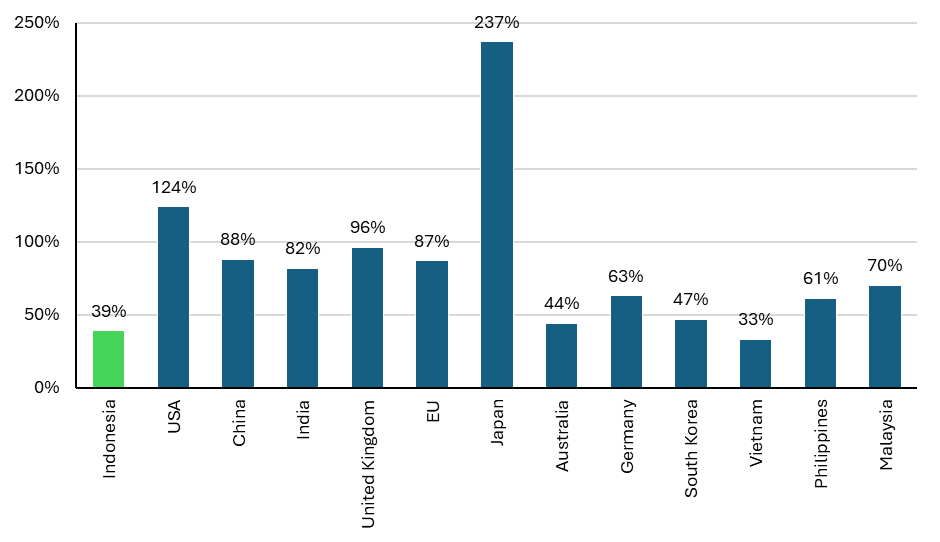
Source: Trading Economics. Unlike other economies, however, Indonesia is one of the least leveraged countries in the world. With government debt-to-GDP below 40%, there is ample room to spend to lift economic growth. Chart 2: 2024 government debt-to-GDP for selected countries
Source: Trading Economics. Typical of years following the election of new Indonesian presidents, government spending and economic activity has been weak in 2025. This presents the potential for a rebound in 2026 as newly installed government ministers and SOE leadership teams begin to execute on key programs and strategies. To support this growth agenda, a new growth-focused Minister of Finance, Purbaya Yudi Sadewa, took office in September 2025. We are beginning to see the initial impacts of his changes to monetary and fiscal policy, with money supply growth jumping from mid-single digits in August to nearly 20% YoY in September. This will likely help to kick-start the economy into next year. Chart 3: BI adjusted M0 growth versus M2 versus loans growth (% YoY)
Source: BofA Global Research. In addition to low leverage, Indonesia is rich in natural resources, notably critical minerals such as nickel. In an inflationary world, these resources represent assets to the Indonesian economy which can continue to fetch ever-higher prices, supporting a stronger current account. Chart 4: Indonesia plays a significant role in the global supply of some mineral and agricultural goods
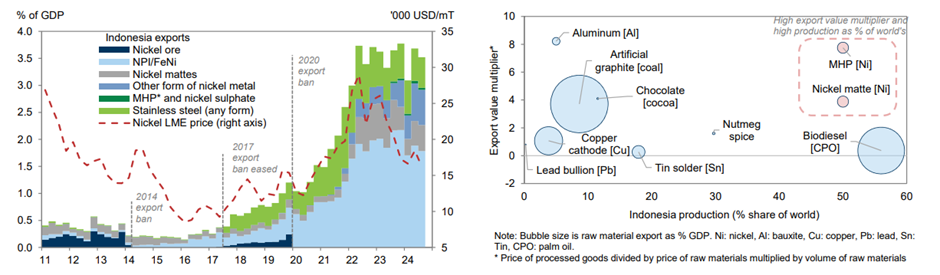
Source: International Trade Center, Ministry of Energy and Mineral Resources, USGS, CEIC, Goldman Sachs Global Investment Research. Indonesia's downstream verticalisation strategy to add value to its "rocks in the ground" has dramatically increased the export value of nickel-based products. As it moves up the value chain in different commodities, this can add material upside to the GDP growth outlook. Chart 5: Nickel-related products export value increased ~8-fold since 2013 (left); Indonesia is a major producer of nickel, whose derivatives have high export value multiplier (right)
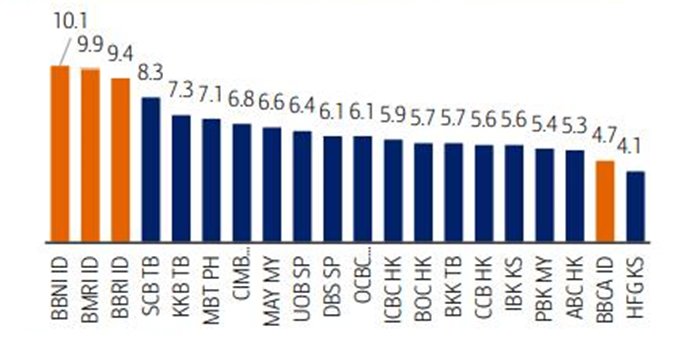
Source: International Trade Center, Haver Analytics, Goldman Sachs Global Investment Research (left); International Trade Center, Ministry of Energy and Mineral Resources, USGS, CEIC, Goldman Sachs Global Investment Research (right). In light of temporary sluggishness in the domestic economy in 2025, we are finding highly attractive opportunities to own leading quality franchises in Indonesia. Some of these companies are generating dividend yields above 10% and delivering ROE approaching 20%, all while trading at discounted valuations. Chart 6: Top yielding large cap APAC banks - FY25E yield (%)
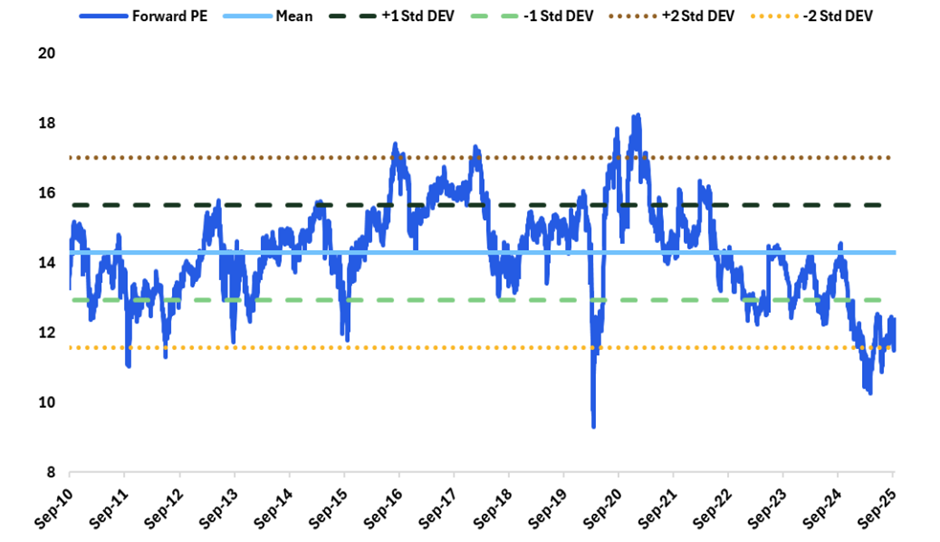
Source: BofA Global Research. Indonesia represents an exciting emerging economy, with a huge population of more than 285 million, rich in sought-after resources. This can support strong economic activity and business earnings into the future, particularly in an inflationary world. Trading at depressed levels of <12x forward P/E, nearly 2 standard deviations below the 15-year mean, and with strong dividend yields in leading larger corporates, now is the time for investors to reconsider Indonesia. These kinds of valuations do not come around often! Chart 7: Indonesia MSCI Index forward P/E
Source: Citi Research, Bloomberg. |
|
Funds operated by this manager: Pendal MicroCap Opportunities Fund , Pendal Sustainable Australian Fixed Interest Fund - Class R , Pendal Focus Australian Share Fund , Pendal Horizon Sustainable Australian Share Fund , Regnan Credit Impact Trust Fund , Pendal Sustainable Australian Share Fund , Pendal Multi-Asset Target Return Fund , Barrow Hanley Concentrated Global Share Fund , Pendal Active Balanced Fund , Pendal Active Conservative Fund , Pendal Australian Equity Fund , Pendal Australian Long/Short Fund , Pendal Australian Share Fund , Pendal Dynamic Income Fund - Class R , Pendal Fixed Interest Fund , Pendal Global Emerging Markets Opportunities Fund - Wholesale Class , Pendal Global Property Securities Fund , Pendal Government Bond Fund , Pendal Imputation Fund , Pendal MidCap Fund , Pendal Monthly Income Plus Fund , Pendal Property Investment Fund , Pendal Short Term Income Securities Fund , Pendal Smaller Companies Fund |
|
This information has been prepared by Pendal Fund Services Limited (PFSL) ABN 13 161 249 332, AFSL No 431426 and is current as at December 8, 2021. PFSL is the responsible entity and issuer of units in the Pendal Multi-Asset Target Return Fund (Fund) ARSN: 623 987 968. A product disclosure statement (PDS) is available for the Fund and can be obtained by calling 1300 346 821 or visiting www.pendalgroup.com. The Target Market Determination (TMD) for the Fund is available at www.pendalgroup.com/ddo. You should obtain and consider the PDS and the TMD before deciding whether to acquire, continue to hold or dispose of units in the Fund. An investment in the Fund or any of the funds referred to in this web page is subject to investment risk, including possible delays in repayment of withdrawal proceeds and loss of income and principal invested. This information is for general purposes only, should not be considered as a comprehensive statement on any matter and should not be relied upon as such. It has been prepared without taking into account any recipient's personal objectives, financial situation or needs. Because of this, recipients should, before acting on this information, consider its appropriateness having regard to their individual objectives, financial situation and needs. This information is not to be regarded as a securities recommendation. The information may contain material provided by third parties, is given in good faith and has been derived from sources believed to be accurate as at its issue date. While such material is published with necessary permission, and while all reasonable care has been taken to ensure that the information is complete and correct, to the maximum extent permitted by law neither PFSL nor any company in the Pendal group accepts any responsibility or liability for the accuracy or completeness of this information. Performance figures are calculated in accordance with the Financial Services Council (FSC) standards. Performance data (post-fee) assumes reinvestment of distributions and is calculated using exit prices, net of management costs. Performance data (pre-fee) is calculated by adding back management costs to the post-fee performance. Past performance is not a reliable indicator of future performance. Any projections are predictive only and should not be relied upon when making an investment decision or recommendation. Whilst we have used every effort to ensure that the assumptions on which the projections are based are reasonable, the projections may be based on incorrect assumptions or may not take into account known or unknown risks and uncertainties. The actual results may differ materially from these projections. For more information, please call Customer Relations on 1300 346 821 8am to 6pm (Sydney time) or visit our website www.pendalgroup.com |



20 Nov 2025 - Performance Report: Altor AltFi Income Fund
[Current Manager Report if available]

20 Nov 2025 - Beyond the Search box: what is the future of Search in the age of AI?
|
Beyond the Search box: what is the future of Search in the age of AI? Magellan Asset Management October 2025 (5 min read) |
|
For two decades, the search box has been the undisputed gateway to the internet, a frictionless tool embedded in our daily lives. But this familiar landscape is undergoing a transformational change, driven by the rapid emergence of Generative AI (GenAI). This evolution is forcing us to reconsider not just how we find information, but how the companies that provide it will create value in the coming years. The two leaders in consumer-facing GenAI1 tools are OpenAI (via ChatGPT) and Alphabet (via Gemini). The new landscape of search When ChatGPT launched in 2022, it acquired 100 million users in just two months, a pace unmatched by any prior consumer technology. Its first-to-market user-friendly GenAI tool has catapulted ChatGPT to the most-used app in the world, but still behind Google.com as the most frequented website. Current usage statistics include:
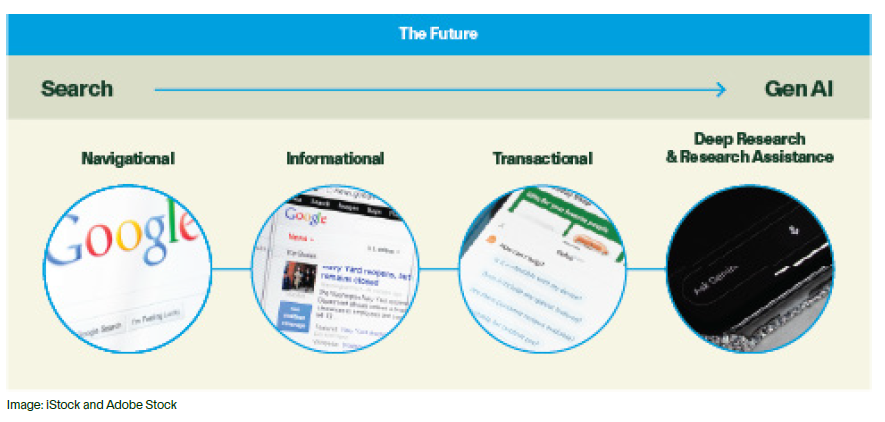
Currently, however, traditional search and GenAI serve distinct purposes. Google Search has long been the master of specific intent. Its usage is dominated by informational queries (e.g., "what is the weather in Brisbane?") at ~55%, navigational queries (e.g., "Australian Museum website") at ~30%, and commercial queries (e.g., "buy flights to Melbourne") at ~15%. GenAI, on the other hand, excels at complexity. Around 70% of its use is for deep research and assistance, such as summarising reports or helping with homework. The remaining 30% comprises more search-like queries. The who of the future of Search These two worlds of Search and GenAI, in our view, are rapidly converging. The future of Search isn't a battle of one versus the other, but a synthesis of both. Magellan expect features and use cases to emerge that improve the experience for informational, navigational, commercial and deep research needs, as well as the emergence of agentic AI2 use cases. At present, ChatGPT has the GenAI mindshare of the consumer given its first-mover advantage. Google has Search mindshare - and isn't standing still on GenAI. Google, the pioneer of AI, is now integrating AI Overview into its core Search product, already reaching over 1.5 billion users of the tool, and over 450 million monthly 2 Agentic AI is an AI system that can autonomously and proactively act to achieve goals. Agentic AI can independently plan or make decisions to complete tasks.active users (MAU) of the Gemini app. In addition, Alphabet's scale and interconnected ecosystem are strategic advantages in driving future growth. Alphabet's assets include YouTube (>2.7 billion MAU), Android (>3.5 billion users), Chrome (>3.5 billion users), Gmail (>1.8 billion MAU), Google Cloud, and Waymo. This powerful consumer base and diversified platform, combined with Alphabet's GenAI capabilities, is a powerful platform to drive the adoption of GenAI and Agentic AI use cases. The breadth and depth of these services should enable Google to customise the AI experience for its users, which is hard to replicate.
Monetisation in the GenAI search era The most critical question for investors is how this new technology will be monetised. Alphabet's current model is a digital advertising fortress, with Search ad revenue representing a ~$200 billion annual revenue stream, and an estimated 90% market share in search. Impressively, this revenue is generated from ads being shown on only about 20% of searches. The future, however, points to a more diversified revenue stack, and more, albeit still concentrated, competition. For example, OpenAI currently generates US$12 billion in revenue and is aiming to grow 10x by 2029. At Magellan, we see four key pillars emerging:
In summary, the world of search is evolving, creating a powerful new monetisation model. Magellan view that Alphabet is far more than just a search engine; it's a diversified ecosystem supercharged by AI and primed to lead in the future of search. 1 Generative AI or GenAI is a class of AI algorithm that can create new content such as text, images, audio and code based on learnings from existing data. 2 Agentic AI is an AI system that can autonomously and proactively act to achieve goals. Agentic AI can independently plan or make decisions to complete tasks. |
|
Funds operated by this manager: Vinva Global Alpha Fund - Active ETF (ASX: V1AC) , Vinva Australian Equity Fund , Vinva Global Equity Fund , Vinva Australian Alpha Extension Fund , Vinva Global Alpha Extension Fund - Class A , Magellan Infrastructure Fund , Magellan Global Opportunities Fund No.2 , Magellan Infrastructure Fund (Unhedged) , Magellan Core Infrastructure Fund , Magellan Global Opportunities Fund Active ETF (ASX:OPPT) Important Information: This material has been delivered to you by Magellan Asset Management Limited ABN 31 120 593 946 AFS Licence No. 304 301 trading as Magellan Investment Partners ('Magellan Investment Partners') and has been prepared for general information purposes only and must not be construed as investment advice or as an investment recommendation. This material does not take into account your investment objectives, financial situation or particular needs. This material does not constitute an offer or inducement to engage in an investment activity nor does it form part of any offer documentation, offer or invitation to purchase, sell or subscribe for interests in any type of investment product or service. You should obtain and consider the relevant Product Disclosure Statement ('PDS') and Target Market Determination ('TMD') and consider obtaining professional investment advice tailored to your specific circumstances before making a decision about whether to acquire, or continue to hold, the relevant financial product. A copy of the relevant PDS and TMD relating to a Magellan Investment Partners financial product may be obtained by calling +61 2 9235 4888 or by visiting www.magellaninvestmentpartners.com Past performance is not necessarily indicative of future results and no person guarantees the future performance of any financial product or service, the amount or timing of any return from it, that asset allocations will be met, that it will be able to implement its investment strategy or that its investment objectives will be achieved. This material may contain 'forward-looking statements'. Actual events or results or the actual performance of a Magellan Investment Partners financial product or service may differ materially from those reflected or contemplated in such forward-looking statements. This material may include data, research and other information from third party sources. No guarantee is made that such information is accurate, complete or timely and no warranty is given regarding results obtained from its use. This information is subject to change at any time and no person has any responsibility to update any of the information provided in this material. Statements contained in this material that are not historical facts are based on current expectations, estimates, projections, opinions and beliefs of Magellan Investment Partners or the third party responsible for making those statements (as relevant). Such statements involve known and unknown risks, uncertainties and other factors, and undue reliance should not be placed thereon. No representation or warranty is made with respect to the accuracy or completeness of any of the information contained in this material. Magellan Investment Partners will not be responsible or liable for any losses arising from your use or reliance upon any part of the information contained in this material. Any third-party trademarks contained herein are the property of their respective owners and Magellan Investment Partners claims no ownership in, nor any affiliation with, such trademarks. Any third-party trademarks contained herein are the property of their respective owners, are used for information purposes and only to identify the company names or brands of their respective owners, and no affiliation, sponsorship or endorsement should be inferred from such use. This material and the information contained within it may not be reproduced, or disclosed, in whole or in part, without the prior written consent of Magellan Investment Partners. (080825-#W17) |

19 Nov 2025 - Performance Report: Argonaut Global Gold Fund
[Current Manager Report if available]

19 Nov 2025 - Performance Report: Seed Funds Management Financial Income Fund
[Current Manager Report if available]

19 Nov 2025 - Staying the course
|
Staying the course Canopy Investors October 2025 (5-min read) 'Investing is not a game where the guy with the 160 IQ beats the guy with the 130 IQ. Once you have ordinary intelligence, what you need is the temperament to control the urges that get other people into trouble in investing.' Like maintaining a healthy diet and exercise routine, sound investment principles are simple to explain but difficult to execute. The challenge isn't understanding that you should buy quality companies at attractive prices - it's maintaining discipline when the approach is out of favour, others are profiting from speculation, and patience is tested. At Canopy, we believe having a logical investment process that can be applied consistently is critical to achieving this over the long term. The magic formula's lessonIn The Little Book That Beats The Market (2005), Joel Greenblatt outlined an elegantly simple investment strategy. He ranked all stocks by return on capital (a measure of quality) and earnings yield (a measure of value), purchased equal-weighted positions in the highest-ranked 30 stocks, and rebalanced annually. This 'magic formula' portfolio outperformed the market in every rolling ten-year period from 1988 to 2004. The strategy worked, but with an important catch. Within each successful ten-year period, there were stretches lasting up to three years where it underperformed, sometimes significantly. Investors who stayed the course captured the superior long-term returns, while those who abandoned it during difficult periods did not. The formula was straightforward and could be replicated by any investor. The barrier to success wasn't complexity or access to information, but temperament. This pattern repeats across many successful investment strategies: the approach matters, but the ability to stick with it through inevitable difficult periods matters just as much. Why process mattersA well-designed investment process serves several crucial purposes beyond simply organising your work:
|
|
Funds operated by this manager:
|
