


NEWS

12 Aug 2022 - Performance Report: DS Capital Growth Fund
| Report Date | |
| Manager | |
| Fund Name | |
| Strategy | |
| Latest Return Date | |
| Latest Return | |
| Latest 6 Months | |
| Latest 12 Months | |
| Latest 24 Months (pa) | |
| Annualised Since Inception | |
| Inception Date | |
| FUM (millions) | |
| Fund Overview | The investment team looks for industrial businesses that are simple to understand, generally avoiding large caps, pure mining, biotech and start-ups. They also look for: - Access to management; - Businesses with a competitive edge; - Profitable companies with good margins, organic growth prospects, strong market position and a track record of healthy dividend growth; - Sectors with structural advantage and barriers to entry; - 15% p.a. pre-tax compound return on each holding; and - A history of stable and predictable cash flows that DS Capital can understand and value. |
| Manager Comments | The DS Capital Growth Fund has a track record of 9 years and 7 months and has outperformed the ASX 200 Total Return Index since inception in January 2013, providing investors with an annualised return of 13.42% compared with the index's return of 8.61% over the same period. On a calendar year basis, the fund has only experienced a negative annual return once in the 9 years and 7 months since its inception. Over the past 12 months, the fund's largest drawdown was -21.05% vs the index's -11.9%, and since inception in January 2013 the fund's largest drawdown was -22.53% vs the index's maximum drawdown over the same period of -26.75%. The fund's maximum drawdown began in February 2020 and lasted 6 months, reaching its lowest point during March 2020. The fund had completely recovered its losses by August 2020. The Manager has delivered these returns with 1.74% less volatility than the index, contributing to a Sharpe ratio which has fallen below 1 five times over the past five years and which currently sits at 0.99 since inception. The fund has provided positive monthly returns 89% of the time in rising markets and 33% of the time during periods of market decline, contributing to an up-capture ratio since inception of 68% and a down-capture ratio of 62%. |
| More Information |

12 Aug 2022 - Performance Report: Bennelong Concentrated Australian Equities Fund
| Report Date | |
| Manager | |
| Fund Name | |
| Strategy | |
| Latest Return Date | |
| Latest Return | |
| Latest 6 Months | |
| Latest 12 Months | |
| Latest 24 Months (pa) | |
| Annualised Since Inception | |
| Inception Date | |
| FUM (millions) | |
| Fund Overview | |
| Manager Comments | The Bennelong Concentrated Australian Equities Fund has a track record of 13 years and 6 months and has outperformed the ASX 200 Total Return Index since inception in February 2009, providing investors with an annualised return of 14.35% compared with the index's return of 9.66% over the same period. On a calendar year basis, the fund has experienced a negative annual return on 2 occasions in the 13 years and 6 months since its inception. Over the past 12 months, the fund's largest drawdown was -31.8% vs the index's -11.9%, and since inception in February 2009 the fund's largest drawdown was -31.8% vs the index's maximum drawdown over the same period of -26.75%. The fund's maximum drawdown began in December 2021 and has lasted 7 months, reaching its lowest point during June 2022. During this period, the index's maximum drawdown was -11.9%. The Manager has delivered these returns with 1.98% more volatility than the index, contributing to a Sharpe ratio which has fallen below 1 five times over the past five years and which currently sits at 0.8 since inception. The fund has provided positive monthly returns 90% of the time in rising markets and 19% of the time during periods of market decline, contributing to an up-capture ratio since inception of 143% and a down-capture ratio of 96%. |
| More Information |

12 Aug 2022 - Why are we so afraid of normal?
|
Why are we so afraid of normal? Yarra Capital Management 25 July 2022
Dion Hershan, Head of Australian Equities, details why he believes the panic in markets today appears excessive. There has been an extreme bout of panic this year (ASX -11%, S&P 500 -19%) regarding the return of what appears to be a traditional business cycle (yes it still exists!) and key settings normalising. With the glory years of low and falling interest rates (supplemented by a bit of QE) now over, financial markets are in a state of flux. This is notwithstanding the obvious inevitability that at some point interest rates would have to move upwards from zero! Commentators, many of whom just finished becoming experts on epidemiology, are now opining on the chance of a recession and discussing it as if it's a fatalistic event. It is worth noting the US had 12 recessions in the 20th century and still fared OK. Unfortunately there appears to be no sensible discussion about the duration or severity of a recession, instead just alarmist rhetoric. While we won't attempt to call the business cycle, we do believe it's worth sharing a few simple facts with reference to the Australian market where we focus:
Financial markets always look forward and often overreact. This sell off has put forward earnings multiples at 12.5-times, the lowest level since the GFC (one standard deviation below the long-term average). Clearly, broad based earnings downgrades are expected in August; a 20% downgrade would put the market at 'fair value', which may very well happen. For what it's worth, we believe this feels like a forced slowdown in the economy and the panic that has ensued seems excessive. We are capitalising on the opportunity and stepping up at the epicentre of the panic to buy a number of quality cyclical and high growth business. We have established a position in Xero (XRO) which has halved and has enormous runway for growth (new markets, lifting average spend) and also increased positions in Carsales.com (CAR), Reliance Worldwide (RWC), and Nine Entertainment (NEC). |
|
Funds operated by this manager: Yarra Australian Equities Fund, Yarra Emerging Leaders Fund, Yarra Enhanced Income Fund, Yarra Income Plus Fund |


11 Aug 2022 - Performance Report: Airlie Australian Share Fund
| Report Date | |
| Manager | |
| Fund Name | |
| Strategy | |
| Latest Return Date | |
| Latest Return | |
| Latest 6 Months | |
| Latest 12 Months | |
| Latest 24 Months (pa) | |
| Annualised Since Inception | |
| Inception Date | |
| FUM (millions) | |
| Fund Overview | The Fund is long-only with a bottom-up focus. It has a concentrated portfolio of 15-35 stocks (target 25). The fund has a maximum cash holding of 10% with an aim to be fully invested. Airlie employs a prudent investment approach that identifies companies based on their financial strength, attractive durable business characteristics and the quality of their management teams. Airlie invests in these companies when their view of their fair value exceeds the prevailing market price. It is jointly managed by Matt Williams and Emma Fisher. Matt has over 25 years' investment experience and formerly held the role of Head of Equities and Portfolio Manager at Perpetual Investments. Emma has over 8 years' investment experience and has previously worked as an investment analyst within the Australian equities team at Fidelity International and, prior to that, at Nomura Securities. |
| Manager Comments | The Airlie Australian Share Fund has a track record of 4 years and 2 months and therefore comparison over all market conditions and against its peers is limited. However, the fund has outperformed the ASX 200 Total Return Index since inception in June 2018, providing investors with an annualised return of 9.55% compared with the index's return of 7.36% over the same period. On a calendar year basis, the fund hasn't experienced any negative annual returns in the 4 years and 2 months since its inception. Over the past 12 months, the fund's largest drawdown was -16.29% vs the index's -11.9%, and since inception in June 2018 the fund's largest drawdown was -23.8% vs the index's maximum drawdown over the same period of -26.75%. The fund's maximum drawdown began in February 2020 and lasted 9 months, reaching its lowest point during March 2020. The fund had completely recovered its losses by November 2020. The Manager has delivered these returns with 0.02% less volatility than the index, contributing to a Sharpe ratio which has fallen below 1 three times over the past four years and which currently sits at 0.6 since inception. The fund has provided positive monthly returns 97% of the time in rising markets and 12% of the time during periods of market decline, contributing to an up-capture ratio since inception of 108% and a down-capture ratio of 97%. |
| More Information |
11 Aug 2022 - Performance Report: Bennelong Australian Equities Fund
| Report Date | |
| Manager | |
| Fund Name | |
| Strategy | |
| Latest Return Date | |
| Latest Return | |
| Latest 6 Months | |
| Latest 12 Months | |
| Latest 24 Months (pa) | |
| Annualised Since Inception | |
| Inception Date | |
| FUM (millions) | |
| Fund Overview | |
| Manager Comments | The Bennelong Australian Equities Fund has a track record of 13 years and 6 months and has outperformed the ASX 200 Total Return Index since inception in February 2009, providing investors with an annualised return of 12.66% compared with the index's return of 9.66% over the same period. On a calendar year basis, the fund has only experienced a negative annual return once in the 13 years and 6 months since its inception. Over the past 12 months, the fund's largest drawdown was -29.91% vs the index's -11.9%, and since inception in February 2009 the fund's largest drawdown was -29.91% vs the index's maximum drawdown over the same period of -26.75%. The fund's maximum drawdown began in December 2021 and has lasted 7 months, reaching its lowest point during June 2022. During this period, the index's maximum drawdown was -11.9%. The Manager has delivered these returns with 1.51% more volatility than the index, contributing to a Sharpe ratio which has fallen below 1 five times over the past five years and which currently sits at 0.72 since inception. The fund has provided positive monthly returns 91% of the time in rising markets and 17% of the time during periods of market decline, contributing to an up-capture ratio since inception of 134% and a down-capture ratio of 99%. |
| More Information |

11 Aug 2022 - Fundmonitors.com Spotlight Review - Top Performing Australian Small/Mid Cap Managed Funds
|
Fundmonitors.com Spotlight Review - Top Performing Australian Small/Mid Cap Managed Funds FundMonitors.com 10 August 2022 |
|
This FundMonitors research article puts the Spotlight on the performance of Australian Small/Mid Cap Sector over the Financial Year to 30 June, 2022. Following the Covid downturn in March 2020, the sector gained popularity with Australian investors as they looked for the significant opportunities the small cap sector can produce. However the last 12 months has, to use a sporting analogy, been a game of two halves, with the strong performance from July to December 2021 coming to a grinding halt in January 2022. This has seen some small cap stocks reduced to prices below their cash value as noted by Dean Fergie of Cyan Investment Management in a recent Fund in Focus video. As a result, many active small and mid cap funds struggled to provide positive returns in FY 2022. There may be multiple reasons for this, most of which are covered in this video, for investors and managers alike it was a tough and disappointing six months. The graph below shows the distribution of fund returns for the Small/Mid Cap Peer Group on Fundmonitors.com over the 12 months to June 2022. Of the 80 funds included in the group, just 4 managed to post a positive return, with 24 failing to outperform the index. However, the Australian Small/Mid Cap Peer Group as a whole outperformed the S&P/ASX Small Ordinaries Index over the last 5 and 10 years on a cumulative basis. The graph below shows the performance of the entire peer group over 5 years to June 2022, again highlighting the strong rally from April 2020 after the initial Covid shock, and the downturn since December 2021 as increased interest rates adjusted valuations, followed by Russia's invasion of Ukraine in late February. Given the wide variance in individual fund performances, clearly manager and fund selection is a crucial decision, even though the peer group average produced better performance than the underlying index over time. However, this is not as easy as choosing the best performing fund from the latest league table, as shown by the table below showing the Top 25 performing funds for the 12 months to June, 2022, and their performance in previous years: A key point to note is the position of funds in the table each year. Of the top 25 performing funds in the 21/22 Financial year, none appeared in the Top 25 list across all 5 years. Only 4 of them, namely Glenmore Australian Equities Fund, DMX Capital Partners Limited, Nikko AM Core Equity Fund (NZ) and the Ausbil MicroCap Fund, appeared in the Top 25 in four out of five years. Importantly, or perhaps disconcertingly, each of these funds ranked in the bottom 25 performers at least once over the 5 year period. In spite of this, and with the benefit of hindsight, an equal investment in each of these four in July 2017 would have resulted an attractive annualised return of 14.56% over 5 years, albeit with a drawdown of almost 30% in February and March 2020 as Covid hit. While it is a useful exercise to understand which funds have performed best over each 12 month period, the table below shows the Top 25 funds over various time frames, ranked by their 5 year performance. There are some familiar names from the previous table. It is also important to note that 6 funds in Top 25 over 5 years also ranked in the bottom 25 in the 12 months to June 2022. Consistency, particularly given a period with 2 separate downturns - Covid in 2020, and then inflation led increases in interest rates in 2022 - has been difficult to achieve. Given the volatility of the past 3 years in particular, is it also worth considering fund performance based on both a risk and return basis. The following chart shows the top 25 Funds over the past 3 years with their maximum drawdown shown in red. The small and mid cap sector is particularly affected by sharply falling markets when liquidity is reduced, or in a worst case environment, evaporates. Notably, a number of funds that performed well across multiple timeframes have derived their performance in different ways. The DMX Capital Partners Fund was the strongest performer over 3 years primarily as a result of having one of the lowest drawdowns in the peer group, with a Down Capture Ratio of just 51.47. Conversely, the Perpetual Pure Microcap Fund was 7th over 3 years, but with a maximum drawdown of -41.41% it had to rely on an Up Capture Ratio of 147.67 to achieve its position in the Top 10. Conclusion As much as investors, analysts and research houses enjoy the idea of lists of top performing funds, our research has consistently shown that investing in last year's Top 10 does not result in top performance in the following year! In spite of this the natural tendency of investors to chase top performing funds over a short time frame continues, often with disappointing results. So if 12 month performance is not a reliable indicator of a fund's future performance, what is the optimum time frame, or are there other key indicators involved in fund selection? Every fund's offer document contains the disclaimer that "past performance is not a guarantee….. " but every investor looks for a manager's track record as a guide. Making it equally difficult for the investor and advisor is the strong evidence that managers and funds with a track record of under three years outperform their larger peers with a longer track record. There is no clear cut answer - just as there is no clear cut "best" fund or manager. Undoubtedly diversification reduces risk, but potentially it also potentially dampens returns as well. Fund selection and portfolio composition will therefore depend on each investor's risk and return (R&R) profile, itself complicated by the fact that investors' R&R profile changes over time in line with the market outlook. The most obvious (or frustrating) conclusion from the data is that selecting funds with the benefit of data and hindsight is simple, but sadly in real time it is not so easy! All data produced in this report was sourced from the Fundmonitors.com database which provides information on over 700 actively managed funds. Funds can be selected across Peer Groups, multiple sectors and geographies, with tools that enable investors and financial advisors to search and compare funds, run custom reports and create and analyse portfolios. For more information on Fundmonitors.com please click here. Disclaimer: All information in this FundMonitors.com Sector Spotlight is believed to be correct at the time of publication. Past performance is no guarantee of future returns, and investors should make their own enquires and conduct research on any fund prior to making an investment decision. Nothing in this report should be considered as a recommendation for any fund named herein. |

11 Aug 2022 - Challenges and opportunities for global equities: Insights from our recent US research trip
|
Challenges and opportunities for global equities: Insights from our recent US research trip Bell Asset Management July 2022 |
|
|
With global equity valuations coming under pressure due to surging inflation, rising interest rates and elevated commodity prices, the outlook for investors continues to provide uncertainty. On a recent research visit to the US, Portfolio Manager, Adrian Martuccio sat down with various portfolio company management teams to discuss their outlook and business confidence, as well as the impact of inflation on consumer demand and supply. We share a summary of his views and unpack some of the ideas and themes that were addressed. Despite the ongoing list of negatives that investors are facing, there are still a number of positive items that support 'quality' when it comes to taking a long term view on global equities. US insights - what you need to know As we look at the state of the US economy, global company management teams exhibited similar viewpoints about the high likelihood of a recession with the vast majority being more sanguine that a slowdown/recession will ease supply chain bottlenecks. Many businesses believe that supply chain issues are still widespread, primarily labour driven with smaller companies, though these backlogs will likely decline by the end of the year as inventory gets replenished. As recession uncertainty continues, sectors such as manufacturing and selective retail are seeing elevated inventory levels becoming the heart of the problem in their businesses, partly due to growing backlogs, long transit times and over-ordering. Concerns are also mounting about the impact of escalating inflation levels, which has seen the US reach a 40 year high inflation level of 9.1% in June 2022. According to Adrian Martuccio, employee shortages are rife across the nation and inflation continues to be well anchored compared to last year. While investors adjust their expectations of the inflationary pressures they face, we believe that US household and bank balance sheets remain healthy. One thing is certain, a combination of soaring inflation, slowing growth and high company margin expectations is taking place, as the hiking of interest rates on equity valuations evolves into investor worries. The consensus is that company forecasts need to come down and margins across the board are far too high. Management teams believe that stock prices have factored this in, but we believe it will become difficult for companies to rally convincingly in the face of downgrades - with investors now questioning whether company earnings will moderate as both demand and margins come under pressure. Growth sectors under pressure Software and biotech industries, once lucrative and heavily weighted growth sectors, have seen valuations come under significant pressure in the listed space and private companies are now experiencing funding drying up. We believe valuations in the private space will further reduce once companies in these sectors become desperate for the next round of capital inflow or when venture capitalists decide to exit. The US is already entering a new phase of a downturn, and it's expected that there will be plenty of 'down-rounds' that will become painful from an investor's perspective. Regardless of the fact that slower or negative growth has increased materially for information technology sectors, many tech startups are starting to experience job losses as they try to reduce the bleeding of cash. It was evident from our discussions that many larger tech companies that have recently struggled to attract talent due to many startups offering stock (which are now deeply underwater as stock prices plummet),and are finding more talent coming to the market wanting a new and stable job. This instability in the US jobs market, not just in software/cloud but consumer companies, is becoming more challenging as companies find that they need to be rational with their decisions to pivot and sustain their businesses. A snapshot of how the US and global economy is performing as it signals a historic downturn
Capturing 'Quality' in a volatile and uncertain market This year's global market correction reflects several concerns about the economic future. From a stock perspective, sharp declines across equity portfolios are putting investors under severe pressure to hold long-term return potential. In our experience, lower volatile portfolios focused on high quality companies with low levels of debt and high cash flow are an essential indicator of 'Quality'. They have the potential not only to provide superior risk-adjusted returns, but they may also exhibit defensive characteristics in times of market volatility. We expect that 'Quality' as a style will generate material alpha in this current environment. How are we positioned in this environment? Our portfolios remain fully invested, and whilst we adjust our expectations for this evolving environment, our 'Quality at a Reasonable Price' or 'QARP' style (investing in high quality businesses while not overpaying for them) we believe our valuation discipline has and will continue to hold us in good stead in challenging periods. As the market experiences further weakness, there are several opportunities that we have been following and we will likely see more eventuate throughout 2022. Investors should always remember that economic downturns aren't forever and should take a long-term view on their global equities which will help to position their portfolio for an uncertain future ahead.
|


10 Aug 2022 - Performance Report: 4D Global Infrastructure Fund
| Report Date | |
| Manager | |
| Fund Name | |
| Strategy | |
| Latest Return Date | |
| Latest Return | |
| Latest 6 Months | |
| Latest 12 Months | |
| Latest 24 Months (pa) | |
| Annualised Since Inception | |
| Inception Date | |
| FUM (millions) | |
| Fund Overview | The fund is managed as a single portfolio including regulated utilities in gas, electricity and water, transport infrastructure such as airports, ports, road and rail, as well as communication assets such as the towers and satellite sectors. The portfolio is intended to have exposure to both developed and emerging market opportunities, with country risk assessed internally before any investment is considered. The maximum absolute position of an individual stock is 7% of the fund. |
| Manager Comments | The 4D Global Infrastructure Fund has a track record of 6 years and 5 months and has outperformed the S&P Global Infrastructure TR (AUD) Index since inception in March 2016, providing investors with an annualised return of 9.05% compared with the index's return of 8.89% over the same period. On a calendar year basis, the fund has only experienced a negative annual return once in the 6 years and 5 months since its inception. Over the past 12 months, the fund's largest drawdown was -5.82% vs the index's -3.91%, and since inception in March 2016 the fund's largest drawdown was -19.77% vs the index's maximum drawdown over the same period of -24.67%. The fund's maximum drawdown began in February 2020 and lasted 2 years and 2 months, reaching its lowest point during September 2020. The fund had completely recovered its losses by April 2022. The Manager has delivered these returns with 0.38% less volatility than the index, contributing to a Sharpe ratio which has fallen below 1 five times over the past five years and which currently sits at 0.71 since inception. The fund has provided positive monthly returns 96% of the time in rising markets and 13% of the time during periods of market decline, contributing to an up-capture ratio since inception of 99% and a down-capture ratio of 98%. |
| More Information |

10 Aug 2022 - Australian Secure Capital Fund - Market Update July
|
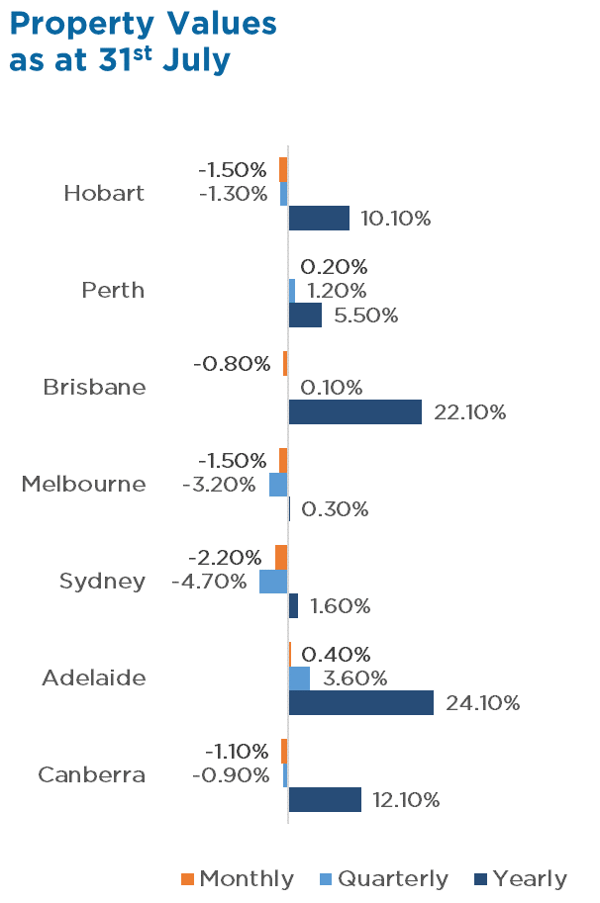
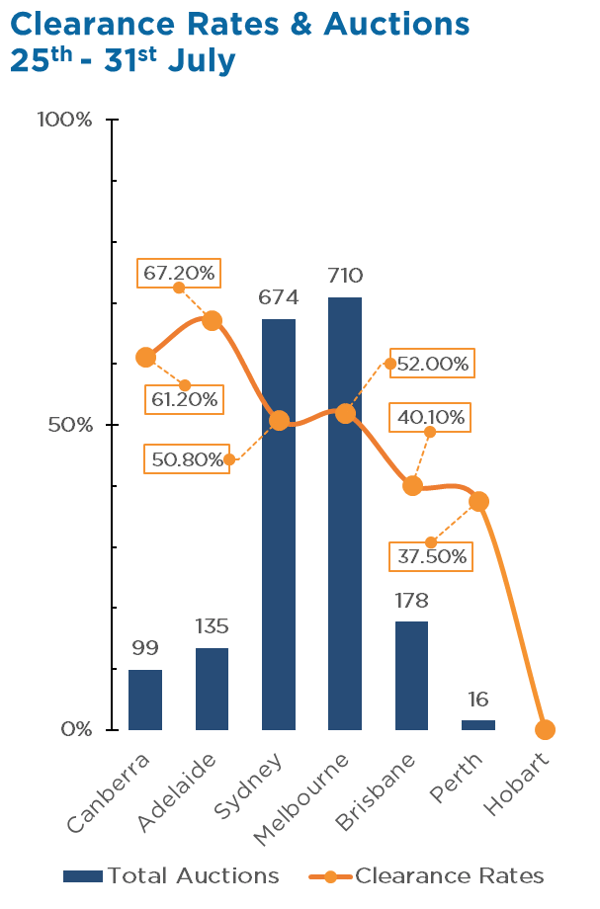
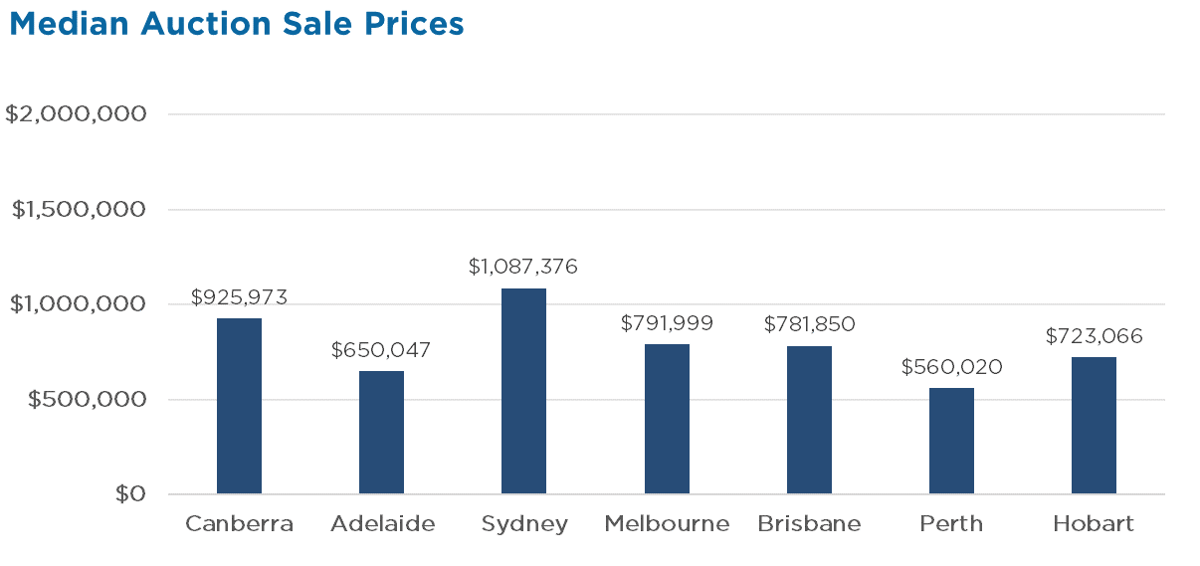
Australian Secure Capital Fund - Market Update July Australian Secure Capital Fund July 2022 Australian residential property values fell by 1.3% in July bringing the total quarterly decline across the country to -2%. Inventory levels have also decreased significantly and have now fallen -21.40% from the mid-March peak, helping to keep overall inventory levels low whilst on the demand side sales activity over the three months to July was -16% lower in comparison to the same period last year. While national home sales are also falling from record highs, they are still +9.20% above the previous five-year average for this time of year. With interest rates expected to rise further, there is a good chance that the number of transacted sales will continue to fall as confidence continues to weigh on the housing sector. On a more positive note, however, rents across the country continued to increase through July rising +0.90% for the month to be +2.80% higher for the quarter and +9.80% higher over the past 12 months.
Funds operated by this manager: ASCF High Yield Fund, ASCF Premium Capital Fund, ASCF Select Income Fund |
10 Aug 2022 - Holding your discipline
|
Holding your discipline Airlie Funds Management July 2022 |
|
Portfolio Managers John Sevior and Matt Williams have worked together in funds management for more than 30 years. In this session, they discuss what it's like to invest in the current market and how it compares with past 'extreme market conditions'. In addition, they assess which ASX companies could perform in these conditions. Speakers: Matt Williams, Portfolio Manager Funds operated by this manager: Important Information: Units in the fund(s) referred to herein are issued by Magellan Asset Management Limited (ABN 31 120 593 946, AFS Licence No. 304 301) trading as Airlie Funds Management ('Airlie') and has been prepared for general information purposes only and must not be construed as investment advice or as an investment recommendation. This material does not take into account your investment objectives, financial situation or particular needs. This material does not constitute an offer or inducement to engage in an investment activity nor does it form part of any offer documentation, offer or invitation to purchase, sell or subscribe for interests in any type of investment product or service. You should obtain and consider the relevant Product Disclosure Statement ('PDS') and Target Market Determination ('TMD') and consider obtaining professional investment advice tailored to your specific circumstances before making a decision to acquire, or continue to hold, the relevant financial product. A copy of the relevant PDS and TMD relating to an Airlie financial product or service may be obtained by calling +61 2 9235 4760 or by visiting www.airliefundsmanagement.com.au. Past performance is not necessarily indicative of future results and no person guarantees the future performance of any financial product or service, the amount or timing of any return from it, that asset allocations will be met, that it will be able to implement its investment strategy or that its investment objectives will be achieved. This material may contain 'forward-looking statements'. Actual events or results or the actual performance of an Airlie financial product or service may differ materially from those reflected or contemplated in such forward-looking statements. This material may include data, research and other information from third party sources. Airlie makes no guarantee that such information is accurate, complete or timely and does not provide any warranties regarding results obtained from its use. This information is subject to change at any time and no person has any responsibility to update any of the information provided in this material. Statements contained in this material that are not historical facts are based on current expectations, estimates, projections, opinions and beliefs of Airlie. Such statements involve known and unknown risks, uncertainties and other factors, and undue reliance should not be placed thereon. Any third party trademarks contained herein are the property of their respective owners and Airlie claims no ownership in, nor any affiliation with, such trademarks. Any third party trademarks that appear in this material are used for information purposes and only to identify the company names or brands of their respective owners. No affiliation, sponsorship or endorsement should be inferred from the use of these trademarks.. This material and the information contained within it may not be reproduced, or disclosed, in whole or in part, without the prior written consent of Airlie. |
