


NEWS

5 Sep 2025 - What the Fed's shift from inflation to employment means for investors
|
What the Fed's shift from inflation to employment means for investors Pendal August 2025 |
|
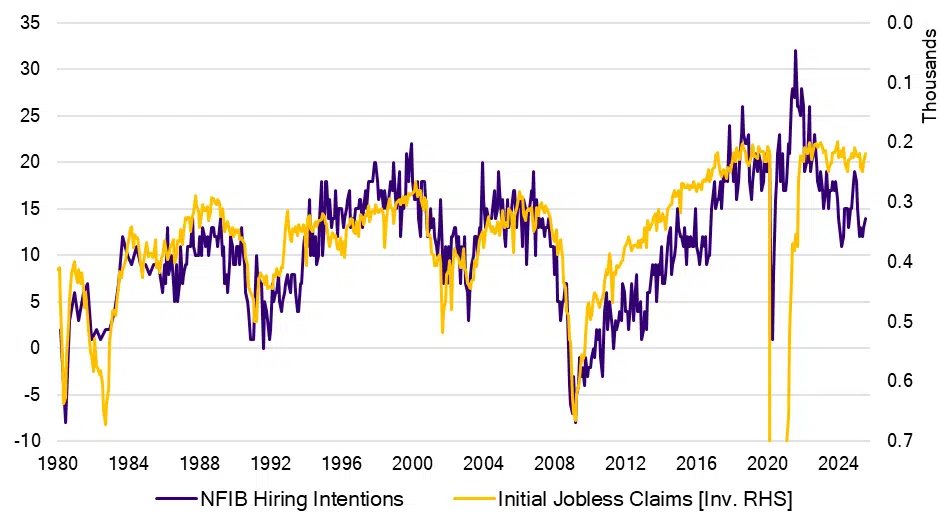
SINCE December 2018, we've known Fed chair Jay Powell is not afraid to pivot. Back then the Fed hiking cycle was forced to an abrupt halt when the US economy came under the strain of the first round of Trump's trade tariffs. By the following October, the Fed had cut rates by 75 percentage points to 1.75%. Powell's latest comments at last weekend's Fed's annual gathering in Jackson Hole, Wyoming, may prove to be another example. In his speech, Powell acknowledged downside risks to employment, suggested further easing from the current "restrictive" policy stance may be appropriate and - for the first time in months - did not make this conditional on the inflation outlook. Since these remarks, the US bond market has priced in an 85% chance of a cut at the next Federal Open Market Committee meeting in September. This would take the upper bound of the Fed Funds target rate to 4.25%. Sceptics view the move as Jay Powell bending to political pressure from President Trump. The chart below suggests the Fed ought to be getting a little more worried. US hiring and firing: NFIB Hiring Intentions and Initial Jobless Claims
Source: BloombergThe purple line shows the hiring intentions of US businesses, according to a monthly survey by the National Federation of Independent Business. The yellow line is an inverted series of US initial jobless claims - a weekly series to reflect new joblessness. The long-standing relationship between the purple and yellow lines is clear to see, and intuitive to grasp. When businesses stop hiring, they eventually have to start firing. And vice versa. When businesses feel the bottom is in, they stop firing, and then they start hiring. This relationship seems to have dislocated of late. We need more time to see whether this is an actual dislocation, or one of those blips in the long-run data. A possible explanation? Perhaps businesses sense the slowdown and have paused hiring, but burned by the post-Covid labour shortages, are not yet willing to let people go. A likely rate cutSeptember will likely bring a rate cut from the Fed. Pendal's analysis of the long-term decision-making bias of the Fed leans heavily on market pricing. In other words, the Fed doesn't like to surprise or disappoint (unlike some other central banks we know). That analysis also shows how sensitive the Committee is to labour-market dynamics. If the Fed has now pivoted its focus from inflation to employment, we too should be looking at the best leading indicators for where labour markets are headed. |
|
Funds operated by this manager: Pendal MicroCap Opportunities Fund , Pendal Sustainable Australian Fixed Interest Fund - Class R , Pendal Focus Australian Share Fund , Pendal Horizon Sustainable Australian Share Fund , Regnan Credit Impact Trust Fund , Pendal Sustainable Australian Share Fund , Pendal Multi-Asset Target Return Fund , Barrow Hanley Concentrated Global Share Fund , Pendal Active Balanced Fund , Pendal Active Conservative Fund , Pendal Australian Equity Fund , Pendal Australian Long/Short Fund , Pendal Australian Share Fund , Pendal Dynamic Income Fund - Class R , Pendal Fixed Interest Fund , Pendal Global Emerging Markets Opportunities Fund - Wholesale Class , Pendal Global Property Securities Fund , Pendal Government Bond Fund , Pendal Imputation Fund , Pendal MidCap Fund , Pendal Monthly Income Plus Fund , Pendal Property Investment Fund , Pendal Short Term Income Securities Fund , Pendal Smaller Companies Fund |
|
This information has been prepared by Pendal Fund Services Limited (PFSL) ABN 13 161 249 332, AFSL No 431426 and is current as at December 8, 2021. PFSL is the responsible entity and issuer of units in the Pendal Multi-Asset Target Return Fund (Fund) ARSN: 623 987 968. A product disclosure statement (PDS) is available for the Fund and can be obtained by calling 1300 346 821 or visiting www.pendalgroup.com. The Target Market Determination (TMD) for the Fund is available at www.pendalgroup.com/ddo. You should obtain and consider the PDS and the TMD before deciding whether to acquire, continue to hold or dispose of units in the Fund. An investment in the Fund or any of the funds referred to in this web page is subject to investment risk, including possible delays in repayment of withdrawal proceeds and loss of income and principal invested. This information is for general purposes only, should not be considered as a comprehensive statement on any matter and should not be relied upon as such. It has been prepared without taking into account any recipient's personal objectives, financial situation or needs. Because of this, recipients should, before acting on this information, consider its appropriateness having regard to their individual objectives, financial situation and needs. This information is not to be regarded as a securities recommendation. The information may contain material provided by third parties, is given in good faith and has been derived from sources believed to be accurate as at its issue date. While such material is published with necessary permission, and while all reasonable care has been taken to ensure that the information is complete and correct, to the maximum extent permitted by law neither PFSL nor any company in the Pendal group accepts any responsibility or liability for the accuracy or completeness of this information. Performance figures are calculated in accordance with the Financial Services Council (FSC) standards. Performance data (post-fee) assumes reinvestment of distributions and is calculated using exit prices, net of management costs. Performance data (pre-fee) is calculated by adding back management costs to the post-fee performance. Past performance is not a reliable indicator of future performance. Any projections are predictive only and should not be relied upon when making an investment decision or recommendation. Whilst we have used every effort to ensure that the assumptions on which the projections are based are reasonable, the projections may be based on incorrect assumptions or may not take into account known or unknown risks and uncertainties. The actual results may differ materially from these projections. For more information, please call Customer Relations on 1300 346 821 8am to 6pm (Sydney time) or visit our website www.pendalgroup.com |

4 Sep 2025 - Climate-related Financial Disclosures: A step toward greater transparency in corporate sustainabilit
|
Climate-related Financial Disclosures: A step toward greater transparency in corporate sustainabilit Janus Henderson Investors August 2025 Liz Harrison, Fixed Interest Strategist - ESG in the Australian Fixed Interest team, discusses the Climate-related Financial Disclosure initiative and how the mandated sustainability reports will be used to enhance transparency and accountability. Sustainability reporting thresholds by group
Source: Janus Henderson, Australian Accounting Standards Board (AASB) Australia has joined many global counterparts by introducing mandatory sustainability reporting for companies and other select legal entities. This initiative, the Climate-related financial disclosure (CRFD), was mandated by the Australian Government in partnership with the key regulator Australian Securities and Investments Commission (ASIC). CRFD began at the start of 2025 and will be implemented over a three-year period. Larger companies are required to comply first, with the following criteria set for mandatory reporting by the end of the third year:
For asset owners, mandatory reporting will apply only to those with at least $5 billion in assets under management (AUM) and that are registered schemes, registrable superannuation entities, or retail corporate collective investment vehicles (CCIV). This requirement for asset owners will commence in Group 2, starting after July 1, 2026. The timing for the release of these reports will be aligned with the start of a company's or asset manager's financial year reporting. The earliest reports from the first group are expected at the beginning of 2026, applicable to those whose reporting period aligns with the calendar year. While this new regulation will become a legal requirement, many companies have already been doing voluntary reporting in their sustainability reports. It has been reported that this is the case for 82% of the ASX2001. For those not familiar with these sustainability reports, they are comprehensive documents, often extending to 100 pages, that ESG professionals spend hours reading through. They provide valuable insights into a company's environmental targets, performance and initiatives, alongside information on employee welfare such as gender pay equality, workplace diversity, staff retention, and charitable contributions. What Information is required in the mandatory sustainability reports?First year requirements include:
Sustainability reports must be included within a company's annual report or linked to a separate sustainability report embedded within the annual report. Second year expansion: From discussions we have had with companies, it is evident that data is still difficult to obtain, with some sectors having no set methodology for reporting of emissions. For example, Rabobank shared how they issue carbon calculators to farmers in their loan book, whereas Nestle are often using Sustainability NGOs to build out their primary data from within their supply chain. Our sense is that it is difficult to have good visibility and confidence in obtaining correct data, but we believe this will evolve. First three years: From 2028, directors will assume full liability for these disclosures. What is climate data useful for and how will practitioners use these reports?As a fixed income investor, data and disclosures in these reports often help steer our questions to an issuer during company engagement. The information helps us home in on the areas where the company might be underperforming against their peers, or is not on track to meet their targets. There are some industries where it is obvious as to what climate risks are - for example, those with high carbon footprints and in 'hard to abate' sectors such as energy, mining and airline companies. For other companies, it's essential to delve deeper into the sources of their emissions, particularly the components of their scope 3 emissions, and assess the measures they are taking to reduce them. We are interested to know whether the company has a credible pathway for decarbonisation, have they set targets, are they on track to meet them, how are they reporting and how are they engaging with their supply chain, amongst other things. Our ESG due diligence starts through analysing the data, reading the company's own sustainability reports and examining third party research reports. This will form the basis of our questions during company engagements and help us assess the ESG risks of a company and the mitigation strategies in play. It all forms part of our ESG integration in the investment portfolios we manage. How do we capture ESG metrics for issuers in our portfolio?
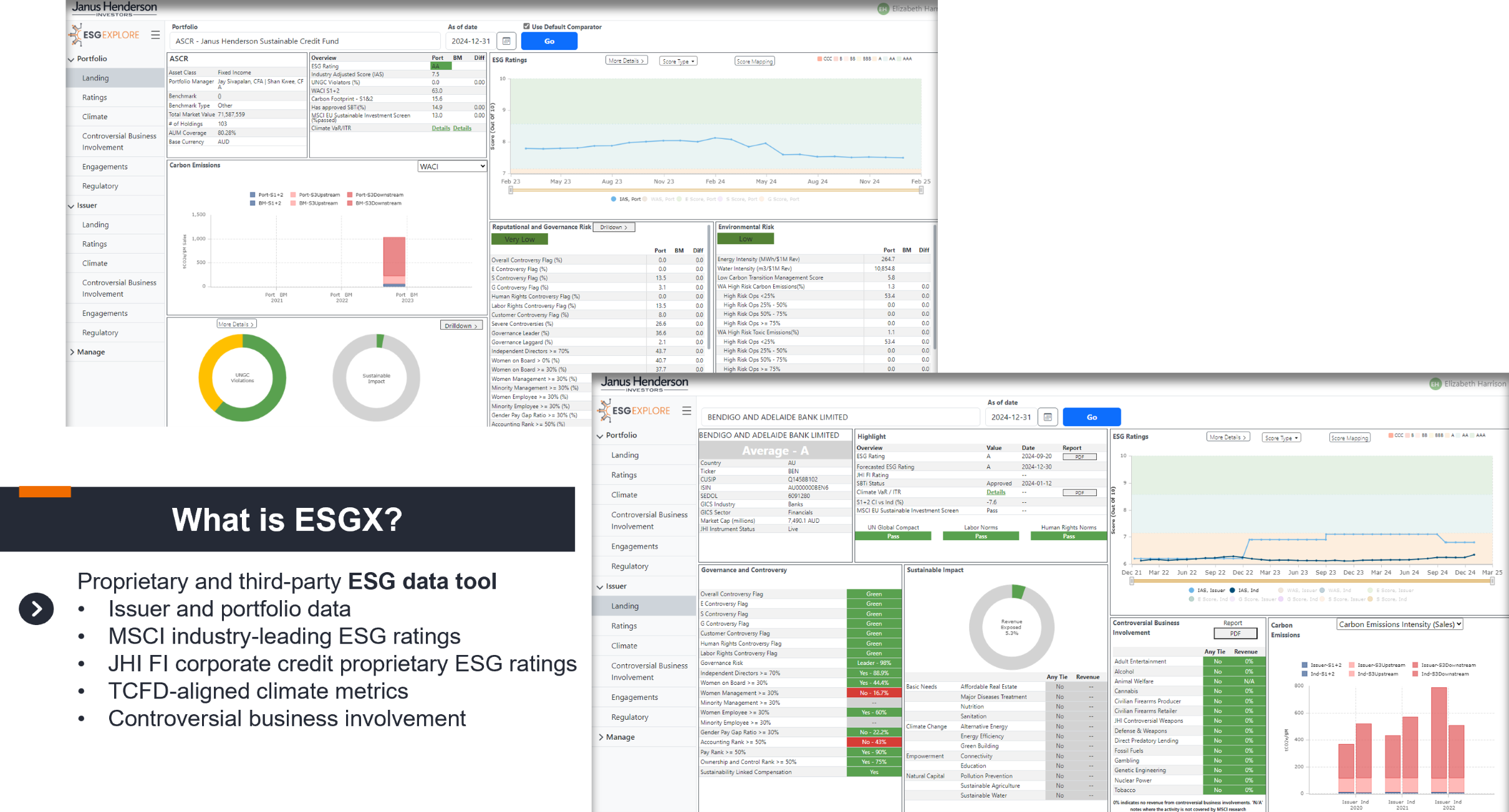
At Janus Henderson, we use MSCI as our preferred data provider. For ease of usage, we have created a proprietary data capture platform called ESG Explore which imports MSCI data. It allows the user to easily search for an issuer and obtain climate data and other ESG metrics such as controversial business involvement, controversies, MSCI risk ratings etc. Further, this same information can be calculated on a portfolio level with the total carbon emissions, weighted average carbon intensity, implied temperature rises of the asset pool and any product involvement all disclosed (where data is available). What reporting do we have available to assist asset owners?
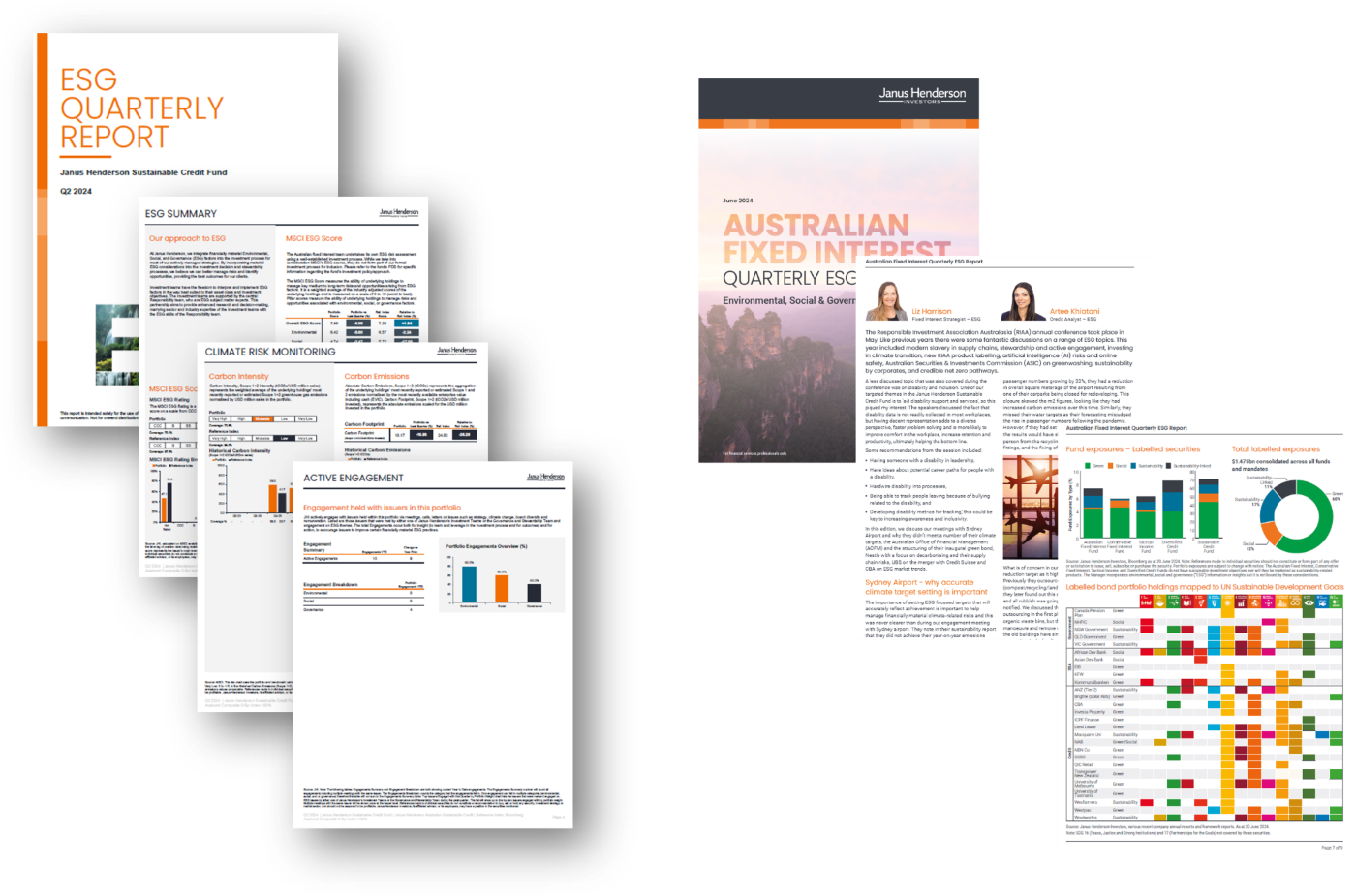
The ESG data of our investment portfolios is then used to create our ESG reporting for the portfolios in which our clients' invest. For asset owners that need to undertake the mandatory sustainability reporting, they will need to report on scope 3 emissions from year 2. Their scope 3 emissions will comprise the scope 1 & 2 emissions of issuers within their investment portfolio. Our ESG reporting details the portfolio's carbon footprint (scope 1+2 tCO2e/USDmn invested), carbon emissions (scope 1+2 tCO2e) and weighted average carbon intensity (scope 1+2 tCO2e/USDmn sales), all reported quarterly. However, as it stands there are limitations with the availability of ESG data, with some issuers still not publishing their emissions or there is no coverage on that company by MSCI. This should improve as all companies are phased into the mandatory climate disclosure reporting. |
||||||||||||||||
|
Funds operated by this manager: Janus Henderson Australian Fixed Interest Fund , Janus Henderson Conservative Fixed Interest Fund , Janus Henderson Diversified Credit Fund , Janus Henderson Global Natural Resources Fund , Janus Henderson Tactical Income Fund , Janus Henderson Australian Fixed Interest Fund - Institutional , Janus Henderson Conservative Fixed Interest Fund - Institutional , Janus Henderson Cash Fund - Institutional , Janus Henderson Global Multi-Strategy Fund , Janus Henderson Global Sustainable Equity Fund , Janus Henderson Sustainable Credit Fund 1Source: ACSI, Promises, Pathways & Performance, Climate change disclosure in the ASX200, July 2024 All opinions and estimates in this information are subject to change without notice and are the views of the author at the time of publication. Janus Henderson is not under any obligation to update this information to the extent that it is or becomes out of date or incorrect. The information herein shall not in any way constitute advice or an invitation to invest. It is solely for information purposes and subject to change without notice. This information does not purport to be a comprehensive statement or description of any markets or securities referred to within. Any references to individual securities do not constitute a securities recommendation. Past performance is not indicative of future performance. The value of an investment and the income from it can fall as well as rise and you may not get back the amount originally invested. Whilst Janus Henderson believe that the information is correct at the date of publication, no warranty or representation is given to this effect and no responsibility can be accepted by Janus Henderson to any end users for any action taken on the basis of this information. |

3 Sep 2025 - The UK ETS - a policy mechanism to deliver net zero
|
The UK ETS - a policy mechanism to deliver net zero abrdn August 2025 The result of the UK Emission Trading Scheme (ETS) consultation could provide a pathway to net-zero emissions by 2050 and potentially offer a roadmap for global climate policy. What's the issue?Net zero refers to a state where the residual emissions that remain after all feasible decarbonisation has taken place are neutralised by carbon removals. The UK targets net-zero emissions by 2050 (Scotland by 2045). Yet, until now, there has been no clear policy mechanism to address these residual emissions. In July, the UK Government released the long-awaited outcome to its consultation on Integrating Greenhouse Gas Removal (GGRs) into the UK ETS. Historically, GGR credits were only usable in voluntary carbon markets as offsets. The new proposal would allow their inclusion in compliance markets, creating a policy mechanism we believe is necessary to achieve a true net-zero end-state. Each year, organisations subject to the UK ETS must purchase and submit emissions allowances through auctions, in line with their operational emissions. Under the proposed changes, GGRs would be made available through the auction mechanism, replacing normal emissions allowances on a one-for-one basis. Crucially, this will not affect the overall supply cap, which continues to decline annually and remains the primary lever through which the ETS drives decarbonisation. Intuitively, this is a sensible approach. To date, revenues from ETS auctions have flowed into the UK Treasury's general budget. Integrating GGRs would continue to boost Treasury revenue, albeit to a lesser extent, while also incentivising capital flows into carbon removal projects. While imperfect, the approach offers a dual benefit of incentivising decarbonisation and generating capital for carbon removal projects. A definitive list of the eligible removal methods hasn't been provided, but it will be guided by the forthcoming GGR British Standard Institution (BSI) standards, which currently includes:
Why are woodland and peatland not on that list?Peatland restorationNot currently on the list, as it avoids emissions rather than removes them. We think excluding peatlands is a misstep. In the UK, degraded peatlands are a significant source of emissions, accounting for 15-20% of Scotland's emissions alone. Their absence from the GGR means there's still no clear financial mechanism to help prevent these emissions. WoodlandThere's a strong indication that woodland creation will be included, but a few things must be resolved first: 1. Standard alignment: The UK Woodland Carbon Code (a voluntary scheme) already sets out standards that the GGR BSI will seek to develop. A decision is needed on whether these two frameworks will co-exist or be consolidated. 2. Policy debate: The UK Climate Change Committee recommended against inclusion, citing concerns around permanence, measurement and verification. Additionally, it highlighted the risk of market distortion and a strategic focus on engineered removals. However, several key organisations (including Department for Environment, Food and Rural Affairs) have pushed back on these concerns. What are the investment risks and opportunities?The proposed integration signals growing policy support and improves long-term market stability for GGR projects. It promotes investment in six ways. 1. Clear integration timeline - lays out the plan to legislate by 2028 and operationalise GGR integration into the ETS by the end of 2029. While subject to additional regulatory assessments and consultation, this blueprint helps reduce uncertainty for GGR developers and investors. 2. Ex-post credit issuance and long-term storage - UK ETS allowances will only be awarded after verified carbon sequestration, ensuring environmental integrity and accountability. Projects must also demonstrate a minimum carbon storage period of 200 years, with liability and fungibility measures in place. While this strengthens credibility, it diverges from some practices in the voluntary carbon market. 3. UK-based projects only - eligibility is limited to domestic removal projects, which is a positive for UK-based initiatives. Moreover, it enables offtake agreements to proceed, helping unlock investment. 4. GGR operators - improved liquidity and price discovery for GGR credits. 5. Double-whammy for carbon capture operators - companies investing in carbon capture infrastructure stand to gain on two fronts: they reduce exposure to the UK ETS carbon price (currently £48/tCO₂) and could potentially generate revenue through GGR credits. This dual incentive could significantly improve project economics. That said, we have concerns about large-scale UK assets, such as Drax's 2.6GW biomass power station, where upstream supply-chain emissions might not be adequately accounted for. Smaller operations, including Evero's Ince biomass power station at 21.5MW, raise fewer concerns. By 2029, the Ince BECCS project will seek to use the HyNet CCS infrastructure to transport and store around 250,000 tonnes of carbon beneath the Irish Sea. Several companies own biomass plants that could meet the criteria: RWE, Veolia, SSE, and E.ON. 6. Improved UK investor sentiment towards nature-based solutions - there's strong momentum behind including woodland creation in the ETS, which would create a demand floor for such projects. Woodland creation is also cheaper than engineered removals like BECCS, making the opportunity scalable and cost-effective. Government modelling suggests including woodland creation in the ETS could result in a cumulative carbon sequestration of 29-39 MtCO2e by 2050 [1] But the benefits go well beyond carbon: the same modelling estimates a Net Present Social Value (NPSV) of £27-34 billion by 2027 [2], factoring in carbon savings, job creation, and wider ecosystem services such as flood protection, improved air quality, and biodiversity gains. (NPSV is an estimate of the total societal benefits of a policy or project, such as health, environmental, and economic gains, expressed in today's money.) Our take?We've responded to the consultation and are encouraged by the findings. While we await final confirmation and further detail, we believe this marks a positive policy shift, one that broadens the range of technologies available to decarbonise the economy. It also strengthens the financial case for these projects and could spur the development of new asset classes, increasing opportunities to support decarbonisation at a lower cost. The UK's policy drive is not happening in isolation. We're seeing similar developments in the EU, California, Quebec, and Brazil [3]. We therefore expect this year's COP30 conference to emphasise the important role of nature-based carbon removals and sinks in the global journey to net zero. |
|
Funds operated by this manager: abrdn Sustainable Asian Opportunities Fund , abrdn Emerging Markets Equity Fund , abrdn Sustainable International Equities Fund , abrdn Global Corporate Bond Fund (Class A) Sources include Carbonfuture's 2025 Global Guide to CDR Policy, CCarbon's WCI Emissions Outlook 2025-2026, and Climate Transparency's Implementation Check on Brazil's Carbon Market.
|

2 Sep 2025 - Australian Secure Capital Fund - Market Update
|
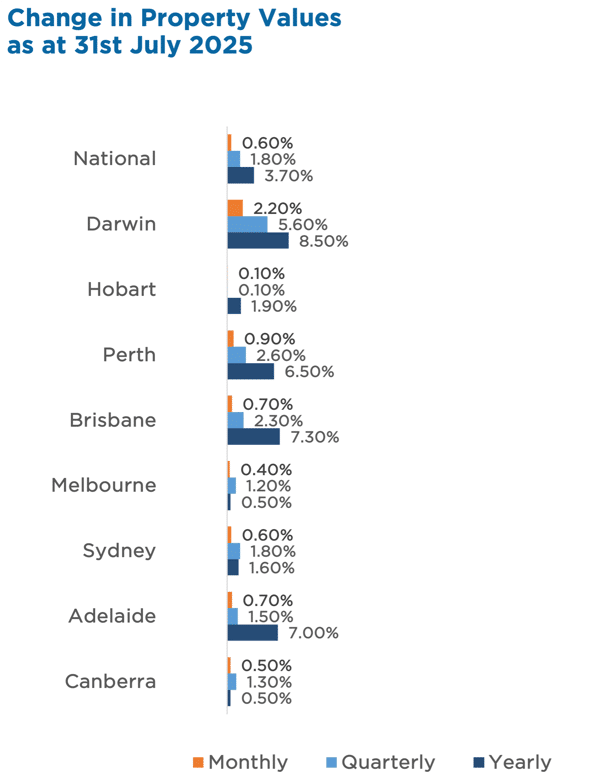
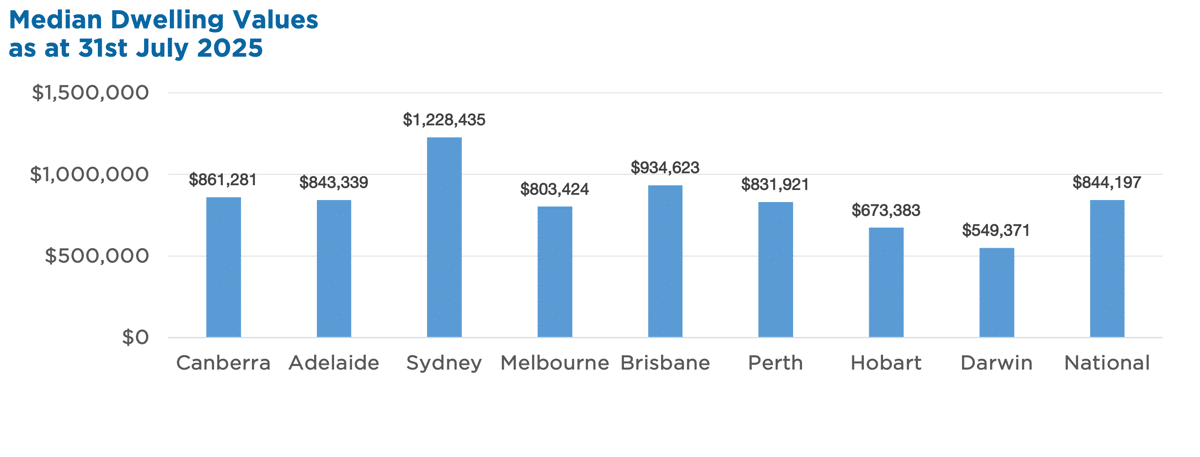
Australian Secure Capital Fund - Market Update Australian Secure Capital Fund August 2025 Australia's housing market kept its winning streak alive in July, with values rising 0.6% -- the sixth straight month of gains. Every capital city saw an uplift, led by Darwin's standout +2.2% and Perth's strong +0.9%. Tight supply (19% below average) and resilient buyer demand are keeping competition fierce, pushing auction clearance rates above the decade average. Houses are still in the lead, up 1.9% for the quarter (about $16,700), while units rose 1.4% (~$9,700) -- widening the record price gap to $223,000. Highlights:
Property Values
|

1 Sep 2025 - New Funds on Fundmonitors.com
|
New Funds on FundMonitors.com |
|
Below are some of the funds we've recently added to our database. Follow the links to view each fund's profile, where you'll have access to their offer documents, monthly reports, historical returns, performance analytics, rankings, research, platform availability, and news & insights. |
|
|
||||||||||||||||||||||
| Wilson Asset Management Leaders Fund | ||||||||||||||||||||||
|
||||||||||||||||||||||
| View Profile | ||||||||||||||||||||||
 |
||||||||||||||||||||||
| La Trobe Australian Credit Fund - 12 Month Term | ||||||||||||||||||||||
|
||||||||||||||||||||||
| View Profile | ||||||||||||||||||||||
 |
||||||||||||||||||||||
| RMC Enhanced Income Fund | ||||||||||||||||||||||
|
||||||||||||||||||||||
| View Profile | ||||||||||||||||||||||
 |
||||||||||||||||||||||
| Remara Investment Grade Credit Fund | ||||||||||||||||||||||
|
||||||||||||||||||||||
| Remara Credit Income Fund | ||||||||||||||||||||||
|
||||||||||||||||||||||
| View Profile | ||||||||||||||||||||||
| Remara Credit Opportunities Fund | ||||||||||||||||||||||
|
||||||||||||||||||||||
| View Profile | ||||||||||||||||||||||
| Remara Opportunistic Development Fund | ||||||||||||||||||||||
|
||||||||||||||||||||||
| View Profile | ||||||||||||||||||||||
|
Want to see more funds? |
||||||||||||||||||||||
|
Subscribe for full access to these funds and over 900 others |

28 Aug 2025 - Are you sure about that? The folly of forecasting

27 Aug 2025 - Recognising a stumble from a fall
|
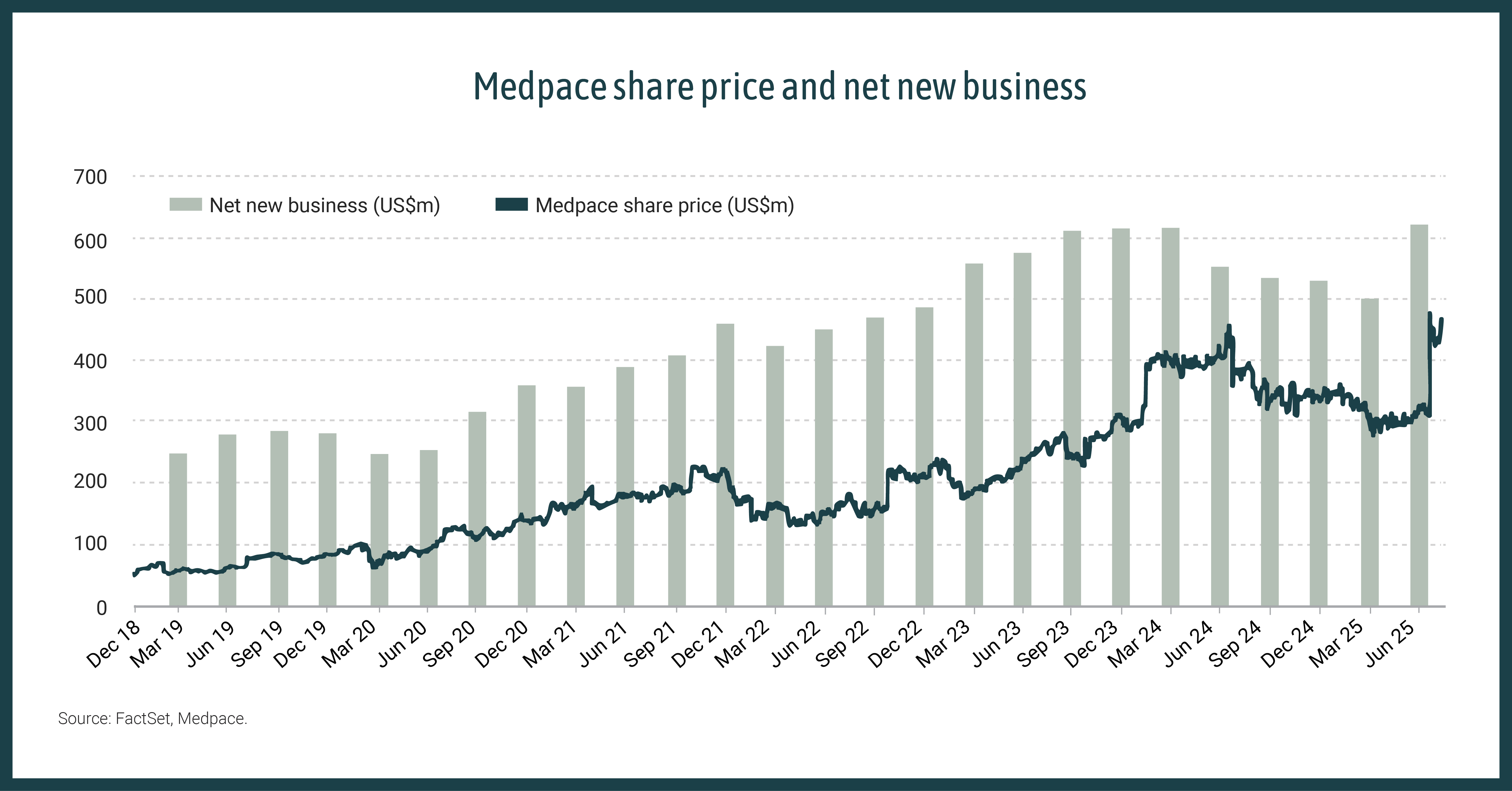
Recognising a stumble from a fall Canopy Investors August 2025 Quality companies typically trade at premium valuations, but when cyclical headwinds are conflated with secular falls, even the best businesses can be dismissed by the market. When heroes stumble excessive negativity can present opportunities to buy quality at a discount. Quality companies are often not hard to spot. The best are well known and trade at a premium valuation as a result. Despite their appeal, quality companies can be risky investments if the price paid is too high. Yet there are times when investors have the opportunity to buy quality at a discounted price, often when cyclical headwinds are conflated with secular concerns, fuelling negative sentiment and fear that the stock is 'dead money' with limited near-term upside. Medpace (MEDP)Take Medpace, for example, an investment in the Canopy Global Small & Mid Cap Fund. This founder-led clinical research organisation focuses on small biotechs and boasts an enviable track record: many years of sales growth exceeding 20%, expanding margins and returns, high cash conversion, and no debt. Its sales represent less than 5% of an addressable market expected to grow 10% pa over the long term. However, from mid-2024 Medpace disclosed lower net new business wins for four consecutive quarters, due to an unexpected increase in trial cancellations by its clients, blamed mostly on a weak funding environment. A litany of additional concerns piled on: potential negative impacts from US drug pricing policy changes, cuts to FDA and NIH funding under the new Secretary of Health and Human Services, and pricing pressure from larger competitors. Despite no fundamental change in the scale of unmet medical need addressed by small biotech, or to Medpace's ability to capture this long-term opportunity, the stock was dismissed by many as 'dead money' with no obvious near-term catalysts, and its share price declined by one-third over the course of a year. At Canopy, we believe investing in high-quality companies at the moment of maximum market pessimism can deliver high returns with relatively low risk. Our Fund holds positions in several companies at various points in their dead money journey. In this instance, we increased our investment in Medpace as investor concerns mounted and the share price fell, improving its return potential, even as the recovery timing remained uncertain. Eventually, the fundamentals reasserted themselves. In Q2, Medpace delivered a surprisingly strong result, with cancellations reverting to normal levels, driving higher net new business growth, which should support higher revenue growth over the coming years. When a positive surprise occurs in a so-called dead money stock, the reaction can be dramatic: Medpace's share price increased 50% the day after the Q2 result. While there was probably no way of predicting the result in advance, the Medpace experience highlights how long term investors can recognise a stumble, as opposed to a fall, and with conviction in the company's long-term prospects, buy quality at a discount.
Source: FactSet, Medpace |
|
Funds operated by this manager:
|

26 Aug 2025 - The art of the comeback
|
The art of the comeback Magellan Asset Management August 2025 |
|
The investment world often prizes consistency and upward momentum--but some of the most compelling returns come from companies that have temporarily lost their way. In a recent Magellan In The Know podcast, Investment Analysts Hannah Dickinson and Emma Henderson shed light on how discerning investors can tap into turnaround stories in the consumer sector and, more importantly, how to separate real opportunity from value traps. What makes a turnaround worth it?At Magellan, a turnaround doesn't mean betting on distressed companies or moonshot startups. Instead, it refers to high-quality businesses facing temporary setbacks--strategic or operational missteps that lead to material share price declines but are fixable. The rewards for identifying a true turnaround early can be significant. Successful recoveries can often result in share price rallies of 50% or more. However, the risks are just as real: historical studies show that only 20-30% of corporate turnarounds actually succeed. That's why we maintain a high bar, filtering only a few Four pillars of turnaround investingThe Magellan investment team apply a disciplined framework to assess whether or not a company genuinely has turnaround potential. The framework is built on four pillars: 1. Fundamentals: Is the business still high quality?Before diving into a company's recovery strategy, we ask ourselves whether or not the business still retains its core strengths. For example, Nike, despite recent setbacks, continues to operate in an attractive industry (sportswear) and retains global brand equity and competitive advantages. Similarly, Kering's challenges On the other hand, companies like Pepsi face more ambiguous issues, such as structural health concerns and policy shifts. These situations, while not necessarily doomed, are harder to categorise as classic turnarounds. 2. Leadership: Who is at the helm?Successful turnarounds often depend on the right CEO. Ideally, this is someone new--an outsider with full autonomy and a mandate to make bold changes. Starbucks offers a telling case: after several underwhelming leadership transitions, the company brought in Brian Niccol from Chipotle, whose track record and However, we would warn that even a celebrated CEO appointment doesn't guarantee success. If governance structures are weak or the leadership lacks experience in managing complexity, execution can flater. 3. Strategy and complexity: Is the plan credible?We look for turnaround strategies that focus on reinforcing a company's core competitive strengths rather than cost-cutting for short-term gains. Estée Lauder, for instance, operates in a highly attractive beauty market and has new leadership but its current plan leans too heavily on easy wins like headcount reduction and Amazon partnerships. We are cautious here, citing concerns regarding innovation, outdated IT systems and supply chain complexity. Nike, by contrast, has a more straightforward strategy: refresh its product innovation pipeline and rebuild damaged retail relationships. These are fixable issues that don't require reinvention of the business model. 4. Timing: Where are we in the recovery cycle?Rather than trying to 'time the market', we assess whether the company is early, mid, or late in its turnaround phase. Has a credible CEO been appointed? Is the strategy clearly communicated? Have investor expectations been reset? Nike again stands out as a case where much of the heavy lifting has occurred already. Product pullbacks have been made, reinvestment is underway, and green shoots in innovation are expected in the next 12-18 months. Conversely, Kering's turnaround is still in its early days with leadership in place, but Valuation and portfolio disciplineValuation is particularly tricky in turnarounds, where near-term earnings are often depressed. We move beyond simple metrics like P/E ratios and instead focus on scenario analysis, assessing a range of possible outcomes and the probability distribution of returns. Position sizing and diversification are critical. Turnarounds typically enter the portfolio as small allocations, with the Magellan investment team continually monitoring signs of progress closely. If the share price falls, we revisit the evidence: is the thesis still intact? If so, we may average down; if not, we remain disciplined in selling. It's not for the faint-hearted, but worth the effortTurnarounds are rarely smooth. They require patience, rigorous analysis, and a clear-eyed view of both risk and reward. However, when done correctly, anchored by strong fundamentals, capable leadership, credible strategy and well-timed execution, they may unlock unique, outsized returns. That said, these opportunities don't come easily. They demand deep sector knowledge, disciplined valuation work, ongoing monitoring, and the ability to separate short-term noise from meaningful signals. For individual investors, that level of commitment and emotional resilience can be difficult to sustain. That's why turnaround investing is often best approached with a disciplined framework and the resources to dig deep. It takes experience to cut through the noise, the analytical firepower to deeply understand what's truly going on inside a company, and the ability to avoid behavioural traps and know when the risk-reward equation truly stacks up. For investors willing to do the work, turnarounds could be one of the most rewarding corners of the market. |
|
Funds operated by this manager: Vinva Global Alpha Fund - Active ETF (ASX: V1AC) , Vinva Australian Equity Fund , Vinva Global Equity Fund , Vinva Australian Alpha Extension Fund , Vinva Global Alpha Extension Fund - Class A , Magellan Infrastructure Fund , Magellan Global Opportunities Fund No.2 , Magellan Infrastructure Fund (Unhedged) , Magellan Core Infrastructure Fund , Magellan Global Opportunities Fund Active ETF (ASX:OPPT) Important Information: Copyright 2025 All rights reserved. Units in the funds referred to in this podcast are issued by Magellan Asset Management Limited ABN 31 120 593 946, AFS Licence No. 304 301 ('Magellan'). This material has been delivered to you by Magellan and has been prepared for general information purposes only and must not be construed as investment advice or as an investment recommendation. This material does not take into account your investment objectives, financial situation or particular needs. This material does not constitute an offer or inducement to engage in an investment activity nor does it form part of any offer documentation, offer or invitation to purchase, sell or subscribe for interests in any type of investment product or service. You should obtain and consider the relevant Product Disclosure Statement ('PDS') and Target Market Determination ('TMD') and consider obtaining professional investment advice tailored to your specific circumstances before making a decision about whether to acquire, or continue to hold, the relevant financial product. A copy of the relevant PDS and TMD relating to a Magellan financial product may be obtained by calling +61 2 9235 4888 or by visiting www.magellangroup.com.au. The opinions expressed in this material are as of the date of publication and are subject to change. The information and opinions contained in this material are not guaranteed as to accuracy or completeness. Past performance is not necessarily indicative of future results and no person guarantees the future performance of any financial product or service, the amount or timing of any return from it, that asset allocations will be met, that it will be able to implement its investment strategy or that its investment objectives will be achieved. This material may contain 'forward looking' statements and no guarantee is made that any forecasts or predictions made will materialise. No representation or warranty is made with respect to the accuracy or completeness of any of the information contained in this material. Magellan will not be responsible or liable for any losses arising from your use or reliance upon any part of the information contained in this material. This material and the information contained within it may not be reproduced, or disclosed, in whole or in part, without the prior written consent of Magellan. Further important information regarding this podcast can be found on the Insights page on our website, www.magellangroup.com.au. |

25 Aug 2025 - Manager Insights | Argonaut Funds Management
|
Chris Gosselin, CEO of FundMonitors.com, speaks with David Franklyn, Managing Director and Co-Head of Funds Management at Argonaut. David outlines the Argonaut Natural Resources Fund, launched in 2020, which has delivered strong returns by investing across mining companies from majors like BHP to small-cap explorers. He highlights the fund's focus on themes such as energy transition and geopolitical risk, with gold as a safe haven and copper as the key growth driver, while noting that resources remain undervalued but vital to global growth.
|

The following article features insights in response to reader questions on investment strategy, asset allocation, and risk management.
22 Aug 2025 - Shares, Property, Volatility & More
|
Shares, Property, Volatility & More Marcus Today August 2025 |
|
The following article and video features insights from Marcus Today in response to reader questions on investment strategy, asset allocation, and risk management. While the views expressed are those of the author and reflect his personal investment philosophy, the principles discussed--such as comparing asset classes, managing volatility, and understanding leveraged products--are broadly relevant to investors and financial professionals. Readers should consider these perspectives alongside their own objectives and risk tolerance. Should You Sell a Paid-Off Investment Property?Ben asked: If the investment property has been paid off, should you sell it and invest in the stock market for a better return? There are a couple of things in there, Ben, which need to be debated. One is, does the stock market give you a better return? The answer to that is -- if the person who's investing is any good, because it is a skill -- then the returns would be better than the investment property, where the asset class grows rather slowly. So I would say the stock market in the right hands is better than the investment property. Should you sell an investment property just because it has been paid off? All I would say to you, Ben, is it's entirely personal. What are you trying to achieve with your investment property? If you're good at investing in property, it's succeeded for you, you know what you're doing. Maybe gear up and buy another investment property, if that's what you're good at. People should stick to what they're good at. So there's no one answer to this question. If the investment property has been paid off, it's entirely down to you -- what you want to do next. Should you put it in the stock market? Only if you know what you're doing.
Dividends vs Rent - Does Frequency Matter?Vishal asked: One of the problems with Australian shares is that they only pay dividends twice a year. Property puts rent in your pocket every week. What are your thoughts on that? Again, entirely a personal choice. Do you need income every month? Or does it not disturb you to get it every six months? I would say to you that wealthy retirees really don't care about needing cash. If you need a regular cash flow, you haven't got enough money, and you're a little bit desperate. Because most wealthy people will have enough money around to see them over for six months in between dividends from shares. Yes, you can spread it out with property, but also what you can do is spread it out with shares. For instance, the CBA pays a dividend, and then three months later ANZ, NAB and Westpac pay a dividend. And then three months later, CBA pays a dividend. So you see, you can put together a portfolio that pays at different times. There used to be a good table -- which you could do yourselves -- which shows you when, because they go ex-dividend the same time and they pay the same time every year, or almost every share. You could grab the top 20 income stocks. You could have a look at our Income Portfolio for some of those, grab the top 20 income stocks and see what month they pay. And you could buy them in proportions that would give you an income over time. But as I say, most wealthy retirees don't really care about the infrequency of getting a dividend. What they're really after is the big lump of franking credit refunds they get at the end of the year -- which you get once a year -- when they put their tax return in. And that's really what they're interested in. And they just budget the whole thing over the year. So no, I don't think there's any problem with shares paying twice a year instead of every month compared to property.
Volatility Is Normal - But ManageableRick asked: How do you look past volatility in the share markets, when the USA is so central to confidence in its performance? You don't. The share market is clearly mentally more volatile than property, and that's one of the great benefits of property -- it doesn't get reported to you in the media every night. Every morning, "the market did this, the market did that." "Your house has gone down 0.3% today, it's up 2%." That would freak you out as much as shares freak you out at the moment -- if it was being reported on all the time. So the impression is the property market is less volatile. How do you manage volatility in shares? Well, you manage it. Most of the market doesn't understand. Most people sitting at a dinner party talking shares will talk about BHP and the CBA in the same breath -- when the BHP share price is moving 5% a week and the Telstra share price moves 2% a week. It's two and a half times more risky, more volatile. Every share, every return you get, has a level of risk. You can work that out using average true range percentage of the share price -- we talk about that in the newsletter a lot -- but you need to understand volatility and risk has to be managed to match you. You have to match it to your own personal investing style. So that's how you handle the volatility -- by being aware of it and managing it. You can't get away from it. The fact that the property market appears less volatile and allows investors to sleep at night -- that's fine. You sleep at night. But I reckon I'll make more money in the stock market if I know what I'm doing. With the volatility, I just have to make sure I manage the volatility. And as you'll know, in any market today, remember -- we all know -- the way we manage the precipitous moments is we cash out. It is less risky. The whole market will tell you you can't time the market. "It's time in the market, not timing the market." I think that's wrong. And I believe timing the market is less risky than giving it to a fund manager who sits in the market come what may with some idea that it's all about the long term. What we do -- cashing out occasionally, getting back in again -- is going to get you a better return and is less risky than somebody who tells you all those Buffett-esque quotes about it being in the long term. "Don't buy anything for ten minutes you wouldn't hold for ten years." Absolute rubbish. You have to time the market, and it's less risky to do that. Geared ETFs - Use With Caution Scott asked: What are your thoughts on leveraging in shares via geared ETFs like GGUS, GEAR etc., if the investor understands the risk? Careful. If you treat some of these synthetic ETFs as investments, you will find they don't do what the underlying index does. Geared ETFs -- if they're created using derivatives -- are going to short-term do what the market does. Longer-term, they won't. Because if they've got derivatives involved, they constantly lose time value. So if you were to, say, buy a synthetic derivative-leveraged ETF over the Nasdaq -- to create that, you're constantly losing time value. So it will underperform the Nasdaq over the longer term. In my view, geared ETFs are for trading. They are not for long-term investment. So if you thought you were going to buy GGUS instead of the US market because you thought the market was going to go up long term, you're going to be disappointed. Because it's going to underperform long-term, because it's being created out of derivatives. Derivatives lose value all the time as time goes past. Slightly complicated -- but look up time value of options, or time decay in derivatives. DISCLAIMER: This content is for general information purposes only and does not constitute personal financial advice. Please consider your own circumstances or seek professional advice before making investment decisions. |
|
Funds operated by this manager: |
