NEWS

15 Dec 2022 - Performance Report: Delft Partners Global High Conviction Strategy
| Report Date | |
| Manager | |
| Fund Name | |
| Strategy | |
| Latest Return Date | |
| Latest Return | |
| Latest 6 Months | |
| Latest 12 Months | |
| Latest 24 Months (pa) | |
| Annualised Since Inception | |
| Inception Date | |
| FUM (millions) | |
| Fund Overview | The quantitative model is proprietary and designed in-house. The critical elements are Valuation, Momentum, and Quality (VMQ) and every stock in the global universe is scored and ranked. Verification of the quant model scores is then cross checked by fundamental analysis in which a company's Accounting policies, Governance, and Strategic positioning is evaluated. The manager believes strategy is suited to investors seeking returns from investing in global companies, diversification away from Australia and a risk aware approach to global investing. It should be noted that this is a strategy in an IMA format and is not offered as a fund. An IMA solution can be a more cost and tax effective solution, for clients who wish to own fewer stocks in a long only strategy. |
| Manager Comments | The Delft Partners Global High Conviction Strategy has a track record of 11 years and 4 months and has outperformed the Global Equity benchmark since inception in August 2011, providing investors with an annualised return of 14.81% compared with the benchmark's return of 12.85% over the same period. On a calendar year basis, the strategy has experienced a negative annual return on 2 occasions in the 11 years and 4 months since its inception. Over the past 12 months, the strategy's largest drawdown was -9.85% vs the index's -15.77%, and since inception in August 2011 the strategy's largest drawdown was -13.33% vs the index's maximum drawdown over the same period of -15.77%. The strategy's maximum drawdown began in February 2020 and lasted 1 year, reaching its lowest point during July 2020. The strategy had completely recovered its losses by February 2021. During this period, the index's maximum drawdown was -13.19%. The Manager has delivered these returns with 1.2% more volatility than the benchmark, contributing to a Sharpe ratio which has fallen below 1 four times over the past five years and which currently sits at 1.08 since inception. The strategy has provided positive monthly returns 88% of the time in rising markets and 14% of the time during periods of market decline, contributing to an up-capture ratio since inception of 100% and a down-capture ratio of 90%. |
| More Information |

15 Dec 2022 - Performance Report: Skerryvore Global Emerging Markets All-Cap Equity Fund
| Report Date | |
| Manager | |
| Fund Name | |
| Strategy | |
| Latest Return Date | |
| Latest Return | |
| Latest 6 Months | |
| Latest 12 Months | |
| Latest 24 Months (pa) | |
| Annualised Since Inception | |
| Inception Date | |
| FUM (millions) | |
| Fund Overview | Emerging markets refers to countries that are transitioning from a low income, less developed economy towards a modern, industrial economy with a higher standard of living and greater connectivity to global markets. The strategy is index unaware (meaning that the Skerryvore team decides to invest in individual stocks based on their merit and without reference to the composition of the Benchmark) and the Fund's country and sector allocations will reflect the active bottom up investment approach of the Skerryvore team. The Fund also invests in companies that are incorporated and listed in developed market countries which have economic exposure to emerging markets. The difference in allocation against any emerging markets index can be significant. |
| Manager Comments | The Skerryvore Global Emerging Markets All-Cap Equity Fund has a track record of 1 year and 4 months and therefore comparison over all market conditions and against its peers is limited. However, the fund has outperformed the MSCI Emerging Markets (MMEF) AUD benchmark since inception in August 2021, providing investors with an annualised return of -5.14% compared with the benchmark's return of -8.86% over the same period. Over the past 12 months, the fund's largest drawdown was -13.9% vs the index's -20.81%, and since inception in August 2021 the fund's largest drawdown was -17.45% vs the index's maximum drawdown over the same period of -21.92%. The fund's maximum drawdown began in September 2021 and has so far lasted 1 year and 2 months, reaching its lowest point during June 2022. The Manager has delivered these returns with 2.67% less volatility than the benchmark, contributing to a Sharpe ratio for performance over the past 12 months of -0.44 and for performance since inception of -0.52. The fund has provided positive monthly returns 100% of the time in rising markets and 30% of the time during periods of market decline, contributing to an up-capture ratio since inception of 70% and a down-capture ratio of 70%. |
| More Information |

15 Dec 2022 - Carbon Regulation Review
|
Carbon Regulation Review Tyndall Asset Management November 2022 Climate regulation in Australia While Australia is in line with other regions in its commitment to the Paris Agreement, in other areas Australia either lags or has less onerous requirements. While the industrial mix in Australia is markedly different from those other regions, rising political pressure will likely lead to moves by the government to close the gap. A timeline of Australian climate regulation Nov 2014 Australia's primary emission reduction policy came into force via the Carbon Farming Initiative Amendment Bill 2014, which established the Emissions Reduction Fund (ERF). The ERF is a voluntary scheme that aims to provide incentives for a range of organisations and individuals to adopt new practices and technologies to reduce their emissions. It offers Australian carbon credit units (ACCUs) to eligible activities, with one ACCU earned for each tonne of carbon dioxide equivalent (tCO2-e) stored or avoided. ACCUs can be sold to generate income, either to the government through a carbon abatement contract, or in the secondary market. This legislation followed the July 2014 repeal of the Carbon Price Mechanism. Eight 'carbon tax repeal' bills were passed by the Senate, making Australia the world's first nation to reverse action on climate change. May 2015 The Renewable Energy (Electricity) Amendment Bill 2015 came into effect. This bill reduced the large-scale Renewable Energy Target from 41,000 GWh to 33,000 GWh of additional renewable electricity generation by 2020 (or 23.5% of the estimated electricity generation for 2020), with this level to be maintained until 2030 once achieved. Aug 2015 Post-2020 emission reduction targets were announced: to reduce greenhouse gas emissions by 26-28% below 2005 levels by 2030. Sep 2015 The 2030 Agenda for Sustainable Development was adopted by all United Nations Member States. i.e. the 17 Sustainable Development Goals (SDGs). Oct 2015 The government announced a temperature commitment to keep global warming to 2 degrees Celsius compared to pre-industrial levels. Dec 2015 The government announced a target of net zero emissions by 2100. Apr 2016 Australia signs the Paris Agreement, a legally binding international treaty on climate change to limit global warming to well below 2 degrees Celsius compared to pre-industrial levels (but preferably to 1.5 degrees). The 194 signatory countries aim to reach global peaking of greenhouse gas emissions as soon as possible to achieve climate-neutrality by mid-century. Jul 2016 The safeguard mechanism, part of the ERF, came into effect. This mechanism placed a legislated obligation on Australia's largest greenhouse gas emitters to keep net emissions below their emissions limit (or baseline). The safeguard mechanism operates under the framework of the National Greenhouse and Energy Reporting Scheme and applies to facilities with direct scope 1 emissions of more than 100,000 tonnes of carbon dioxide equivalent (tCO2-e) per annum. It mostly impacts mining, oil and gas extractors, manufacturers, electricity generators and the waste industry, covering approximately half of Australia's emissions. Safeguard facilities will be able to surrender ACCUs to offset emissions over their baseline. Nov 2016 The Paris Agreement became effective and was ratified in Australia. Feb 2019 The ERF is rebadged as the Climate Solutions Fund, as part of the 'Climate Solutions Package'. This package provides an additional $2 billion over 15 years for carbon abatement programs, using the same process as the ERF. Mar 2019 The safeguard mechanism is amended. Among other changes, the amendments simplify the process of allowing facilities to increase emissions in line with production. Oct 2021 The Australian government commits to Net Zero emissions by 2050. Jun 2022 The greenhouse gas emissions target for 2030 is increased from a 26-28% reduction to a 43% reduction (from 2005 levels). Global comparisons of emissions targets In the US, the target to reduce emissions by 26-28% by 2025 from 2005 levels was announced in Mar 2015. This appears to have influenced the Australian target, which was for an identical reduction but with a later (2030) target date. Comparison of carbon markets The Australian carbon credits scheme is voluntary, with demand driven by a corporate's own emission reduction targets. In the UK and the EU, a "cap and trade" system is used, whereby there is an absolute limit on greenhouse gas emissions for entities covered by the system. This cap is reduced over time to reduce total emissions. Within the system, carbon credits can be traded, allowing emissions reduction to be achieved by the lowest-cost alternative. Reporting requirements In Australia, Task Force on Climate-Related Financial Disclosures (TCFD) reporting is presently not mandatory. However, Chris Bowen (Minister for Industry, Energy and Emissions Reduction of Australia) recently confirmed that climate reporting would become mandatory. Although further details have not yet been provided, since reporting requirements in other regions are higher, it is expected that reporting requirements in Australia will increase over time, including a requirement to report scope 3 emissions. How is Tyndall responding? We expect the Labour government to increase regulation given Australia appears to lag behind global peers. The questions we are asking corporates are:
The responses to these questions, amongst others, enable us to better assess long-term cashflows and assess the risks to these cashflows under different scenarios. Author: Craig Young, Senior Research Analyst Funds operated by this manager: Tyndall Australian Share Concentrated Fund, Tyndall Australian Share Income Fund, Tyndall Australian Share Wholesale Fund Important information: This material was prepared and is issued by Yarra Capital Management Limited (formerly Nikko AM Limited) ABN 99 003 376 252 AFSL No: 237563 (YCML). The information contained in this material is of a general nature only and does not constitute personal advice, nor does it constitute an offer of any financial product. It does not take into account the objectives, financial situation or needs of any individual. For this reason, you should, before acting on this material, consider the appropriateness of the material, having regard to your objectives, financial situation, and needs. The information in this material has been prepared from what is considered to be reliable information, but the accuracy and integrity of the information is not guaranteed. Figures, charts, opinions and other data, including statistics, in this material are current as at the date of publication, unless stated otherwise. The graphs and figures contained in this material include either past or backdated data, and make no promise of future investment returns. Past performance is not an indicator of future performance. Any economic or market forecasts are not guaranteed. Any references to particular securities or sectors are for illustrative purposes only and are as at the date of publication of this material. This is not a recommendation in relation to any named securities or sectors and no warranty or guarantee is provided. |

14 Dec 2022 - Performance Report: Cyan C3G Fund
| Report Date | |
| Manager | |
| Fund Name | |
| Strategy | |
| Latest Return Date | |
| Latest Return | |
| Latest 6 Months | |
| Latest 12 Months | |
| Latest 24 Months (pa) | |
| Annualised Since Inception | |
| Inception Date | |
| FUM (millions) | |
| Fund Overview | Cyan C3G Fund is based on the investment philosophy which can be defined as a comprehensive, clear and considered process focused on delivering growth. These are identified through stringent filter criteria and a rigorous research process. The Manager uses a proprietary stock filter in order to eliminate a large proportion of investments due to both internal characteristics (such as gearing levels or cash flow) and external characteristics (such as exposure to commodity prices or customer concentration). Typically, the Fund looks for businesses that fit one or more of the following criteria: a) under researched, b) fundamentally undervalued, c) have a catalyst for re-rating. The Manager seeks to achieve this investment outcome by actively managing a portfolio of Australian listed securities. When the opportunity to invest in suitable securities cannot be found, the manager may reduce the level of equities exposure and accumulate a defensive cash position. Whilst it is the company's intention, there is no guarantee that any distributions or returns will be declared, or that if declared, the amount of any returns will remain constant or increase over time. The Fund does not invest in derivatives and does not use debt to leverage performance. However, companies in which the Fund invests may be leveraged. |
| Manager Comments | On a calendar year basis, the fund has only experienced a negative annual return once in the 8 years and 4 months since its inception. Over the past 12 months, the fund's largest drawdown was -44.03% vs the index's -24.12%, and since inception in August 2014 the fund's largest drawdown was -45.18% vs the index's maximum drawdown over the same period of -29.12%. The fund's maximum drawdown began in November 2021 and has so far lasted 1 year, reaching its lowest point during September 2022. During this period, the index's maximum drawdown was -24.24%. The Manager has delivered these returns with 0.9% more volatility than the benchmark, contributing to a Sharpe ratio which has fallen below 1 five times over the past five years and which currently sits at 0.35 since inception. The fund has provided positive monthly returns 83% of the time in rising markets and 35% of the time during periods of market decline, contributing to an up-capture ratio since inception of 54% and a down-capture ratio of 83%. |
| More Information |

14 Dec 2022 - Performance Report: Quay Global Real Estate Fund (Unhedged)
| Report Date | |
| Manager | |
| Fund Name | |
| Strategy | |
| Latest Return Date | |
| Latest Return | |
| Latest 6 Months | |
| Latest 12 Months | |
| Latest 24 Months (pa) | |
| Annualised Since Inception | |
| Inception Date | |
| FUM (millions) | |
| Fund Overview | The Fund will invest in a number of global listed real estate companies, groups or funds. The investment strategy is to make investments in real estate securities at a price that will deliver a real, after inflation, total return of 5% per annum (before costs and fees), inclusive of distributions over a longer-term period. The Investment Strategy is indifferent to the constraints of any index benchmarks and is relatively concentrated in its number of investments. The Fund is expected to own between 20 and 40 securities, and from time to time up to 20% of the portfolio maybe invested in cash. The Fund is $A un-hedged. |
| Manager Comments | The Quay Global Real Estate Fund (Unhedged) has a track record of 6 years and 11 months and has outperformed the FTSE EPRA/ NAREIT Developed Index benchmark since inception in January 2016, providing investors with an annualised return of 6.11% compared with the benchmark's return of 3.5% over the same period. On a calendar year basis, the fund has only experienced a negative annual return once in the 6 years and 11 months since its inception. Over the past 12 months, the fund's largest drawdown was -22.45% vs the index's -20.72%, and since inception in January 2016 the fund's largest drawdown was -22.45% vs the index's maximum drawdown over the same period of -26.61%. The fund's maximum drawdown began in January 2022 and has so far lasted 10 months, reaching its lowest point during September 2022. During this period, the index's maximum drawdown was -20.72%. The Manager has delivered these returns with 0.55% less volatility than the benchmark, contributing to a Sharpe ratio which has fallen below 1 five times over the past five years and which currently sits at 0.45 since inception. The fund has provided positive monthly returns 92% of the time in rising markets and 11% of the time during periods of market decline, contributing to an up-capture ratio since inception of 106% and a down-capture ratio of 93%. |
| More Information |

14 Dec 2022 - Net Zero Megatrend
|
Net Zero Megatrend Insync Fund Managers November 2022 We view Energy Transition to be among the most important megatrends affecting the investment landscape. Hydrogen is viewed as a key component of the world's quest to reach 'net zero' and avoid the worst of climate change. Hydrogen demand projections call for a 10-20x increase vs current volumes. This requires trillions of dollars of investment. Green hydrogen is produced with renewable power such as wind and solar, enabling the full life cycle of hydrogen production and consumption to be carbon free. It is one thing to identify a great megatrend but it's another thing altogether to then match this with one or more quality companies that also possess sustainable earnings growth and a superior ROIC. There are many unprofitable companies participating in the Energy Transition megatrend but we consider these to be of a more speculative nature. Our research identified industrial gas companies to be strongly positioned as they are very profitable businesses and have unique domain expertise in hydrogen and CCUS technology (Carbon Capture, Usage and Storage). The Industrial Gas market has undergone significant consolidation in the last 20 years, comprising just 3 global majors: Linde, Air Liquide and Air Products. As a result of the oligopoly style industry structure, they have delivered steady sustainable volume growth over time with consistent pricing gains. Population, GDP and industrialization of middle income markets provide a solid basis for future growth.
Funds operated by this manager: Insync Global Capital Aware Fund, Insync Global Quality Equity Fund Disclaimer |
 Whilst being an attractive energy replacement for many key industrial needs, hydrogen can be difficult to handle safely and cost-effectively. Industrial gas companies possess significant domain and IP expertise in hydrogen and are heavily involved in both traditional and Energy Transition uses of hydrogen. We believe they hold prime position as key project integrators in the build out of green hydrogen infrastructure, providing decades of growth investment potential.
13 Dec 2022 - Performance Report: DS Capital Growth Fund
| Report Date | |
| Manager | |
| Fund Name | |
| Strategy | |
| Latest Return Date | |
| Latest Return | |
| Latest 6 Months | |
| Latest 12 Months | |
| Latest 24 Months (pa) | |
| Annualised Since Inception | |
| Inception Date | |
| FUM (millions) | |
| Fund Overview | The investment team looks for industrial businesses that are simple to understand, generally avoiding large caps, pure mining, biotech and start-ups. They also look for: - Access to management; - Businesses with a competitive edge; - Profitable companies with good margins, organic growth prospects, strong market position and a track record of healthy dividend growth; - Sectors with structural advantage and barriers to entry; - 15% p.a. pre-tax compound return on each holding; and - A history of stable and predictable cash flows that DS Capital can understand and value. |
| Manager Comments | The DS Capital Growth Fund has a track record of 9 years and 11 months and has outperformed the ASX 200 Total Return benchmark since inception in January 2013, providing investors with an annualised return of 12.57% compared with the benchmark's return of 9.08% over the same period. On a calendar year basis, the fund has only experienced a negative annual return once in the 9 years and 11 months since its inception. Over the past 12 months, the fund's largest drawdown was -21.56% vs the index's -11.9%, and since inception in January 2013 the fund's largest drawdown was -22.53% vs the index's maximum drawdown over the same period of -26.75%. The fund's maximum drawdown began in February 2020 and lasted 6 months, reaching its lowest point during March 2020. The fund had completely recovered its losses by August 2020. The Manager has delivered these returns with 1.71% less volatility than the benchmark, contributing to a Sharpe ratio which has fallen below 1 five times over the past five years and which currently sits at 0.91 since inception. The fund has provided positive monthly returns 88% of the time in rising markets and 33% of the time during periods of market decline, contributing to an up-capture ratio since inception of 63% and a down-capture ratio of 66%. |
| More Information |

13 Dec 2022 - The energy development opportunity for European offshore wind
|
The energy development opportunity for European offshore wind 4D Infrastructure November 2022
European policy supports the energy transition The move towards net zero is supported by strong policy in Europe, including the:
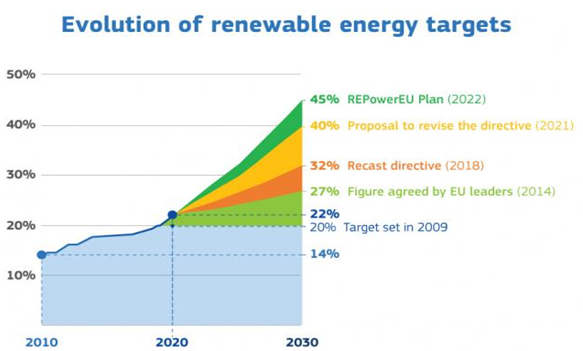
With the ultimate goal of achieving climate neutrality by 2050, the EU unveiled the EGD[i] in December 2019. This general action plan included policy initiatives aimed at starting the green transition and unlocking €1 trillion of investment[ii]. This was soon followed by Fit for 55 in July 2021, a package of policy recommendations (pricing, taxation, standards, support measures) geared at the EGD's implementation with the overarching aim to cut greenhouse gas (GHG) emissions by at least 55% by 2030[iii]. Together, the EGD and Fit for 55 guidelines are aimed at generating 40%[iv] of the EU's electricity from renewable sources by 2030, up from 32% in the 2018 directive[v]. In response to the Russia / Ukraine crisis, the European Commission released the REPowerEU plan in May 2022[iv], which outlines a series of steps to quickly decrease the EU's reliance on Russian fossil fuels by accelerating the transition to clean energy. It suggests raising the EU's 2030 renewable energy targets from 40% to 45%, and places renewables at the centre of Europe's energy security plan'[v]. Similarly, the UK released their Energy Security Strategy in April 2022, which also increased several renewable targets to increase energy independence and accelerate the pathway to net zero.
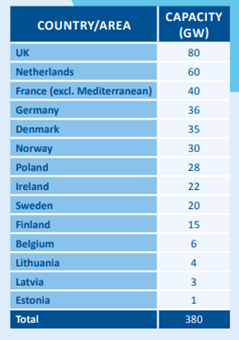
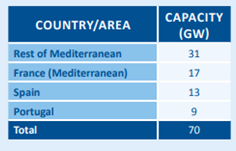
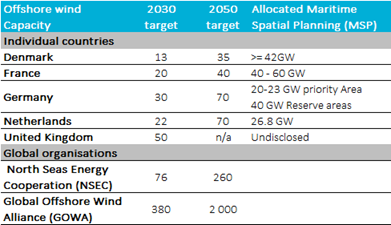
Source: Renewable energy targets (europa.eu)v The European offshore wind market is expected to grow significantly to meet net zeroIn its dedicated strategy on offshore renewables, the EU targeted 60 gigawatts (GW) of offshore wind capacity by 2030 and 300 GW by 2050 compared to 20 GW at the end of 2020[vi]. With REPowerEU, WindEurope[vii] estimates that 510 GW of new wind capacity (both offshore and onshore) will need to be developed by 2030, up from 190 GW today - equating to 39 GW per year new build (only 11 GW was built in 2021 and 18 GW estimated for 2022). While the REPowerEU didn't directly increase offshore capacity targets, there is nevertheless a strong focus on quicker renewables deployment to support the sector through faster permitting, improving supply chain bottlenecks and improved planning among member states. Meanwhile, the UK directly increased their offshore wind targets from 40 to 50 GW by 2030, alongside acceleration of other low/no carbon technologies such as nuclear, solar and clean hydrogen[viii]. Industry leader, Orsted, notes that just meeting Europe's targets will require doubling the: "build-out rate of 3-4 GW offshore wind per year to 8 GW per year by 2030, and a further increase to 20 GW per year from 2036"[vi]. Quality wind resources support European offshore wind developmentEurope (including the UK) benefits from some of the best areas in the world for offshore wind. It's supported by great wind resource - with relatively strong and consistent wind speeds, as well as shallow water and calmer sea states - which makes it easier to develop sites closer to shore. Also, much of Northern Europe is disadvantaged by a relative lack of sunshine, which gives relative support to wind power. The tables below present WindEurope's estimated deployment by 2050 of 450 GW offshore wind capacity across European countries, and highlights the strong potential of Northern Europe.
Source: WindEurope Our Energy Our Futureix Maritime spatial planning (MSP) highlights the potential for further offshore wind growthAllocation of seabed is the first step in offshore wind development. According to a 2022 study by WindEurope[x], EU member states allocated approximately 52,000 sq.km for offshore wind development through their respective MSPs. This is equivalent to more than 220 GW of capacity, and exceeds existing 2030 targets in major offshore European markets. While not all of these sites will be allocated to developers, and even less will make it to final investment decision, the numbers highlight the potential for further industry growth.
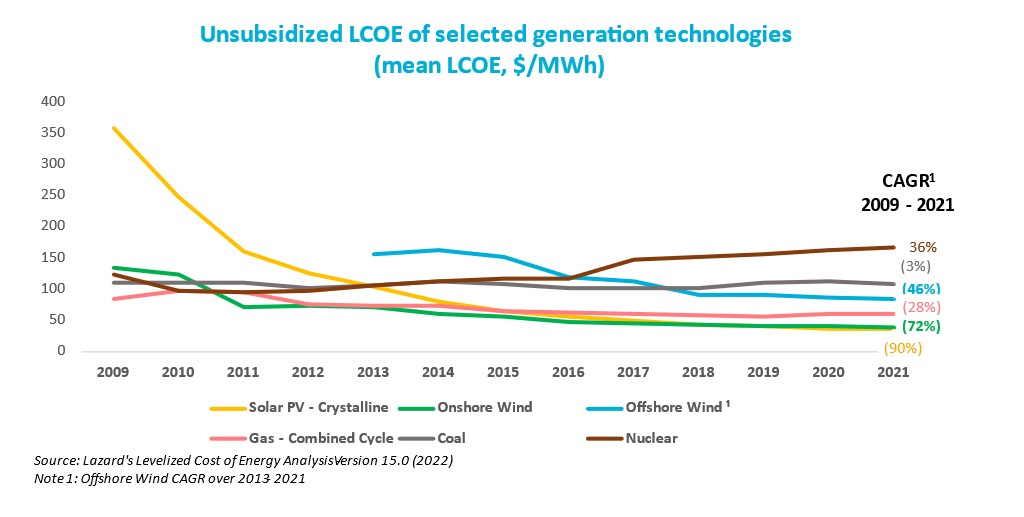
Offshore wind is now competitiveOver the last decade, offshore wind has evolved from a niche technology to a mainstream one, thanks to a sharp decline in the costs associated with installation and operation. According to Lazard's latest unsubsidized levelized cost of energy analysis ('LCOE')[xix], offshore wind technology is now more economic than legacy power sources of coal and nuclear. This cost trend is expected to continue, albeit at a slower rate, largely driven by scale and ongoing technological advancements.
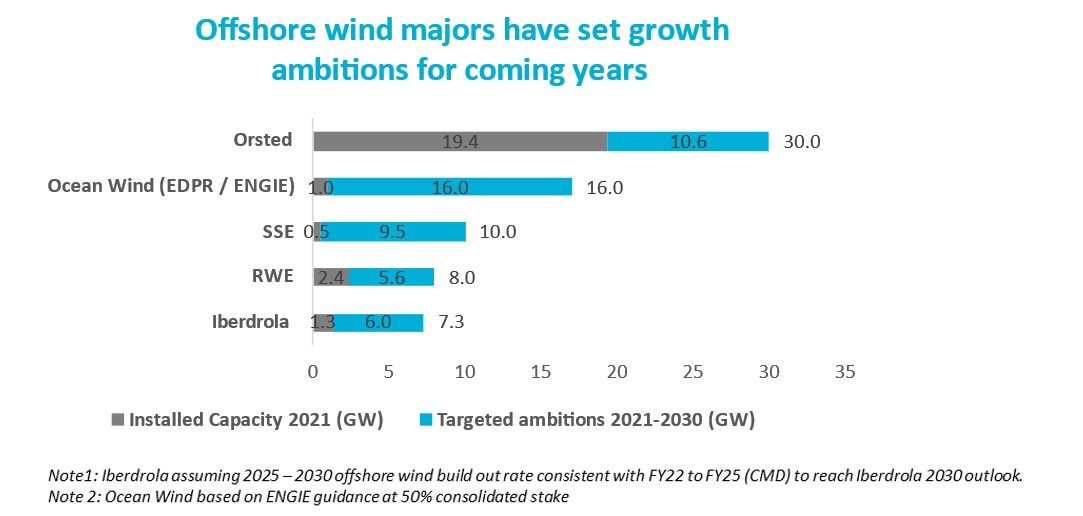
Utilities and pureplay developers are strongly leveraged to offshore wind growthIt's estimated that expanding offshore renewable energy will require investment north of US$1 trillion in the next decade. This will be funded predominantly by private capital to not only build increasingly larger new wind farms at sea, but also scale up nascent technology like floating turbines[xx]. The scale of the opportunity is reflected in the development pipelines of most of Europe's renewable leaders (most of whom are in 4D's investment universe), which are expected to see significant capacity expansion over the next decade.
Source: xxi, xxii, xxiii, xxiv, xxv Risks to the story: increased competition, cost inflation and lower subsidies are potential headwinds to growthCompetitionGiven the industry's growth prospects, competition in the sector is increasing rapidly. In addition to pureplay developers and utilities, oil majors and infrastructure, and pension funds have all entered the market. This includes the likes of Shell, BP, Total and Macquarie's Green Investment Group[xxvi] According to a 2021 Crown Estate Wind report[xxvii], 15% of offshore wind farms in the UK, both operational and under construction, were held by oil & gas producers (up from 12% in 2020) while financial investors accounted for 19%. Competition will therefore be supportive in reducing required returns and the cost of offshore wind development - supporting its proliferation - but will diminish returns for existing market participants. Non-subsidised bidsGovernments are also providing less financial support to developers as the industry matures. In several recent offshore wind tenders in Germany, Netherlands and Denmark, winning bids were non-subsidised offtake bids. Meanwhile, Denmark's last offshore wind auction for its Thor wind farm used negative bidding, meaning the winner, RWE, will be paying development rights to the government[xxviii]. InflationThe current inflationary environment is also putting pressure on offshore wind developers' returns. A typical offshore project takes several years to be completed. Usually, nominal prices are awarded at the beginning, while development costs are secured in later development stages. Hence, projects with prices awarded under the assumption of low / moderate inflation, with costs that have not yet been fully secured, face the risk of compressed returns, which could jeopardise the investment decision. Additionally, rising costs of steel is putting pressure on turbine manufacturers and ultimately impacting offshore wind developers' returns[xxix]. ConclusionWhile there is obviously huge appeal in capitalising on the growing offshore wind opportunity in Europe, companies do face several hurdles and risks in achieving standalone satisfactory returns on these large capital-intensive projects. At 4D, while monitoring the pureplay operators, we currently see greater opportunity to capitalise on the theme through transmission and distribution networks and integrated utilities. An example is our position in Iberdrola - a well-run, undervalued company we believe has a strong track record in offshore development and a diversified business model (networks, renewables, and supply) which allows flexibility in its capital allocation and allows it to better manage the return pressures faced by pureplay renewable companies. This flexibility was evident in the recent Capital Market Day, where increased focus and capital was allocated to networks over generation in the current environment. |
|
Funds operated by this manager: 4D Global Infrastructure Fund, 4D Emerging Markets Infrastructure FundThe content contained in this article represents the opinions of the authors. This commentary in no way constitutes a solicitation of business or investment advice. It is intended solely as an avenue for the authors to express their personal views on investing and for the entertainment of the reader. [i] https://ec.europa.eu/commission/presscorner/detail/en/ip_19_6691 |


12 Dec 2022 - Performance Report: L1 Capital Long Short Fund (Monthly Class)
| Report Date | |
| Manager | |
| Fund Name | |
| Strategy | |
| Latest Return Date | |
| Latest Return | |
| Latest 6 Months | |
| Latest 12 Months | |
| Latest 24 Months (pa) | |
| Annualised Since Inception | |
| Inception Date | |
| FUM (millions) | |
| Fund Overview | |
| Manager Comments | The L1 Capital Long Short Fund (Monthly Class) has a track record of 8 years and 3 months and has outperformed the ASX 200 Total Return Index since inception in September 2014, providing investors with an annualised return of 20.65% compared with the index's return of 7.54% over the same period. On a calendar year basis, the fund has only experienced a negative annual return once in the 8 years and 3 months since its inception. Over the past 12 months, the fund's largest drawdown was -19.5% vs the index's -11.9%, and since inception in September 2014 the fund's largest drawdown was -39.11% vs the index's maximum drawdown over the same period of -26.75%. The fund's maximum drawdown began in February 2018 and lasted 2 years and 9 months, reaching its lowest point during March 2020. The fund had completely recovered its losses by November 2020. The Manager has delivered these returns with 6.48% more volatility than the index, contributing to a Sharpe ratio which has fallen below 1 four times over the past five years and which currently sits at 0.94 since inception. The fund has provided positive monthly returns 79% of the time in rising markets and 62% of the time during periods of market decline, contributing to an up-capture ratio since inception of 88% and a down-capture ratio of 27%. |
| More Information |

12 Dec 2022 - Once-in-a-generation opportunity in emerging market debt
|
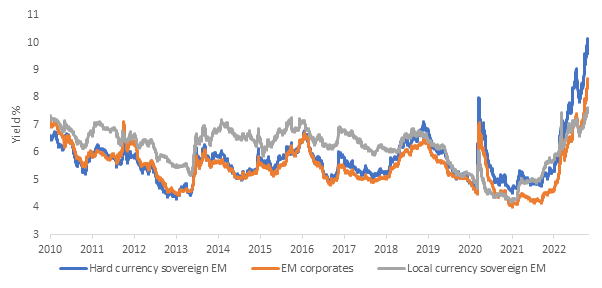
Once-in-a-generation opportunity in emerging market debt abrdn November 2022 The current global environment is undoubtedly problematic for emerging market debt (EMD). As of 3 November, the US Federal Reserve (Fed) had hiked US interest rates by a remarkable 375 basis points (bps) since just mid-March. With most other countries also aggressively raising rates to combat high inflation, the result has been slowing global growth and markedly tighter global liquidity conditions. Adding further to the negative mix have been the soaring US dollar, the Ukraine war and struggling Chinese economy. Despite all this, however, some important countervailing factors lead us to believe that the risk/reward balance is now attractive for EMD. Indeed, four key factors indicate to us that after the brutal sell-off of 2022, EMD could now be offering a potentially once-in-a-generation investment opportunity. 1. Historically attractive yieldsIn all asset markets, investors rationally prefer to buy whenever valuations are attractive. In the bond market context, arguably the single most important valuation measure is the yield level. The history of EM bond markets shows that it's always preferable to buy at historically elevated yields. This makes sense because with higher yields the starting level of recurring income (from coupon payments) is high and there's greater potential for price appreciation whenever yields revert lower over time. More defensively, in the event of prices staying weak, a sizeable income component can have a cushioning impact for total returns. As shown below, the end-October index yield of 9.66% for hard currency sovereign EM bondsi was 437 basis points (bps) higher than at end-2021, and far above the 20-year average of 6.43%. For comparison, during the period of heightened pandemic uncertainty, the index yield peaked at 7.99% on 19 March 2020. Those recognising value around this time and investing would have been richly rewardedii - by early August 2020, the yield had normalised to less than 5%, giving a total period return of 26%. Emerging market debt yields since 2010 Source: Bloomberg, November 2022; Past performance is not a guide to future performance Yields in the other segments of EMD are similarly dislocated at present, suggesting potentially attractive entry points. In the case of local currency sovereign bondsiii, the end-October index yield of 7.43% was 171bps higher than at end-2021, and above the 20-year average of 6.51%. For EM corporatesiv, the end-October yield of 8.53% was 395bps higher than at end-2021, and far above the 20-year average of 6.13%. 2. Inflation close to peaking"…in most EM countries, inflation now appears close to peaking, and should move to a sustainably lower trend path as the lagged impact of past rate hikes comes through." It is worth remembering that the key driver of higher interest rates and government bond yields everywhere has been unusually high and rising inflation. However, in most EM countries, inflation now appears close to peaking, and should move to a sustainably lower trend path as the lagged impact of past rate hikes comes through. As more evidence for this emerges, central banks should be able to first pause tightening and then eventually begin easing policy to support growth. In the case of the US, current market expectations suggest the Fed should complete hiking rates before the end of H1 of 2023, with a peak Fed Funds Rate of around 5%. Importantly, since this is substantially baked into current elevated US Treasury yields, the scope for continued negative impetus to EM bonds from here seems much more limited. On the contrary, the impact could easily become positive depending on how quickly the Fed 'pivots' to a more growth-supportive policy path. Furthermore, any pivot could also help ease the headwind of US dollar strength. 3. Supportive supply-side pictureOn the technical side, the supply picture for EMD is now highly supportive. Owing to market conditions, sovereign and corporate issuance in the first nine months of 2022 was USD352 billion (bn), a huge decline compared to USD724bn in the whole of 2021. Additionally, many issuers are choosing to retire outstanding bonds rather than refinance at less attractive rates. As a result, JP Morgan is forecasting that combined EM sovereign and EM corporate foreign currency bond new issuance will be negative this year to the tune of around USD102bn.v All else equal, a reduced supply of bonds should act as a downforce for yields. For professional investors, the 'buyers' market' environment should also be conducive for attractive new issuance premiums. 4. Comparatively good economic fundamentalsIn terms of fundamentals, weaker growth conditions are bound to have a negative impact in terms of tax revenues and EM corporate earnings, as well as default rates. However, in many cases, the expected growth shock from higher rates will be much less than for developed markets (DMs). For example, in its October World Economic Outlookvi, the IMF forecast that 2023 'EM and Developing Economies' growth of 3.7% will be a full percentage point higher than for 'Advanced Economies'. At the same time, recent fiscal and public debt dynamics of many EM countries seem less problematic than in developed counterparts, helped in part by more restrained pandemic-related spending. This is broadly true in the corporate context too, where EM companies' leverage relative to similarly rated developed market companies is around 1 to 2 times lower in aggregate. Final thoughts - the importance of selectivityWhile the overall risk/reward balance now looks quite compelling for EMD, we also think the current environment strongly reinforces the need for investing selectivity. This is because each country or issuer is unique, with differential exposure to key risk factors. More broadly, we think that careful country and credit selection increases in importance in weaker growth environments. This includes with respect to the critical aim of avoiding potential 'value traps' - those cases where higher bond yields may not be compensating for the totality of risks. Author: Brett Diment, Head of Global Emerging Market Debt |
|
Funds operated by this manager: Aberdeen Standard Actively Hedged International Equities Fund, Aberdeen Standard Asian Opportunities Fund, Aberdeen Standard Australian Small Companies Fund, Aberdeen Standard Emerging Opportunities Fund, Aberdeen Standard Ex-20 Australian Equities Fund (Class A), Aberdeen Standard Focused Sustainable Australian Equity Fund, Aberdeen Standard Fully Hedged International Equities Fund, Aberdeen Standard Global Absolute Return Strategies Fund, Aberdeen Standard Global Corporate Bond Fund, Aberdeen Standard International Equity Fund , Aberdeen Standard Life Absolute Return Global Bond Strategies Fund, Aberdeen Standard Multi Asset Real Return Fund, Aberdeen Standard Multi-Asset Income Fund References i JPM EMBI Global Diversified Index ii Total index return for period from 19.03.2020 to 06.08.2020 iii JPM GBI-EM Global Diversified Index iv JPM CEMBI Broad Diversified Index v JPM Emerging Markets Strategy and Outlook, October 2022 vi IMF World Economic Outlook, October 2022 |