


NEWS

11 Sep 2023 - New Funds on Fundmonitors.com
|
New Funds on FundMonitors.com |
|
Below are some of the funds we've recently added to our database. Follow the links to view each fund's profile, where you'll have access to their offer documents, monthly reports, historical returns, performance analytics, rankings, research, platform availability, and news & insights. |
 |
|||||||||||||||||||
| Altor Emerging PIPE Fund | |||||||||||||||||||
|
|||||||||||||||||||
| View Profile | |||||||||||||||||||
 |
|||||||||||||||||||
| CCM Systematic Macro Plus Fund | |||||||||||||||||||
|
|||||||||||||||||||
| View Profile | |||||||||||||||||||
 |
|||||||||||||||||||
| Trovio Digital Asset Fund | |||||||||||||||||||
|
|||||||||||||||||||
| View Profile | |||||||||||||||||||
 |
|||||||||||||||||||
| Capital Prudential Wholesale Real Estate Income Opportunity Fund | |||||||||||||||||||
|
|||||||||||||||||||
| View Profile | |||||||||||||||||||
|
|
|||||||||||||||||||
| MA Priority Income Fund | |||||||||||||||||||
|
|||||||||||||||||||
| MA Secured Real Estate Income Fund | |||||||||||||||||||
|
|||||||||||||||||||
| View Profile | |||||||||||||||||||
| MA Secured Loan Series - Class A | |||||||||||||||||||
|
|||||||||||||||||||
| View Profile | |||||||||||||||||||
| MA Secured Loan Series - Class B | |||||||||||||||||||
|
|||||||||||||||||||
| View Profile | |||||||||||||||||||
 |
|||||||||||||||||||
| Tectonic Opportunities Fund | |||||||||||||||||||
|
|||||||||||||||||||
| View Profile | |||||||||||||||||||
|
Want to see more funds? |
|||||||||||||||||||
|
Subscribe for full access to these funds and over 700 others |

11 Sep 2023 - Performance Report: Rixon Income Fund
[Current Manager Report if available]

8 Sep 2023 - Hedge Clippings | 15 September 2023
|
|
|
|
Hedge Clippings | 14 September 2023 After all the machinations which have surrounded Qantas over the past few weeks, and which have taken the focus of Hedge Clippings away from the real task of looking at economic issues and the performance of managed funds, it is probably time to get back to basics. Having said that, the trials (literal and figurative) facing Qantas, and in particular the new CEO, Vanessa Hudson, and Chairman Richard Goyder are far from over. Hudson of course can, and will claim - or blame - her predecessor, although it seems like she either endorsed his policies, or didn't or couldn't stand up to his overbearing style. She'll no doubt get away with that excuse, but Goyder has nowhere to hide as chairman, and one who was cheer-leader-in-chief for the recently departed Irish elf. Goyder either believed Joyce was the "best CEO in Australia by a length of a straight" as he described him, or he was fooled into thinking so. Either way, it was a massive character judgment failure on his part, as well as one of corporate governance. The upcoming Qantas AGM is scheduled for November 3rd, and should be a jam packed and fiery event. Qantas might even resort to selling non existing tickets to it, but even though it's scheduled just a few days before the Melbourne Cup, it's doubtful if the chairman will be referring to his previous racing analogy when farewelling his disgraced former CEO. What the whole Qatar / flightless tickets debacle has done is to call into question the level of overt, or maybe covert, influence membership of the Qantas Chairman's Club wields throughout the corridors of Canberra and beyond. Power corrupts: Absolute power corrupts absolutely, or so the saying goes. The issue in this case is not power, but undue influence, or the perception of it. Didn't we say it was time to get back to basics of the economy? The hard/soft landing debate continues, both here and overseas - at least in the US, as it appears the landing in the UK is unlikely to be anything but hard. China's landing is likely to be bumpy at best, but getting an accurate picture of the world's second largest economy is anything but easy, coupled with the centralised and authoritarian decision making process. Australia's tightening phase would appear to be over, although it looks like rates won't come down anytime soon, given the unemployment rate remains sub 4%. There are a few wild cards out there, as always. Saudi Arabia and Russia are in lockstep to reduce oil production and keep oil prices, and therefore inflation, high. Tensions around Taiwan remain, even if overshadowed by China's economic issues, and of course Ukraine remains an unknown outcome. Thankfully it's footy finals season to take one's mind off such issues, although you can always stay up late / get up early to watch the Wallabies trying to get out of their pool into the quarter finals of the RWC. Watch this space! News & Insights Cultivating change - Nestlé's leading approach on sustainability and creating shared value | Magellan Asset Management Quay podcast: How high rates are impacting REITs | Quay Global Investors August 2023 Performance News Bennelong Concentrated Australian Equities Fund Argonaut Natural Resources Fund Bennelong Long Short Equity Fund Delft Partners Global High Conviction Strategy Glenmore Australian Equities Fund |
|
|
If you'd like to receive Hedge Clippings direct to your inbox each Friday |
8 Sep 2023 - Hedge Clippings | 08 September 2023
|
|
|
|
Hedge Clippings | 08 September 2023 Yesterday marked what will probably be Philip Lowe's final speaking engagement whilst RBA Governor before handing over to his deputy Michele Bullock on 18th September. Free from the shackles of his position and convention, the outgoing governor took the opportunity to set the record straight on what he had (and had not) promised, whilst also taking a few shots at the level of reporting and attention his previous statements and comments had received. Of course, whilst in the role he had carefully avoided having an all out war with the media (Eddie Jones, take a lesson in humility) understanding that one rarely gets the last word in - no doubt remembering the old adage "never to argue with the person with the microphone". Whilst being pretty direct in his comments and opinion of the media, he was somewhat more subtle, but equally correct in also having a go at government in his speech entitled "Some Closing Remarks". Lowe stated the obvious: Government should carry some of the can for inflation and interest rates, and thus the property market and mortgage stress. In reality the RBA is very much the messenger, in spite of the so called independence. It is the government of the day that has the authority and ability, plus a wide variety of potential policy tools to steer the economy, instead of leaving it to the RBA and the blunt instrument of monetary policy to do the work for them. Fat chance of that happening! As Lowe said, it would require some "innovative thinking" which is a rare commodity in politicians, particularly once they're elected, and don't want to lose the benefits of office - even the unofficial ones, such as membership of the Qantas chairman's lounge, (which really should have been renamed Joyce's Jolly long ago). History has shown we've had multiple examples of "innovative thinking" over the years - think Mark Johnson's 2009 report, Australia as a Financial Centre, or Ken Henry's 2010 Tax Review with its 138 recommendations, most of which are still gathering dust. The major item from the Henry Review which was implemented by the then Rudd Government was the move to create a resources Super Profit Tax. The proposal was highly controversial, and has been suggested as the main reason why Rudd lost power. Both were announced with great fanfare (even if then Minister for Financial Services, Chris Bowen released his response in mid January, 2010, hardly likely to get anyone's serious attention) but neither Johnson's and Henry's efforts or recommendations resulted in little to no "Committed Action". Bottom line - don't trust politicians to actually do anything innovative, even if it is clearly in the national interest, if it also involves personal risk - as Paul Keating said "in the race of life always back self interest - at least you know it's trying". During his term as RBA Governor, Lowe did exactly what was required with the tools available to him, and given the cards he was dealt by the global economy, and policy of the day. He lowered rates to zero in response to COVID and government policy, which resulted in households and corporates being awash with cash, which along with Russia's invasion of Ukraine led to an outbreak of inflation. Like all central banks, he tightened rates (less than the US or UK) to stifle inflation, hopefully without choking the economy in the process. The government takes the credit for low unemployment, but is happy for Lowe and the RBA to take the blame for high interest rates and mortgage stress, to the extent they declined to renew his term in office. It's the government's responsibility to ensure there's sufficient housing to accommodate an immigration level of 300,000+ this year which is helping to keep house prices high, but they won't take the blame when it hurts those under mortgage or rental stress. Lowe will leave with a record of having set and kept to his narrow path, and what may shape up to be a soft landing - no mean feat. He should be applauded. Meanwhile the government has been left with a mess of its own making with - whatever the outcome - a divisive referendum campaign, and egg, or worse on its face over the Qatar fiasco, as has the Qantas board. Alan Joyce is probably public enemy Number 1 in Australia at present, and most people would be lining up to give him the following treatment: News & Insights New Funds on FundMonitors.com Hybrid securities - How risky are they? | PURE Asset Management The Experiences Megatrend | Insync Fund Managers August 2023 Performance News Bennelong Australian Equities Fund |
|
|
If you'd like to receive Hedge Clippings direct to your inbox each Friday |

8 Sep 2023 - Sorting bubbles from justified inflations!
|
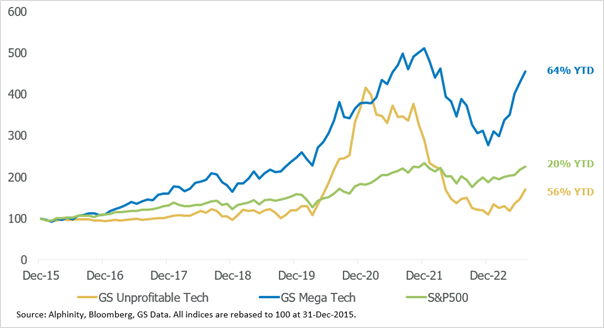
Sorting bubbles from justified inflations! Alphinity Investment Management August 2023 Since Chat GPT3 crashed onto the scene at the end of 2022, the world has been swept up in (generative) Artificial Intelligence (AI) euphoria. AI related stocks have all rallied, companies have expanded their capital plans and gone to great lengths to explain how and why they use AI, and analysts have sharpened their bull case scenarios for future growth opportunities. We've seen similar transformative technology breakthrough exuberance rise and fall in the past, such as Web 3, the metaverse and crypto architecture last year. Is AI just another tech bubble about to implode? Or something much more substantive? The answer is yes to both. In this note, we expand on why we remain excited about the use cases and subsequent earnings potential that can be built off the back of AI in the future and why we believe this technology shift, and the value that it can create, is real. Investors however need to be very selective as the monetisation potential of AI will flow through different elements of the chain at various levels an at different times. Two clear early winners in our view are Microsoft and Nvidia. The AI induced rally The release of Chat GPT did bring the technology sector heavily back into focus in the first half of the year with the Mega (or profitable) Tech index rallying 64% to the end of July. But this reborn tech euphoria also dragged the Unprofitable Tech stocks 37% higher, to outperform the broader US market by more than 40% and 15% respectively. AI enthused rally has boosted profitable and unprofitable tech stocks YTD
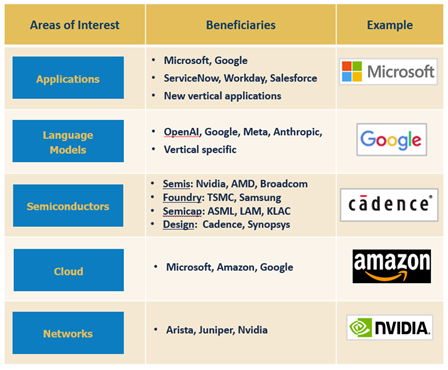
There is undoubtedly an element of AI froth that has come into the technology sector, as some companies have seen AI potential wash into their share prices before a clear articulation of how the earnings that will back these valuations will emerge. And we have seen the downside of this where companies such as Data Dog and Palantir have had solid falls after earnings disappointments, while some of the air has also come out of other companies such as MongoDB, Snowflake and Salesforce. We expect the market to become more discerning in terms of wanting to see a clearer monetisation path to determine who the key winners will be as opposed to the broad lifting of almost all boats even tangentially brushing up against the AI theme that we have seen so far this year. Use cases of generative AI In terms of winners in the AI space, it is all about a clear identification of use cases. AI is not a new theme. The difference now is generative AI developments expand these technological capabilities and put them within the reach of hundreds of millions of new users each month. The IDC estimates the global AI market will see 19% compound annual growth between now and 2026 to reach US$900bn while Goldman Sachs predicts generative AI alone could drive 7% or an almost $7trn increase in annual global GDP growth over the coming decade. There are various elements of the tech ecosystem where value will emerge to varying degrees. At the front end you have the key enablers such as semiconductor designers like Nvidia that will benefit along with foundry businesses like TSMC and Samsung and the semiconductor equipment players such as ASML, Applied Materials and Lam Research who supply them. Then you shift towards the infrastructure names such as networks businesses like Arista, and the cloud players that span Microsofts Azure, Amazons AWS and Googles GCP. But the really exciting opportunities should emerge beyond the initial enablers and infrastructure players and be in those businesses that can create applications based on AI. Established businesses such as ServiceNow, Workday and Salesforce are working to embed AI within their current offering, but the real opportunity is likely to be in the emergence of a business that applies AI to a deep revenue pool and owns that vertical. Whether that be in healthcare, finance or customer service, there is potential for an AI leader to emerge that could be the next big tech name in 5yrs. AI offers a plethora of investment opportunities, but not all created equal
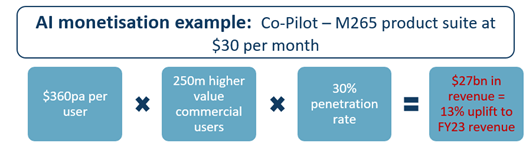
Source: Alphinity, 31 July 2023 Two clear early winners currently - Microsoft & Nvidia Investing in AI is like investing in any other idea for Alphinity; find the investment ideas that are showing earnings leadership, come wrapped in a quality business, and are bound by a reasonable valuation. In AI it comes down to identifying a tangible use case and the monetisation potential that flows off the back of this to driving earnings outperformance, exceptional returns and valuation upside. Microsoft and Nvidia are two clear early winners in AI that display these characteristics. Microsoft (MSFT) - Well positioned for broad secular trends in technology and a leader in AI Microsoft has multiple legs of opportunity flowing from AI. At the front end, it has announced pricing for its AI infused M365 co-pilot product at $30per user per month. Applying this pricing to Microsoft's 250m commercial users of it's higher value products, we estimate Co-pilot can drive an extra $27bn in revenue, or 13%, over a 3-5yr period, assuming a conservative 30% penetration rate. There is also the uplift in consumption that will run through Microsofts cloud business Azure, a potentially simpler Ai product for the extra 200m commercial users on simple product sets, plus incremental gains from any shift in search traffic from Google to Bing. Wrap this together and while the Microsoft share price has risen in 1H23, investors are currently paying 30x Price to Earnings for a business that can grow mid-teens over the next 3 with multiple growth drivers. MSFT offers tangible AI monetisation
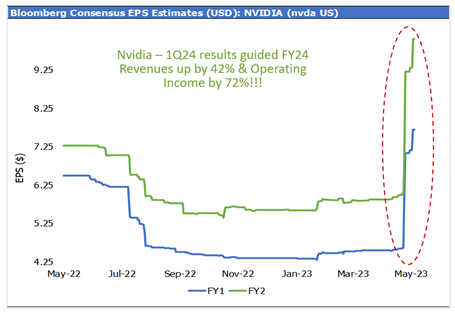
Source: Alphinity, Bloomberg, 31 July 2023 Nvidia (NVDA) - Global leader in Graphics Processing Units with generative AI a gamechanger Nvidia is the other key initial beneficiary from AI, with their most recent result generating an almost unprecedented upgrade in earnings expectations for a business of its scale. Generative Ai is all about GPU's given their ability to run calculations and simulations in parallel; the key tasks for AI. And Nvidia sits front and centre as the leader in terms of GPU performance coupled with a powerful software capability making their GPU's flexible and programmable. The key to the Nvidia investment case is ensuring that the current demand is not just a flash in the pan. To our mind, there is sustainability to this demand given that generative AI has triggered a shift in data centre infrastructure from CPU's towards GPU's. With around $1tr of datacentre infrastructure installed, and this infrastructure turning over around every 4 years, this provides rich structural tailwinds that should drive Nvidia earnings for years to come. On our estimates, NVDA should generate around $30bn in datacentre revenue this year (2/3rds of total revenue). If we push the shift from CPU to GPU through our discounted cashflow model, we estimate that datacentre revenues can increase to $80bn CY27. Investors are paying c40x FY24 Price/Earnings, with what looks like growth to come for the years ahead. Revenue & margin uplifts driving unprecedented EPS upgrades over next two years
Source: Alphinity, Bloomberg, 31 July 2023 In summary, AI is an exciting investment opportunity, with many growth tangents still to be discovered. But like any investment, investors need to be able to have a line of sight to the earnings potential and be disciplined in terms of what they pay for these companies to ensure that they are not riding a bubble that may eventually pop. Authors: Elfreda Jonker, Client Portfolio Manager & Investment Specialist and Trent Masters, Global Portfolio Manager |
|
Funds operated by this manager: Alphinity Australian Share Fund, Alphinity Concentrated Australian Share Fund, Alphinity Global Equity Fund, Alphinity Sustainable Share Fund Disclaimer |

7 Sep 2023 - Fear Not - 5 Steps to Successfully Navigate a Stock Market Fall
|
Fear Not - 5 Steps to Successfully Navigate a Stock Market Fall Marcus Today August 2023 |
|
No doubt a lot of you, scarred by the GFC, by the 2020 pandemic-inspired drop in the market, or by the next potential sell-off, are constantly worried about a significant market correction. It's no fun investing in 'fear', and if that's you, then let me tell you about fear, and in so doing, rid yourself of the constant worry that the stock market is about to fall over and destroy your financial expectations. Sidenote: Anyone who is wealthy, inactive, or incapable of selling can stop reading here. First, You Need to Understand FearThere is always, always, always something to fear when it comes to the stock market, and fear is good, because it's the fear that creates opportunities. Rather than avoid fear, you should welcome it. It is in the grip of stock market fear and exuberance that the most money is made in the shortest timeframe. You should also understand that when fear starts, we will perpetuate it. Fear is great for us; for the financial media, the brokers, the financial planners, the fund managers, the financial advisers. In fact, it's great for the whole finance industry. Some commentators make a living out of fear, like Nouriel Roubini, or Marc Faber with his 'Doom and Gloom' report. Why? Because fear triggers insecurity which drives investors to us. Fear is the sheep dog of financial services. It rounds up the sheep so we can shear them. Yes, the sheep, that's you. Fear is also a powerful magnet when it comes to attracting eyeballs, and in a competition for clicks, when investors are at their most fearful, the clicks and eyeball numbers explode. Everyone wants advice, and we will provide. Advice is the 'Trojan Horse' of our commercial purpose. Fear achieves that for us. It is so much more effective than common cheerfulness.Fear and ClickbaitClickbait, in it's natural form, starts with the words "5 Things...". To capitalise on that, we chuck in some of the top clickbait keywords, and then, if the glorious moment (as now) presents, we throw in some fear. "5 Things", the keywords "Warren" and "Buffett", and a small sprinkling of fear, and you have the most commercial headline in finance. It goes like this: "5 Reasons Warren Buffett Thinks the Stock Market Will Crash" Publish and wait. A 5-Step Simple Plan of Action for You - When the market loses it's head in fear1) Stay cold, objective, and logical. Be 'Spock'. Look down on the fear, don't join in. Being emotional will not help you, it will cost you. 2) Accept what your shares are worth now. Don't dwell for a moment on the highs, and how much you were worth. The highs are gone and there's nothing you can do about it. Anchor yourself to yesterday's prices and it will deliver nothing but regret and a feeling of stupidity. Look at the bottom of the spreadsheet. That's what you're worth. Accept it. 3) Get excited. The market only presents great opportunities occasionally. One is coming. It is from moments like these that quick money is made. 4) Take an informed guess at what you think is going to happen next. The only thing that matters is what's going to happen, not what has happened. Read the Marcus Today newsletter and decide for yourself if the sell-off is a blip or a trend. 5) Decide what to do, if anything. Understand that no one knows. Do your best. Just decide. And live with it. Accept the outcome, right or wrong. The only crime is deciding nothing and letting it all happen to you. So, My Thought Process in Preparing for the Next Sell Off Goes Like This:1) Take ten seconds - For a few moments of weakness, I thought about how I could have called this earlier in the newsletter, before each fall in the market. Tiger Woods says you are allowed ten seconds to express your emotion after a golf shot. But that's all. Take ten seconds. It's good for you. But there's nothing to be done about that now. It is what it is. Time to move on and decide what to do next. 2) Identify the core issues - I read a lot (as always), and quickly (it's pretty obvious) identified the core of the issues for the last correction. Macro stuff. In this case, inflation, interest rates and the fear of a US recession, with a sprinkling of China lockdowns and Russian risk. 3) Decide if it's a 'blip' or a 'trend' - I made an assessment of whether the main issues were likely to persist, or turn on a sixpence. I decided they were more likely to persist. 4) Do something, or decide to do nothing - I sold the three market-related ETFs in our 'Strategy Portfolio', and almost every stock in our 'Ideas Portfolio'. I'm good at selling, it's a thing I do well. You should learn to do it. It's cathartic. You wake up the next day hoping the market collapses, rather than fearing it will. It's empowering to have cash and be "ready to go". 5) Take it day by day until the bottom - Now the game is to watch and wait for 'peak fear'. The market will bottom one day. It could be tomorrow, or it could be in a year. You must take it one day at a time. Wake up every morning and react. There's no predicting it. I know I'll make more money in the recovery from the bottom, and more than I lost in the last few days of any correction. If I can get it right, and if I can time it right for our subscribers, it will be fabulous. And that's how you approach this moment when it comes again. With the intention to exploit everyone else's fear. By the way. You can time the bottom. Don't listen to those feeble commentators that say you can't. They want it to be impossible, so they don't have to do it. For financial professionals, it's a lot more effort handling active clients than it is handling docile 'buy and hold' sheep, and the more clients they can convince that timing can't be done, the less activity they incur for the same amount of fees. Just saying. The Bottom LineYou should welcome corrections and other people's fears. The most exploitable moments of the market are the fabulous, exponential, irrational, exuberant bits at the top and the most fearful, despondent, capitulations at the bottom. They are the bits, the extremes, and the opportunities, that make the market worthwhile. Those extremes, those moments of stupidity, absurdity, farce, ridiculousness, and nonsense are brought on by other people's irrational fear and exuberance. You should expect them, look forward to them, and use them, not avoid them. A good investor watches and exploits the herd. They don't join the herd. Let that be you. Author: Marcus Padley, Founder of Marcus Today |
|
Funds operated by this manager: |
 The bottom line is that fear is just part of the great game that is the stock market (any market). It creates the lows, it creates the best opportunities to make money, and for the finance industry, it is gold. Whether it is a broker looking for an order, a media person looking for attention, or a financial planner looking to convince a client that they need them, fear gets more traction than optimism, fear gets attention, and fear gets clicks. So when the stock market drops 5% in a day, there are a few things you don't do. You don't join in! Fear makes you vulnerable as an investor. It distorts your normally objective state of mind. If you get fearful when the market loses it's head, you become part of the herd. Far better if you recognise it for what it is, an emotional "moment" in other people's minds, and think about how you can exploit it. It will vary depending on the sort of investor you are, and the sort of risk appetite you have.
6 Sep 2023 - Compelling case for bonds as recession looms
|
Compelling case for bonds as recession looms JCB Jamieson Coote Bonds August 2023
Central banks the world over have hiked rates with unprecedented velocity and ferociousness as they look to rein in inflation. With this hiking cycle now nearing its peak, Jamieson Coote Bonds senior portfolio manager, James Wilson says investors should assess their portfolios and take advantage of emerging opportunities in fixed income. KEY TAKEAWAYS
BRACING FOR A SLOWDOWNSince March 2020, the geopolitical forces shaping markets have shifted dramatically. Markets have lurched from a global pandemic to the outbreak of Europe's first land war since conflict rocked the Balkans in the 1990s. Meanwhile, rising nationalist sentiment across other major economies has polarised the political landscape - particularly in the US. Economics and markets: a dose of reality
Source: Jamieson Coote Bonds More recently, Mr Wilson said investors have contended with a "world of overshoots". "We've seen oil travel from -US$30 to over US$120, and back to somewhere in the eighties where we are now. "We've had the Bitcoin bubble. We've gone from US$5,000 to US$68,000 where we all wanted to be part of the big bubble there until it all popped and went back to US$16,000. And that's since recovered again. Now we are seeing equities being led by Artificial Intelligence. "All this is happening in a highly indebted world where US mortgage-holders are under trillions and trillions of dollars of debt."
It's not just mortgage debt that's expected to provide headwinds for markets. Mr Wilson noted that US credit card debt is hovering around the US$1 trillion mark1. Taken together, Mr Wilson said these indicators suggest the market is "cycling between the late 'upswing phase' and the 'economy slows' phase. In blunter terms, global markets appear to be heading towards recession. Where are we at in the business/investing cycle?
Source: Jamieson Coote Bonds team analysis CHARTING A COURSE FORWARDLooking ahead, Mr Wilson said the uncertainty hanging over markets will likely remain, however clues to what might play out can be found by looking back to 2007, right before the Global Financial Crisis struck. "As we know, nothing really happened, and then everything happened," he said. "Rates hit 5%. You could buy a 3-month T-Bill for above 5% for more than a year, and then everything came crashing down." Precisely what will cause a recession this time around is more difficult to pinpoint, Mr Wilson said - and the lagging effects of monetary policy mean the trigger could still be a while off. When it does hit, however, Mr Wilson said the United Kingdom and Europe will likely feel its effects first. "They've got big exposure to energy, and they're against the US dollar," he said. "Then the US and then Australia would go into recession as inflation and jobs will lead unemployment rates to go higher." Historically, Mr Wilson said, rate hiking cycles undertaken by the US Fed invariably create a financial crisis somewhere in the world. INFLATION EASING SLOWLYInflation has become a hot-button issue for investors, policymakers and a majority of households over the past two years. The US Consumer Price Index (CPI) peaked at 9.1% in June last year, with Australian CPI reaching a peak of 7.8% in December that same year. Since then, CPI figures have steadily reduced. In the US, inflation is sitting just above 3%, while Australia's July CPI print came in at 6%. "These are outstanding moves," Mr Wilson said. "I know central bankers aren't making many friends hiking interest rates as the cost of living pressures that everyone's suffering from globally, but it's been the right idea. It's going to help economies." Mr Wilson added that the Citi Inflation Surprise index - which measures forecasters' expectations against realised inflation data - showed that since 2020, inflation was consistently higher than expected. In the past few months, this trend has been broken. "We're no longer seeing surprises to the upside," Mr Wilson said, "which means we're not getting the volatility in the data, which means we most likely aren't going to see binary moves in the actual bond yields." Although inflation expectations are starting to ease, Mr Wilson said he doesn't expect to see CPI dip below 2% "anytime soon", and that inflation will likely remain 'sticky' for some time. OPPORTUNITIES EMERGING FOR ACTIVE MANAGERSLeading into the Jackson Hole symposium, US bond markets are pricing in rate cuts between 120 and 130 basis points for the year ahead. "That isn't necessarily saying that we (Australia) are going to have 120 basis points of rate cuts. What that could be saying to bond traders is that there could be a 50% chance of close to 250 basis points of cuts," Mr Wilson said. In Australia, market pricing tells a different story - one more interest rate hike (likely before the end of the year) and no 'big' rate cutting cycle like US markets are expecting. Interestingly, Australia's three-year bond rate currently sits at 3.8% - 30 basis points below the cash rate. In the US, that gap between the three-year bond rate and the cash rate is closer to 100 basis points. "If you think about that level, Australian three-year bonds are actually quite cheap in that sense because they're not pricing in any of the rate cutting cycle. There are definitely opportunities to be owning those assets," Mr Wilson said. Mr Wilson also noted that bond and share market yield curves are "not too dissimilar", suggesting the credit stack is upside down. Bond yields are genuinely compelling for investors Where are investors securing their yield from, and at what cost to the portfolio?
Source: JCB team analysis, based on data from Bloomberg Similarly, property cap rates are starting to 'come into line' with bond yields, Mr Wilson said, making a 'compelling' case for bond investment. This is further evidenced by the state of US deficits, Mr Wilson said, which suggest there's a huge amount of issuance yet to come. "And at some price point, bonds will clear. There is a price that's going to cheapen up, but bonds will clear at some price and someone will buy the US treasuries and the Australian government bonds for that matter at a level." The money used to purchase those assets somewhere - whether credit, equities or something else, the money will come from somewhere to fund these purchases, Mr Wilson said. "We're already seeing that in asset allocations, that makes bonds a very compelling investment option over time, and we expect this to continue." 1. A Saphir, 'US credit card debt tops $1 trillion, overall consumer debt little changed', Reuters, August 9 2023, accessed 15 August 2023 Funds operated by this manager: CC Jamieson Coote Bonds Active Bond Fund (Class A), CC Jamieson Coote Bonds Dynamic Alpha Fund, CC Jamieson Coote Bonds Global Bond Fund (Class A - Hedged) Important InformationThis article has been prepared by JamiesonCooteBonds Pty Ltd ('JCB') ACN 165 890 282 AFSL 459018. This article is supplied on the following conditions which are expressly accepted and agreed to by each interested party ('Recipient').The information is provided only to wholesale or sophisticated investor Recipients as defined by the Corporations Act 2001 (Cth). JCB is not licensed in Australia to provide financial product advice or other financial services to retail investors. The information in this article is general financial product advice only and has been prepared without taking into account the objectives, financial situation or needs of any particular person.The information is not intended for any general distribution or publication and must be retained in a confidential manner. Information contained herein consists of confidential proprietary information constituting the sole property of JCB and respecting JCB and its investment activities; its use is restricted accordingly. This article does not purport to contain all of the information that may be required to evaluate JCB or their funds and the Recipient should conduct their own independent review, investigations and analysis of JCB and of the information contained or referred to in this presentation.Neither JCB nor their representatives and respective employees or officers (collectively, 'the Beneficiaries') make any representation or warranty, express or implied, as to the accuracy, reliability or completeness of the information contained in this article or subsequently provided to the Recipient or its advisers by any of the Beneficiaries, including, without limitation, any historical financial information, the estimates and projections and any other financial information derived there from, and nothing contained in this article is, or shall be relied upon, as a promise or representation, whether as to the past or the future. Past performance is not a reliable indicator of future performance. The information in this article has not been the subject of complete due diligence nor has all such information been the subject of proper verification by the Beneficiaries.Except insofar as liability under any law cannot be excluded, the Beneficiaries shall have no responsibility arising in respect of the information contained in this article or subsequently provided by them or in any other way for errors or omissions (including responsibility to any person by reason of negligence). An investor should, before making any investment decisions, consider the appropriateness of the information in this article, and seek professional advice, having regard to the investor's objectives, financial situation and needs. For further information and before investing, please read the Product Disclosure Statement ('PDS') which is available at www.jamiesoncootebonds.com.au. |


5 Sep 2023 - The Experiences Megatrend
|
The Experiences Megatrend Insync Fund Managers August 2023
Despite Covid's interruption it has continued to gain momentum. Its recovery is proving remarkable, as experiences remain a potent megatrend with substantial growth potential ahead, even amidst short-term economic woes. Despite the headlines throughout the pandemic and general market commentator's gloomy predictions, our research at Insync told us otherwise. For players that had strong capital bases, tight reins on expenses, and prudent investment allocation strategies, they could endure the worst the pandemic could throw at them. These businesses emerged stronger, such as the prime stock in our portfolio did. Many of its peers however weren't as strong, with some folding or forcibly downsized. Additionally, entire sectors of travel/experiences almost collapsed (e.g. cruise lines). For those left standing, their hold on the market and thus their margins became bigger and stronger. An increase in interest rates and inflation had minimal impact on their performance in the post pandemic recovery.
These businesses emerged stronger, such as the prime stock in our portfolio did. Many of its peers however weren't as strong, with some folding or forcibly downsized. Additionally, entire sectors of travel/experiences almost collapsed (e.g. cruise lines). For those left standing, their hold on the market and thus their margins became bigger and stronger. An increase in interest rates and inflation had minimal impact on their performance in the post pandemic recovery. What and who is driving this megatrend? Over the past decade, the desire of consumers has shifted towards experience-based offerings and is influencing people's spending priorities. This shift spearheaded initially by millennials has spread across all age groups. Ironically it gained further traction from covid's travel restrictions. A proof point can be found in air travel; that whilst business trips are relatively flat compared to pre-covid, overall commercial flights hit a global record in June this year. A significant majority of 74% of Americans, as a further example, now prioritize experiences over material possessions according to a third-party research study. This is no different to us here in Australia and New Zealand or in Europe. Notably, millennials and Gen Zers are leading this trend as travel becomes an increasingly regular and a vital priority for these age groups . With 44% of travellers aged 18 to 34 asserting that travel is more important post-pandemic, it's evident that this generational shift is taking hold.
The fast approaching impact of AI on this megatrend. With AI developing quickly it is vital to understand its impact on business models of all companies that we invest in. Our research shows that online travel agencies(OTAs) are extremely well placed, contrary to many investors placing them in the AI loser's basket.
This is because the OTAs operate far downstream of where AI will have its heaviest and nearest impacts. Consider this single aspect; OTAs employ tens of thousands of staff in local markets around the world to source then continue to manage the fragmented accommodation supply to make it homogenously, digitally bookable globally. Importantly, our prime holding is already investing heavily in utilising AI. This is a critical piece of OTA infrastructure that the likes of Google or ChatGPT will both struggle to execute and match the capabilities of dominant OTAs. Indeed Google recently tried and failed to gain a foothold in this sector after significant investment and effort. Funds operated by this manager: Insync Global Capital Aware Fund, Insync Global Quality Equity Fund Disclaimer |


4 Sep 2023 - Hybrid securities - How risky are they?
|
Hybrid securities - How risky are they? PURE Asset Management August 2023
Hybrid securities is a catch-all term and refers to both preference shares and convertible loan notes. They are financial instruments that combine the characteristics of both debt and equity. This article will focus on Convertible Loans, or simply, Convertibles. These instruments, like traditional debt, pay a rate of interest and have more protections than shares, but they also have the option to be converted into the shares of the Company at some point in the future. The conversion feature makes them attractive to investors who believe that the value of the Company's shares will increase over time. By holding a Convertible, investors have the potential to participate in the share price appreciation, while also receiving interest while they wait. The conversion price is typically set at a premium to the current market price of the shares, or it can be based on a discount to a future pricing event, for example an IPO. When the share price rises above the conversion price, the holder can convert into shares and make a profit. Convertibles can be a way to gain exposure to both income and growth, but like any investment they come with some risks, which could largely be considered to sit between the risk of shares and the risk of traditional debt. What are the main risks?Credit riskThe largest risk of a Convertible is credit risk. Credit risk is the risk of default, if the borrowing Company is unable to pay the interest on the loan, or even payback the original capital, which may be result in a partial or a complete loss of capital. A key factor influencing the level of risk is the level of security attached to the Convertible. The capital of all companies sits in a capital stack (see below). At the top of the stack is a senior secured loan and at the bottom, equity. The risk of an investment is largely correlated to where the capital sits in the capital stack. Convertibles are typically the top three, so less risky than preference or ordinary shares. (Note that a Company may not have all the layers in the table, but most will have several.)
In an efficient market, higher levels of credit risk will be associated with higher borrowing costs as the investor wants to receive a higher return for the perceived risk of the investment. In simplistic terms, the higher up the stack, the more other investors' capital there is that would first need to be lost, before the investors above them suffers loss. In a private market, lenders and borrowers negotiate directly. A savvy lender/private debt manager will attempt to negotiate with the borrower the appropriate terms and conditions, controls, reporting obligations, covenants, and security to ensure the lender has greater influence over the loan terms in an effort to mitigate potential loss risk. Covenants and ongoing borrower reporting requirements are negotiated in order to provide protection and early warning of changing risks. Liquidity riskLiquidity risk refers to the inability to sell or trade an investment when needed. Unlisted hybrid securities are an illiquid investment, and therefore carry the risk that if something goes wrong in the Company, such as a credit risk event, the holder may not be able to liquidate their position in a timely manner. While hybrid listed on the ASX may offer some liquidity, most are often less liquid than the ordinary shares making them harder to sell. Conversion riskWhen the Convertible converts into shares, the number of shares to be issued to the holder will typically be calculated by dividing the loan amount plus any accumulated interest by a certain share price. This conversion price will often be pre-determined as a fixed price, or it can be priced with a reference to future prevailing share price. What is not know at the time of investing is what level of profit, or even loss, will result at the conversion event. Some Convertibles have an enforced conversion event, for example at IPO, and in other cases, the Conversion is at the direction of the holder. If the holder retains the right to choose and elects not to convert, the Company must repay the capital plus any accrued interest. This structure is preferable as it carries less risk of loss on conversion if the Company has performed poorly. Convertibles vs. traditional debtConvertibles can be more complex than traditional debt and may have a higher level of return because of the attractive feature of being able to participate in the upside if things go well. Convertibles vs. equitiesEquities represent ownership in a Company, and their value can fluctuate based on a variety of factors such as company performance, industry trends, and overall market conditions. They can be considered riskier than debt because the value of the shares can fluctuate greatly. Convertibles, on the other hand, pay a fixed or floating rate of interest and also have some of the characteristics of ordinary shares, such as potential for capital appreciation. They tend to be less risky than equities because they typically provide a consistent income stream and also have some or all of the protections intrinsic to debt. As with any investment, it's important for investors to conduct their own research and consider their own risk tolerance before investing in hybrid securities. It's also important to diversify your portfolio and not to put all of your eggs in one basket. Funds operated by this manager: |

1 Sep 2023 - Hedge Clippings | 01 September 2023
|
|
|
|
Hedge Clippings | 01 September 2023 Reputation and trust are everything! Anyone involved in financial services - irrespective of which side of the desk they're on - is well aware of the importance of reputation and trust, particularly so as an advisor providing financial advice, or as a fund manager investing other peoples' money. Of course, that doesn't stop dodgy operators, normally driven by both their own greed, and assisted by the greed of some investors, from having a go. When it does occur, it inevitably ends up in tears for the investor, and loss of reputation (or worse) for the perpetrators, as the banks discovered during the Hayne Royal Commission. Mayfair 101 is a prime example and one suspects that's the reason head honcho and salesman James Mawhinney is trying so desperately to salvage his reputation. For the record or the forgetful, Mayfair went down the gurgler, along with over $200 million of "sophisticated" investors' money, thanks to some slick advertising and endorsements from some who should have known better. Finally, ASIC took court action to shut the failed operation, and Mawhinney in turn has fought back, and is reportedly set to re-launch Mayfair. However, in spite of 93% of their reviews on Trust Pilot being "5 star", his reputation is forever settled. If anything, the reputation of Trust Pilot as a reliable source of information is tarnished by association as well. Which brings us to the complete destruction (in our view) of the reputation of Qantas, along with that of CEO Alan Joyce. To be fair, the so called "National Carrier's" reputation as a five star airline took a beating some time ago, as service levels, baggage handling, flight delays, and just about every other factor, other than their safety record, went into a spin. More recently, the obfuscation around expiring flight credits (since reversed thanks to widespread publicity including a Senate grilling for Joyce), Qantas Chairman's Lounge membership for Albo's son, and political pressure to block competition from Qatar Airways, has added to their woes. Finally, this week the ACCC finished the job by taking Qantas to court for advertising flights which had already been cancelled. Presumably, the logic behind this was either to garner even more flight credits, or to stop passengers booking elsewhere. Either way, immoral, and in the ACCC's view, illegal. Qantas was once one of the most valuable brands in Australia, and possibly the world. Greed and a simple lack of ethics has destroyed that, and Joyce's reputation with it. Along with Albo's, and the combined Qantas boards', reputations tarnished by association. As the ACCC's case drags through the courts, and the media, the damage will continue. Joyce meanwhile will be long gone, pockets bulging. We pity his successor, who will have to pick up the pieces. While on the subject of handovers and successors, next Tuesday's RBA meeting will be Philip Lowe's last before handing over to his deputy Michelle Bullock. We suspect no change in direction, and that Lowe will leave - as history will show - with an excellent reputation. Some will note his misjudged "no rate rise until 2024" comment "forecast" but he seems to have traversed his "narrow path" well. Finally, last week we included this photo of Mick Jagger and Mitch McConnell. The week's news only confirmed what we all (possibly with the exception of Mitch himself) knew. News & Insights What really matters in investing | Magellan Asset Management Investing Essentials: How a financial adviser can help | Bennelong Funds Management July 2023 Performance News |
|
|
If you'd like to receive Hedge Clippings direct to your inbox each Friday |
