


NEWS

10 Oct 2024 - Performance Report: Seed Funds Management Hybrid Income Fund
[Current Manager Report if available]

10 Oct 2024 - Performance Report: Bennelong Australian Equities Fund
[Current Manager Report if available]

10 Oct 2024 - ESG Insights: China emerges as green energy leader.
|
ESG Insights: China emerges as green energy leader. Tyndall Asset Management September 2024 I recently spent a few days in Hong Kong meeting with Asian companies and experts to explore China's economic shift from relying predominantly on infrastructure and real estate to its emergence as a global leader in renewable energy. Government policies support emerging industriesChina's rapid economic growth over the last few decades has been driven by investment, infrastructure development, and real estate. In 2021, real estate investment accounted for 27% of China's total fixed asset investment, but by 2023, this figure had fallen to 22% and is arguably even lower today. The sector has faced shrinking investments, declining sales, and a notable drop in housing prices. Between January and July 2024, real estate development investment decreased by 10.2% year-on-year (YoY) to RMB 6.09 trillion. The gross floor area (GFA) of new construction starts also saw a significant decline, with a 23.2% YoY decrease, while the GFA of completed projects dropped by 21.8% YoY. Although real estate remains a significant contributor to the economy, the Chinese government has been actively working to diversify the country's economic drivers. The government has introduced policies aimed at reducing payments and interest rates on property loans to prevent a collapse in the real estate market, which remains a vital part of China's economy. At the same time, the government has implemented significant reforms and provided incentives to encourage the growth of key industries such as EVs, solar energy, and lithium-ion batteries. These new sectors are crucial not only for domestic growth but also for China's goal to become a global leader in renewable energy and green technologies. I will discuss two of these industries in further detail in this paper. Global leader in EV manufacturingThe electric vehicle (EV) sector is a cornerstone of China's new industrial policy. As the world shifts toward cleaner energy, China has positioned itself at the forefront of the EV revolution. By 2024, domestic EV penetration had surpassed 50%, reflecting the growing consumer demand for environmentally friendly alternatives to internal combustion engine (ICE) vehicles. The Chinese government's push for sustainable transport has been instrumental in shaping this industry. However, subsidies are no longer the primary source of EV growth, as these vehicles have become competitive with ICE cars. The rapid growth of China's EV market is one of the most significant trends in the country's industrial landscape. In 2023 alone, EV sales in China reached 7.8 million units, representing a significant share of the global EV market. This growth has been driven by several factors, including government subsidies, the development of battery technology and an extensive charging infrastructure network. Additionally, Chinese consumers are increasingly favouring EVs over ICE vehicles. China's EV market is not only expanding domestically but is also influencing global markets. Chinese automakers such as BYD, Li Auto, and NIO are rapidly gaining market share within China and overseas. Chinese EV manufacturers have overtaken many traditional automakers in sales and technological innovation, with BYD now ranked fifth in global EV sales. However, Chinese automakers face challenges in expanding globally, due to the impact of trade barriers and tariffs. In 2024, the European Union imposed tariffs up to 38% on EVs imported from China, while the United States and Canada have also increased tariffs on Chinese EVs. The US and Canada appear to be particularly concerned about the software within the vehicles with a built-in internet connection. The issue relates to concerns on Chinese companies collecting data on American drivers and infrastructure together with the potential for foreign adversaries to remotely manipulate connected cars on the US roads. Overcapacity increases price competitionThe Chinese government's massive investments in EV manufacturing have resulted in an oversupply of vehicles. Many companies, particularly smaller startups, are struggling to maintain profitability due to the high cost of production and competition from established players. While companies like BYD and NIO have scaled production efficiently, others are facing challenges with underutilised capacity and financial losses. This overcapacity has led to price competition, with many manufacturers slashing prices to maintain market share. This has resulted in thin profit margins across the industry, particularly for companies still in the early stages of scaling production. China dominates solar energy productionSolar energy is another key sector in China's energy transition. China is the world's largest producer of solar panels, accounting for over 90% of global production. Between 2021 and 2023, China's solar capacity more than doubled, driven by strong demand and technological innovation. The country added over 200 gigawatts (GW) of solar capacity during this period, making it the largest solar energy producer in the world. The Levelised Cost of Energy (LCOE) for solar power has dropped significantly, making it cost-competitive with traditional energy sources such as coal and natural gas. By 2023, the LCOE for solar power in China fell to just $0.04 per kilowatt-hour, on par with the cost of coal-fired electricity. Chinese companies have improved solar efficiency while reducing production costs, making solar energy more affordable and accessible. This has enabled China to export its solar products globally, particularly in Europe, Asia, and the Americas. One of the most significant innovations in the solar industry has been the development of "N-type" solar cells, which offer higher conversion efficiency than traditional "P-type" cells. These advanced solar cells have helped reduce the overall cost of solar energy, making it more competitive with other forms of electricity generation. Despite this impressive growth, China's solar industry faces similar challenges to the EV industry. The rapid expansion of production capacity has led to an oversupply of solar panels, causing prices to plummet. Between 2021 and 2023, the average cost of solar panels fell by more than 60%, squeezing manufacturers' profit margins. To address overcapacity, the Chinese government has implemented policies encouraging consolidation within the industry. Smaller, less efficient producers are encouraged to exit the market, while larger companies expand their market share. This process of consolidation is expected to help stabilise prices and improve profitability in the long term. Expansion into global marketsChina's solar industry is also expanding its presence in international markets, particularly in Southeast Asia and the Middle East. Chinese companies such as Longi, Jinko Solar, and Trina Solar have established production facilities in countries like Malaysia, Vietnam, and Thailand, where they can benefit from lower production costs and favourable trade policies. In the Middle East, these companies are scaling up operations to meet the region's growing demand for renewable energy. The United Arab Emirates and Saudi Arabia have become key markets for Chinese solar products. China's dominance of the Global Battery marketThe rise of electric vehicles (EVs) has significantly increased the global demand for lithium-ion batteries. As countries strive to transition to cleaner energy sources, the battery industry has become a critical component of this shift. China has emerged as a dominant force in battery production, contributing to a substantial oversupply in the market. China's battery production capacity in 2023 alone matched global demand, highlighting its overwhelming presence in the industry. The country has invested heavily in research and development, with companies like BYD and CATL leading the charge. This dominance is not just in sheer volume but also in technological advancements, making China a formidable player in the global battery market. Global lithium-ion battery manufacturing capacity has outpaced demand, with an estimated 2,600 GWh produced in 2023 against a demand of 950 GWh. This oversupply is expected to increase, leading to falling prices and squeezing profit margins for manufacturers. For consumers, this could mean more affordable EVs and stationary storage solutions. The low prices are making it difficult for new entrants outside of China to compete, even with generous support provided by the US Inflation Reduction Act and other such support structures. The sustainability of the low battery prices is an intriguing question and will likely result in an industry shakeout as is normal during overcapacity cycles. Lithium, a key raw material cost is in over supply and thus helping keep battery prices low. However, regulatory and environmental approvals are making it more difficult to bring on new mining or refining capacity than build a battery plant. This may help bring the supply and demand fundamentals back into balance. ConclusionChina's industrial transition represents a fundamental shift in its economic model, as the country moves away from traditional investment-driven sectors like real estate and toward new, innovative industries such as EVs, solar energy and lithium-ion batteries. These sectors are crucial to China's long-term economic sustainability and its efforts to reduce carbon emissions and become a global leader in green technology. Exports of the traditional labour-intensive products are declining due to falling competitiveness. However, the capital and technology intensive industries are rapidly filling the gap. This transition is not without its challenges. EV, lithium-ion battery and solar industries all currently face significant issues related to overcapacity, profitability, and growing international competition. The Chinese government's role in managing these challenges through policies and supply-side reforms will be critical in ensuring the success of these industries. As China continues to expand its global presence in the EV and solar sectors, it is poised to remain a dominant player in the global market for green technologies. However, the country must navigate complex trade dynamics and competition from other global players to maintain its competitive edge. Western World governments do not want to be totally reliant on China for these technologies. Australia plays a significant role in China's ongoing industrial transition and its legacy industries given its endowment of both critical minerals and iron ore. Tyndall currently holds a modest overweight in the resources sector, exposing it to the short-term stabilisation of the property market and the China economy, as well as to the longer thematic that relates to global decarbonisation and China's industrial transition. Author: Brad Potter, Head of Australian Equities Funds operated by this manager: Tyndall Australian Share Concentrated Fund, Tyndall Australian Share Income Fund, Tyndall Australian Share Wholesale Fund |

9 Oct 2024 - Trip Insights: LatAm (Part 1)

8 Oct 2024 - New Funds on Fundmonitors.com
|
New Funds on FundMonitors.com |
|
Below are some of the funds we've recently added to our database. Follow the links to view each fund's profile, where you'll have access to their offer documents, monthly reports, historical returns, performance analytics, rankings, research, platform availability, and news & insights. |
 |
||||||||||||||||||||||
| Dimensional Two-Year Sustainability Fixed Int. Trust AUD Class | ||||||||||||||||||||||
|
||||||||||||||||||||||
| View Profile | ||||||||||||||||||||||
| Dimensional World Allocation 70/30 Trust | ||||||||||||||||||||||
|
||||||||||||||||||||||
| View Profile | ||||||||||||||||||||||
| Dimensional World Allocation 30/70 Trust | ||||||||||||||||||||||
|
||||||||||||||||||||||
| Dimensional World Allocation 50/50 Trust | ||||||||||||||||||||||
|
||||||||||||||||||||||
| Dimensional Sustainability World Allocation 70/30 Trust | ||||||||||||||||||||||
|
||||||||||||||||||||||
| View Profile | ||||||||||||||||||||||
 |
||||||||||||||||||||||
| Magellan Core Global Fund | ||||||||||||||||||||||
|
||||||||||||||||||||||
| View Profile | ||||||||||||||||||||||
|
Want to see more funds? |
||||||||||||||||||||||
|
Subscribe for full access to these funds and over 850 others |

4 Oct 2024 - Hedge Clippings | 04 October 2024
|
|
|
|
Hedge Clippings | 04 October 2024 The seasonally adjusted August Household Spending Indicator results released by the ABS earlier today - produced from source data of credit card spending from participating banks, supermarket transactions, and new vehicle sales - were unchanged month on month, with the July and June results re-adjusted downwards to -0.5% and -0.1% respectively. Given recent wage increases, energy assistance, and Stage III Tax cuts, all the indications are that consumers are keeping their hands in their pockets - at least when it comes to reaching for the plastic, or doing the weekly grocery shop. Over 12 months the number was +1.7% - best described as muted, particularly given annual inflation is running at double that figure, depending on which number (Seasonally adjusted, excluding volatile items or annual trimmed mean) one looks at. Household spending has been declining from a post COVID induced high of 29% in August 2022, with the latest figure particularly driven by goods (-0.3%) vs. services, including air travel, catering, and accommodation (+0.4%). Peering through the breakdown, it seems Australia's two speed economy, or two speed demographics is real. Those doing it tough are doing without, while those that can afford travel, catering and accommodation are still doing OK. As the ABS numbers are only "experimental" and cover credit card spending and supermarket data it will have to wait until the next set of Retail Trade numbers are released on 31 October, a day after the next CPI result. The RBA will then have a few days to consider the numbers prior to their next meeting scheduled for the 4th and 5th of November, the second day of which inconveniently clashes with the Melbourne Cup. With the RBA announcement at 2:30 and the Cup starting at 3:00, there are going to be some conflicts of attention, except of course in Melbourne itself when Race Day is marked by a Public Holiday. Prior to that, and starting next week, there are multiple speeches, remarks and panel appearances from various RBA members, including Deputy Governor Hauser, and Assistant Governors Christopher Kent and Sarah Hunter, which are only likely to maintain the Bank's current stance - inflation is the number one game, and they won't be hurried into cutting rates until they're certain it's been put back in the bottle. Over in the US it looks as if inflation might have been tamed, with market watchers waiting to see the US jobs report for September, due to be released overnight tonight to gauge if the Fed's next cut will be another 0.5%. The median forecast is for 150,000 new jobs in September, leaving the unemployment rate at 4.2%, in which case the Fed might only cut 0.25%. While the US economy seems on the right track, a combination of the port workers' strike which started this week, and critical escalation of the conflict between Israel, Hamas, Hezbollah, and Iran, could derail that. Meanwhile, the Trump and Harris camps continue to trade claim and counter claim, while spending untold millions on advertising in what looks like a photo finish for the White House - also on Cup Day, November 5th - which from a distance looks too close to call. News & Insights New Funds on FundMonitors.com 10k Words | Equitable Investors August 2024 Performance News Delft Partners Global High Conviction Strategy |
|
|
If you'd like to receive Hedge Clippings direct to your inbox each Friday |

4 Oct 2024 - Performance Report: Insync Global Quality Equity Fund
[Current Manager Report if available]

4 Oct 2024 - The Rate Debate - Ep51 The rest of the world is changing, so why aren't we?
|
The Rate Debate - Ep51 The rest of the world is changing, so why aren't we? Yarra Capital Management September 2024 The big question remains: will Australia follow the Fed's lead or stick to its current path? In Episode 51 of The Rate Debate, Co-Head of Fixed Income Darren Langer and Investment Manager Jessica Ren unpack the Fed's recent decision, explore the chances of rate cuts before Australia's next federal election, and debate the importance and reliability of employment data for the RBA. They also take a closer look at inflation pressures, from petrol prices and energy rebates to rising service costs. |
|
Funds operated by this manager: Yarra Australian Equities Fund, Yarra Emerging Leaders Fund, Yarra Enhanced Income Fund, Yarra Income Plus Fund |

3 Oct 2024 - Performance Report: ECCM Systematic Trend Fund
[Current Manager Report if available]

3 Oct 2024 - Emerging Markets are offering one of the biggest opportunities in a lifetime
|
Emerging Markets are offering one of the biggest opportunities in a lifetime Ox Capital (Fidante Partners) September 2024 The term "BRICS" was coined in 2001, and it refers to a collection of developing countries - Brazil, Russia, India, China and South Africa. Since then, the BRICS nations' share of global GDP (based on purchasing power parity) has surpassed that of developed economies, contributing to over ~60% of global GDP. China for example, grew its share of world GDP (PPP) to ~19% from ~8% in 2001. While China's growth is more mature, many other emerging economies are poised to continue the economic catch-up, as these economies still have relatively low-income per capita levels, and growth is driven by sound economic policies. 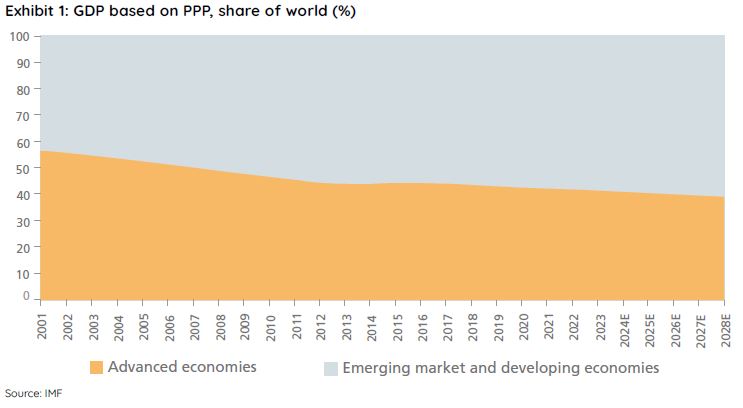 Notably, emerging markets equities are at a multi-decade low in price to earnings and price to book valuations compared to that of developed markets. It is an important fact given EM equities have historically outperformed developed market over the long-term. A general lack of interest has led to extraordinarily appealing valuations. We are looking at an attractive entry point with forward price to earnings multiples at depressed levels for quality companies with sustainable long-term growth and a backdrop supportive of outperformance. Moreover, many EM economies are undergoing continued economic development and political reforms. The economic fundamentals are much better than in prior years. Inflation is trending lower in many EMs allowing central banks to cut rates. A slowing developed markets economy is set to benefit emerging economies as we believe a slowdown in growth for the US will lead to interest rate cuts. Additionally, a declining US dollar and official interest rates are set to benefit emerging market equities. 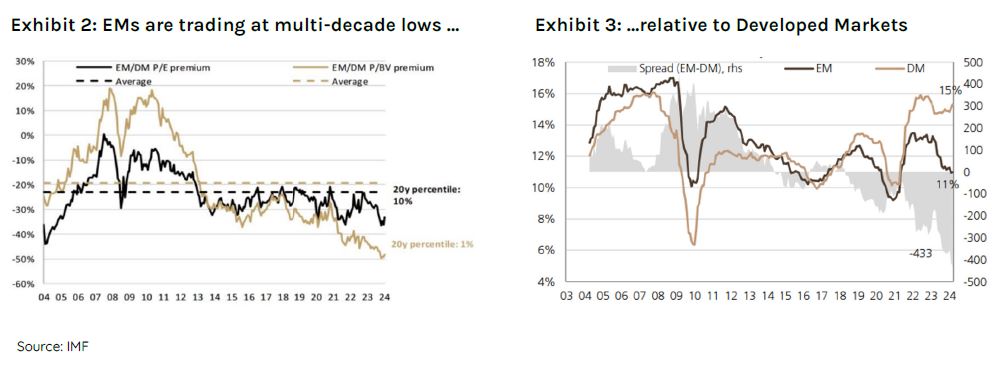 The recent period of underperformance for emerging markets, is an outlier in our view. EM economies were much more indebted and starting valuations were high over a decade ago. The present outlook is vastly different. Fiscal balances are healthy while debt to GDP ratios are at stable levels. Corporates are in a healthy position. Moreover, many EM regions are rich in key commodities for the upcoming Net Zero energy transition. We remain optimistic on emerging markets and believe the fundamentals are in place for EMs to outperform developed economies. Our proprietary quant model (the MOAT) is pointing to a very difficult environment for many developed markets into 2H2024 into 2025 including the US, versus an improving outlook for many EM countries, including China. Ox Capital is positioned now to benefit by investing in quality companies with sustained growth at attractive valuations across EM countries. In a volatile environment such as the one we are in; it is important to try to hedge the volatility. Ox has the capability to manage the portfolio dynamically that has reduced volatility in the past. Theme 1: A weaker USDThe US interest rate hikes by the central bank (Federal Reserve) has driven a stronger US Dollar. The recent strength of the "greenback" has been a headwind for emerging economies. This is logical as a stronger dollar can impact capital flows, trade, direct investment, and can impact credit growth. We believe the eventual decline in the USD will provide a tailwind for emerging market equities as returns are typically higher when the USD is declining in value. Historically, EMs outperformed the market by ~20% on average over the period since 2003. 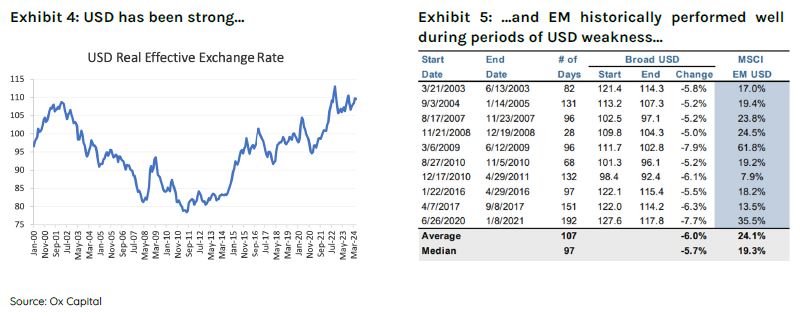 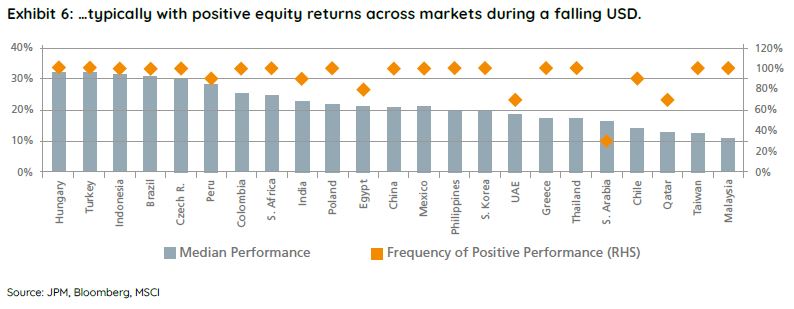 Theme 2: Rate CutsThe US federal funds rate has peaked and the FOMC is likely to cut rates as inflation moderates within its targets range. EM markets have historically performed well when the US cuts interest rate. Moreover, local central banks have been fiscally responsible. Many central banks have already started to cut official interest rates as inflation has trended back towards many central bank targets. Rate policy looks too restrictive, and cuts are likely to continue.  Theme 3: Supply chain reconfiguration and nearshoring.A reconfiguration of global supply chains will boost economic growth for a number of economies, especially nearshoring in ASEAN and LATAM, boosting GDP growth through foreign direct investments. Vietnam is a notable beneficiary of this trend. Greater foreign direct investment into an ever more open and market driven economy, with some of the most comprehensive free trade agreements in place globally, is providing strong employment opportunities for this young and vibrant country. As such, we believe this backdrop provides a foundation for alpha generating opportunities. 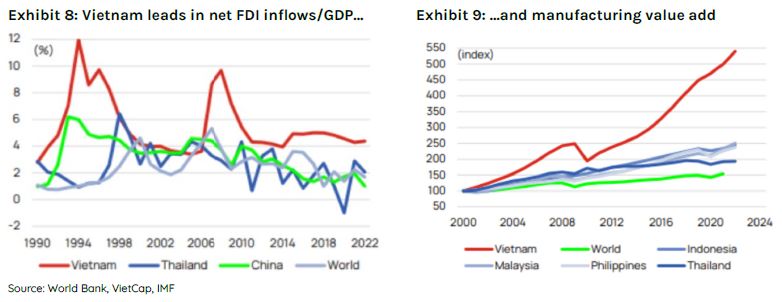 Moreover, nearshoring is a significant opportunity for the LATAM region in the coming years based on their geographical proximity to North America, and relatively cheap skilled labour. Nearshoring could add US$78 billion per annum in additional export revenue in LATAM in the coming years with Mexico being the primary beneficiary. Trade is especially important for Mexico. Mexico relies heavily on its industrial sectors for exports, with the manufacturing sector representing >80% total exports. Mexico's manufacturing sector has grown and matured over the years. Most recently, the top three export categories include auto-components, electronics, and machineries. Mexico is well placed with its long-established export capabilities to fulfil manufacturing orders for an increasing number of international companies. Mexico's relationship with the US is already well-established, as it is the largest exporter to the US. The country's ~15% share of US imports has now surpassed China's ~14%. 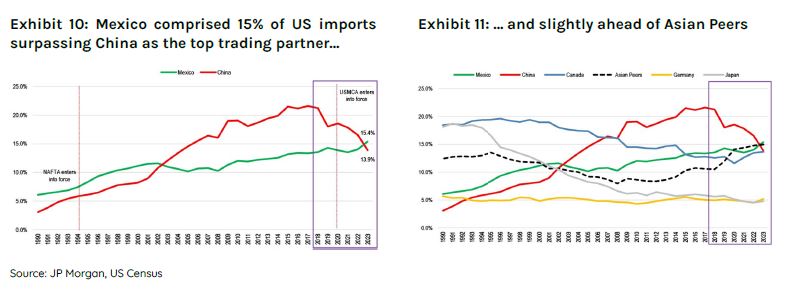 Growth in developed economies is expected to slow as rates have likely peaked. In contrast, despite recent economic challenges, the Chinese economy is expected to grow faster than the US, Japan, and Euro Area. Although China's growth is lower than in recent years, its economy is showing signs of bottoming, on the back of the Chinese authorities showing a willingness to stimulate and support the economy. Keep in mind that interest rates in China are low with minimal inflation relative to the rest of the developed world. A positive set up for equities in the year ahead. Moreover, Emerging countries make up the bulk of global growth, contributing to over ~60% of global GDP, but is under appreciated by global investors. Funds operated by this manager: Ox Capital Dynamic Emerging Markets Fund Important Information: This material has been prepared by Ox Capital Management Pty Ltd (Ox Cap) (ABN 60 648 887 914) Ox Cap is the holder of an Australian financial services license AFSL 533828 and is regulated under the laws of Australia. This document does not relate to any financial or investment product or service and does not constitute or form part of any offer to sell, or any solicitation of any offer to subscribe or interests and the information provided is intended to be general in nature only. This should not form the basis of, or be relied upon for the purpose of, any investment decision. This document is not available to retail investors as defined under local laws. This document has been prepared without taking into account any person's objectives, financial situation or needs. Any person receiving the information in this document should consider the appropriaten |
