


NEWS

17 Jun 2022 - Fears about green inflation overblown
|
Fears about green inflation overblown abrdn 07 June 2022 Fears that the global transition to a low-carbon economy will drive inflation over the long term are overblown, with the tightening of monetary policy set to have far greater implications for portfolios. Some observers point to the energy transition as inherently inflationary, with companies compelled to invest less in fossil-fuel energy at a time when the costs for renewable energy remain elevated. The market has labelled this green inflation - the contribution that environmental policies have on the cost of delivering goods and services that is passed on via supply chains to consumer prices. In truth, there are a variety of regulations and policies that can influence inflation. The international push-back against globalisation - for example, the continued imposition of trade tariffs - is one of the forces putting upward pressure on prices. While the pandemic has highlighted the fragility of global supply chains and logistical networks, Russia's invasion of Ukraine has extended inflationary drivers by delaying the recovery process and amplifying commodity price pressures as the war restricts access to energy, metals and grains. However, the reason that the US has an inflation problem is not due to climate policies, but because its economy was overstimulated as it emerged from Covid-19. The US retained accommodative monetary and fiscal policies for too long, and now its labour market is running red hot. A multi-year commodity boom in areas of renewable energy that require specialist components - such a rare earth metals - is possible owing to high demand and limited supply. But overall, we don't see green inflation as a meaningful contributor to rising consumer prices over the long term. Climate policies tend to operate over decades, meaning they're a structural driver of relative prices. However, at an aggregate level, consumers will only ever experience sustained high inflation if major central banks allow that to happen. Even if we were to see sustained commodity price increases, we would not expect headline inflation to remain above central bank targets for extended periods. We urge investors to look beyond the short term and think about the likely disinflationary consequences of prolonged global policy-tightening in the pipeline. We urge investors to think about the likely disinflationary consequences of prolonged global policy-tightening in the pipeline. What we're seeing now is central banks reacting to excess inflation, and we expect them to prioritise anchoring inflation over growth. We don't think we'll be debating green inflation in two years' time, rather the consequences of a US recession that came sooner than expected. Really, the narrative around green inflation is being driven by what's happening in the West. On the whole, inflation is far lower across Asia Pacific, where climate policy is at a much earlier stage of implementation and there aren't the same constraints on the fossil fuel sector. Moreover, delays in the reopening of Asian economies post Covid-19 has led to more subdued activity levels. Asia's growing importanceOne key question for investors to consider is the role that Asia Pacific will play in the technological innovation required to effect the global energy transition, and whether that will be disinflationary. From a macroeconomic perspective, policy initiatives by governments and central banks in Asia Pacific have been more prudent, with less willingness to prop up markets artificially. The region has far lower debt levels, fewer constraints on governments and strong state capacity to act. There's tremendous capital available to Asian governments and companies to effect the energy transition. We believe Asian companies will play an increasingly prominent role in investor portfolios. There can be no energy transition without Asia, where industrial pollution has forced governments to act. Heavy investment has brought the cost of technology down sharply over the past decade. Solar power became cheaper than coal-fired energy by 2015 in India, enabling it to invest in renewable energy quite aggressively. We think the technological innovation we are seeing at Asian companies to solve real world problems should be better reflected in portfolios. Some of these companies are working hard to bring down the cost of green hydrogen. Nowhere is this more relevant than China's highly polluting manufacturing sector, which needs to embrace new energies to clean up entire supply chains. China wants to do for green hydrogen what it has already done for solar technology and some wind turbine technologies. We're optimistic, since it will only take progress in countries such as India and China to have a marked impact on correcting some problems the planet is facing. Ultimately, we want to see the power of capitalism and innovation turned towards the global energy transition. But wealthier nations need to live up to their commitments to assist poorer countries so that they don't routinely get left behind. While China will continue to play a critical role in bringing down the costs of technology, this will take time and poorer countries will need support in the interim. Of course, asset managers have parameters on what they can and can't invest in. Poor countries often have low credit ratings, governance problems or capital markets not fully formed. We must find a way to mobilise capital to benefit these countries; it's part of the equation that needs solving. In the near term, some solutions will appear inflationary. Electric vehicles, for example, are more expensive than those with internal combustion engines. Yet electric vehicles is where we see relative prices falling the most - and that's true of a wide range of renewable technologies, such as solar PV. But forces that appear inflationary today can be disinflationary in future. There will also come a time when commodity prices fall, and as a big commodity importer Asia would be a major beneficiary. What's incumbent on asset managers when promoting sustainable investments is to communicate that it's a long-term decision. Commodity and fossil-fuel-intensive businesses are doing well because production costs have risen more slowly than prices, which is good for earnings and valuations. Conversely, valuations among renewables became expensive at times last year because many of the businesses are growth firms, so as the interest-rate structure increased, the discount rate applied to their earnings also increased - leading to significant underperformance. What it underlines is that investors are likely to experience plenty of variance along the way. Even if you're confident that central banks will get on top of this problem eventually, strategies that seek to manage inflation and volatility will be appealing from a portfolio perspective over the near term.
Author: Jeremy Lawson, Chief Economist, abrdn Research Institute |
|
Funds operated by this manager: Aberdeen Standard Actively Hedged International Equities Fund, Aberdeen Standard Asian Opportunities Fund, Aberdeen Standard Australian Small Companies Fund, Aberdeen Standard Emerging Opportunities Fund, Aberdeen Standard Ex-20 Australian Equities Fund (Class A), Aberdeen Standard Focused Sustainable Australian Equity Fund, Aberdeen Standard Fully Hedged International Equities Fund, Aberdeen Standard Global Absolute Return Strategies Fund, Aberdeen Standard Global Corporate Bond Fund, Aberdeen Standard International Equity Fund , Aberdeen Standard Life Absolute Return Global Bond Strategies Fund, Aberdeen Standard Multi Asset Real Return Fund, Aberdeen Standard Multi-Asset Income Fund |

17 Jun 2022 - The Rate Debate - Episode 28
|
The Rate Debate - Episode 28 Yarra Capital Management 04 May 2022 Has the RBA hit panic mode? With rates on the rise, higher inflation and wages below expectation, has Australia's central bank panicked by hiking rates by 50bps, the largest monthly move in over 20 years? The RBA's charter is to ensure the economic prosperity and welfare of the Australian people, which increasingly appears to be being overlooked in favour of an inflation target that isn't easily achievable without causing recession. |
|
Funds operated by this manager: Yarra Australian Equities Fund, Yarra Emerging Leaders Fund, Yarra Enhanced Income Fund, Yarra Income Plus Fund |

16 Jun 2022 - Why it's all about Earnings Growth
|
Why it's all about Earnings Growth Insync Fund Managers May 2022 Why it's all about Earnings Growth Companies that sustainably grow their earnings at high rates over the long term are called Compounders. Investing in a portfolio of Compounders is an ideal way to generate wealth for longer-term oriented investors that tend to also beat market averages with less risk. This chart shows the tight correlation between returns of the S&P 500 (orange line) and earnings growth (blue line) since 1926. NB: Grey bars are US recessions
Insync's focus is on investing in the most profitable businesses with long runways of growth resulting in a portfolio full of Compounders. Inflation & interest rate impacts By focusing on identifying businesses benefitting from megatrends with sustainable earnings growth, means we do not need to concern ourselves with market timing, economic growth forecasts, inflation, or the future of interest rates. Throughout the last 100 years we've experienced periods of high economic growth, recessions, different inflation and interest rate settings, wars, pandemics, crisis and on it goes, but the one thing that has remained consistent... Over the long term, share prices follow the growth in their earnings. Media and many market 'experts' continue to be concerned about the risk of a sustained period of higher inflation. They worry over a short-term 'rotation' from quality growth stocks of the type Insync seek to own to value stocks. The latter in many cases is simply taken as equating to lowly rated companies and reopening stocks, such as airlines, energy, and transport. There are 3 problems with this view that can trap investors:
In sharp contrast good businesses remain strong at this stage of the cycle. They continue delivering the earnings growth that propel share prices over the long term. This is what makes their share price progress both sustainable and well founded. High margins and superior pricing power from Insync's portfolio of 29 highly profitable companies across 18 global Megatrends offers "the holy grail" of inflation-busting companies. Pricing power, sound debt management and margin control allow great companies to handle inflation and interest rates well. LVMH and Microsoft (featured in October update) are portfolio examples that recently increased prices of their products with no impact on their sales growth. Profitability + Revenue Growth Short term, investors typically fret over interest rate rises and all growth stocks suffer initially, as they adopt an indiscriminate machine-gun approach to selling. Over time however, the more profitable businesses with strong revenue growth start to reassert their upward trajectory in their share prices, as investors appreciate their long-term consistent earnings power. Stocks with "quality growth" attributes, such as high returns on capital, strong balance sheets, and consistent earnings growth, have typically outperformed in past situations similar to what we face today (Mid-2014 through early 2016 and from 2017 through mid-2019. Source- Goldman Sachs).
This is in sharp contrast to stocks with strong revenue growth projections that also have negative margins or low current profitability. They are highly sensitive to changes in interest rates (These stocks propelled the short-term returns of many of the Growth funds in 2021). Many of them lack profit and cash flow, which doesn't give you much downside protection if they don't deliver. Many rely on the constant supply of new capital to fund their operations. These types of companies have very long durations because their present values are driven primarily by expectations of positive cash flows at a distant point in the future. We call this HOPE. As the saying goes; we don't rely on hope as a sound strategy. Stocks with valuations entirely dependent on future growth in the distant future are vulnerable to a dramatic drop in price if rates rise sharply or revenue growth expectations are reduced. This chart (performance of the Goldman Sachs Non-Profitable Tech Basket) shows the downside risk to this sector of unprofitable high revenue growth companies. The index has fallen by close to 40% from its peak in February 2021. The index consists of non-profitable US listed companies in innovative industries.
Unsurprisingly, popular "new era" stocks held by high growth managers have also suffered a similar fate with examples noted below.
Funds operated by this manager: Insync Global Capital Aware Fund, Insync Global Quality Equity Fund Disclaimer |


15 Jun 2022 - Manager Insights | Magellan Asset Management
|
|
|
|
Damen Purcell, COO of FundMonitors.com, speaks with Chris Wheldon, Portfolio Manager at Magellan Asset Management. The Magellan High Conviction Fund has a track record of 8 years and 8 months. On a calendar year basis, the fund has only experienced a negative annual return once since its inception and has provided positive returns 88% of the time, contributing to an up-capture ratio for returns since inception of 83.03%.
|
15 Jun 2022 - Why "making dirty cleaner" is key to 2030
|
Why "making dirty cleaner" is key to 2030 Yarra Capital Management May 2022
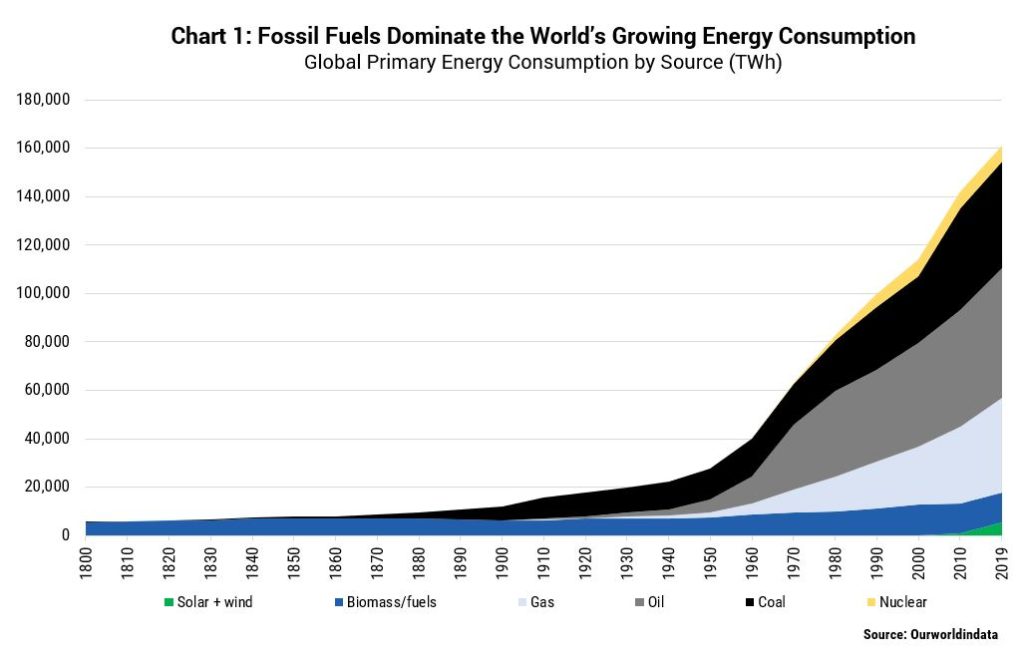
As Australia resets to a more ambitious 2030 emissions target under a new Labor government, it's time we address the largest opportunity on our pathway to net zero emissions: "making dirty cleaner". David Gilmour, Portfolio Analyst and ESG Specialist, details why. As Australia resets to a more ambitious 2030 emissions target under a new Labor government, it's time we address the largest opportunity on our pathway to net zero emissions: "making dirty cleaner". For too long, sustainability investment has centred on future facing industries, like renewables, and blatantly ignored the dirtiest industries. The focus has been on the cure to emissions, with no consideration to prevention. Divestment has been the weapon of choice. The Ukraine-Russia war has been a wake-up call. Fossil fuels, despite Western efforts to curb supply, are necessary for energy security when global trade is dividing into geopolitical blocks. What's more, they continue to dominate the world's growing demand for energy (Chart 1). To break their nexus with economic growth - and simultaneously transition without widening wealth inequality - we need to solve the demand side for both industry and the consumer. And that requires investor support and engagement.
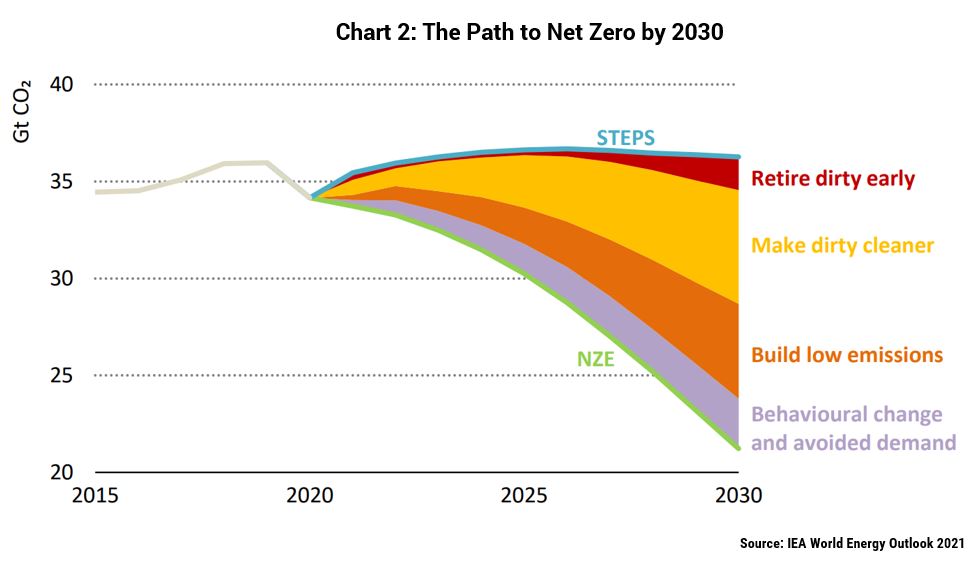
According to the International Energy Agency (IEA), we cannot simply divide energy investments into "clean" and "dirty". In fact, the largest part of emissions reductions under its net zero scenario - the same one purists cite when arguing to cease new fossil fuel production - comes from a middle ground of "transition" investments (Chart 2). Examples include project enhancements to reduce methane leakage, efficiency or flexibility measures in industrial processes, coal-to-gas switching (e.g. new gas boilers), refurbishments of power plants to support co-firing with low emissions fuels, and gas-fired plants that enable higher renewables penetration.
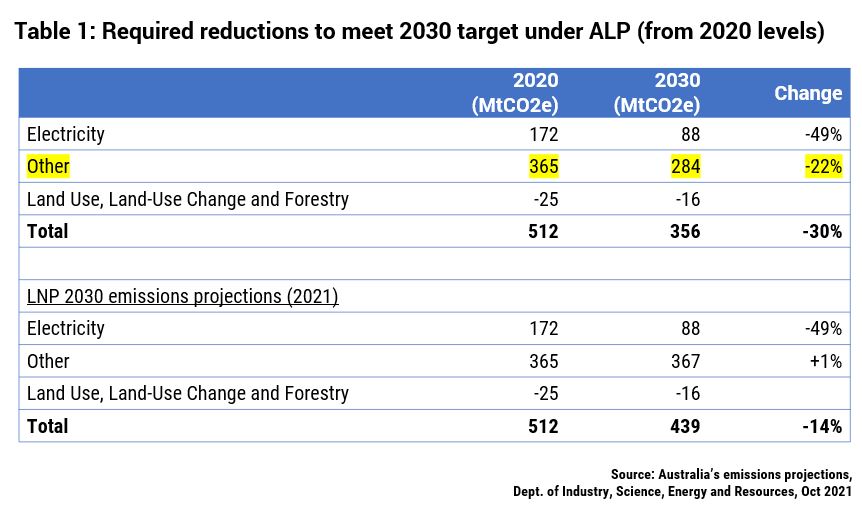
Within Goldman Sachs' latest forecast for a 37% fall in US emissions by 2030[1] (below the Biden Administration's target 50-52% reduction), energy efficiency is the first of three themes driving emissions lower over the short term. Outside Utilities, GS forecasts the biggest reductions to come from Oil & Gas Producers, Diversified Metals & Mining and Aluminium[2] - sectors where ownership by ESG focused investors is limited. Domestically it's a similar story. Like the US, Australia's electricity sector only accounts for around 30% of total emissions. Labor's new target for a 43% reduction on emissions to 2030 (based on 2005 levels) will require substantive efforts from Industry and Transport since, as we discussed last year, the Electricity sector is already stretched to its limit with a forecast 49% reduction by 2030 from today's levels. When you dig into the numbers, Labor's target equates to -30% on 2020 emissions levels, from 512MT today to 356Mt in 2030. This compares to the Coalition's projection for 439MT by 2030 (-14%) (Table 1). If we assume no further emissions reductions in the electricity sector under Labor, then it needs a -22% reduction in emissions from the "Other" sources, versus the Coalition's former forecast for +1%.
The new Federal government has also committed to strengthening the existing Safeguard Mechanism (SGM) to support its national target. Currently, Australia's largest emitting facilities (>100,000 tonnes per annum) have to purchase credits (ACCUs) when their emissions rise above generously set baselines. We support Labor's proposal to reduce these baselines over time which, if enacted, will drive greater energy efficiency and lowest-cost abatement solutions. Investors must also play an important role. We believe strongly in company engagement over exclusion; the former can lead to outperformance, while the latter shifts ownership to parts of the market with less oversight and deprives companies of capital when they need it most. That's why we are shareholders in high emitters such as Alumina (AWC), a company with a harder pathway to net zero but has the capability to benefit from the transition. AWC is already among the lowest emitters among major alumina producers, is pursuing early-stage technologies and is a clear beneficiary of green capex given the expected growth in demand for aluminium (39% demand growth to 2030[3]). We are also overweight Worley (WOR), which is well positioned to capture higher structural demand from energy transition work over and above its traditional work for the oil & gas industry. Once we solve the demand side, we expect supply from the oil & gas industry will take care of itself as customers evaporate. Until then Australian gas producers enjoy a privileged position. They are low sovereign risk for European countries weaning themselves off Russian gas, and will contribute significantly to lowering emissions in Asia as coal-to-gas switching takes place. Early this year we established a position in Woodside Petroleum (WPL), a company which predominantly produces gas and has a new strategy to invest $US5bn in new energy opportunities by 2030. Our focus remains on working with management to strengthen its 2030 interim target and lower its reliance on offsets. As ever, we continue to test the resolve of Australian companies to reduce their exposure to climate change risks and whether they are pursuing the right opportunities in the transition. Importantly, we have no intention of sidelining companies that provide critical products, especially when cleaning up their operations will cause the largest reductions in global emissions to a low carbon future. |
|
Funds operated by this manager: Yarra Australian Equities Fund, Yarra Emerging Leaders Fund, Yarra Enhanced Income Fund, Yarra Income Plus Fund [1] Source: Goldman Sachs: The path to lower US emissions, and what can drive impact, May 2022.
|


14 Jun 2022 - Record high inflation could trigger a fresh eurozone financial crisis
|
Record high inflation could trigger a fresh eurozone financial crisis Magellan Asset Management May 2022 Italy's 66th post-war government collapsed in January 2021 when Prime Minister Giuseppe Conte was forced to resign after former premier Matteo Renzi removed his minor Italia Viva party from the ruling coalition. President Sergio Mattarella encouraged the parties to revive the alliance so he could avoid calling a snap general election during a pandemic. But the talks went nowhere. As concerns grew that any election might usher right-wing populists into power, Mattarella pulled off a masterstroke. In early February, Mattarella unexpectedly contacted Mario Draghi; yes, 'Super Mario' who saved the euro in 2012 with his 'whatever it takes' comment. Mattarella asked the chief of the European Central Bank from 2011 to 2019 to begin talks to form a 'national unity' government. Within days, Draghi had won a parliamentary majority to become Italy's 29th prime minister since 1946 and its fourth unelected (or 'technocratic') premier since 1993.[1] Investors were pleased. On February 13 when Draghi assumed office, 'lo spread' - the yield at which Italian 10-year government bonds trade over their German equivalents, a number that is judged the bellwether of EU economic and political risks - had narrowed to a five-year low of just under 100 basis points. Draghi's government retains the confidence of investors yet lo spread has widened to 200 basis points (as the German 10-year bond topped 1% for the first time since 2015).[2] What malfunction occurred that widened the gap towards the 300 basis-point level that is seen by many as the tripwire for a crisis? None that was Draghi's fault. The culprit, like elsewhere in the world, is inflation. Eurozone inflation has climbed to its highest since the euro was created in 1999. Consumer prices surged 8.1% in the 12 months to May due to the ECB's promiscuous monetary policy, mammoth fiscal support during the pandemic, rising energy prices due to the switch to renewables, and supply blockages created by pandemic disruptions. The way Russia's war on Ukraine has boosted energy, commodity and food prices is likely to keep eurozone inflation elevated. The ECB has one objective; to maintain price instability, which is interpreted as keeping inflation below 2%. The central bank modelled on the inflation-hating Deutsche Bundesbank has little choice but to tighten monetary policy when inflation is nearly four times its target. Since 2016, the ECB's key rate has stood at 0%, while the overnight deposit rate has been negative since 2014 (and at a record minus 0.5% since 2019).[3] When the pandemic struck, the ECB added to various asset-buying programs[4] that gained heft when the bank first undertook quantitative easing in 2015. Over the past seven years, the central bank has purchased 3.9 trillion euros of eurozone assets, including 723 billion of Italian public debt, an amount equal to nearly 40% of Italy's GDP.[5] Given the record inflation, talk is mounting the ECB in July will raise rates for the first time since 2011, in what would be the first step towards boosting the key rate to a 'neutral' level of about 1.5% next year. The central bank is curtailing, and intends to end, its asset purchases.[6] Many central banks are raising key rates to tame inflation. For most countries, the main threat is the resultant slowing in economic growth boosts the jobless rate, perhaps to worrying levels if economies slump into recession. The ramifications of tighter monetary policy for the 19-member eurozone are wider and more concerning for three reasons. The first is the ECB is poised to stop acting as the buyer of last resort for its almost-bankrupt 'Club Med' members such as Italy, where gross government debt stood at 151% of GDP at the end of 2021.[7] No financier of government deficits (as some see it) for indebted sovereigns, especially Italy, will likely trigger a bond sell-off that puts the finances of debt-heavy governments on an unsustainable footing. Rising yields might restart the 'doom loop' that triggered the collapses of Greece, Ireland and Spain from 2010, whereby national bank bond holdings held as capital reserves plunge in value and the national government and commercial lenders become entwined in a downward spiral. The ECB would be exposed as lacking any credible way to quell such a government-bank suicide bind short of resuming the asset-buying that fuels the inflation it seeks to kill. The second way tighter ECB monetary policy is troubling is that the resultant economic downturn will remind indebted euro-users that they have no independent monetary policy to help their economies, nor a bespoke currency they can endlessly print to meet debt repayments, or devalue to export their way out of trouble. The only macro tool domestic policymakers possess is fiscal policy. The problem is many indebted governments are already running large fiscal deficits - Rome's shortfall over 2021 stood at 7.2% of GDP[8] and is forecast to be 6.0% in 2022[9] - and their debt loads mean these dearths can't be widened or prolonged. As talk mounts that indebted countries should quit the euro to reinstall the other macro tools, populist Italian politicians are bound to rekindle plans for a parallel currency as the least traumatic way for Italy to readopt the lira. The third means by which higher inflation is poisonous for the eurozone is that it creates a fissure between the area's creditor and debtor nations that would make it harder to find durable solutions for the euro. Inflation-phobic but inflation-ridden Germany and other creditors such as Finland and the Netherlands will squabble with France (government debt at 113% of GDP), Greece (193%), Italy, Portugal (127%) and Spain (118%) over how far the ECB should go to rein in inflation. The leaders of the creditor countries will be under domestic political pressure to ensure the ECB smothers inflation. They will battle with debtor leaders over how the ECB might support tottering governments and wobbly national banks sitting atop troubled economies. In line with this hawk-dove split, the Netherlands central bank chief Klaas Knot in July became the first ECB policy-board member to call for the bank to raise its key rate by 50 basis points to tackle inflation.[10] To maintain its inflation-fighting credentials, the ECB must raise interest rates enough to tame inflation, even if that stance crushes economic growth. The core concern of such tight monetary policy is that it will expose how the euro's flawed structure - that it is a currency union without the necessary political, fiscal or banking unions - has become explosive due to the large debts of southern eurozone governments. To be sure, policymakers are likely to once again thrash out some last-minute fudge that defers a denouement on the euro's fate. But temporary solutions are only, well, temporary and the euro needs a durable resolution. The indebted south could win the political tussle such that the ECB never makes a serious attempt to tame inflation. Due to generous pandemic support, creditor nations have higher government debt-to-GDP ratios - Germany's is 69%, the Netherland's 52%. They thus might tolerate faster inflation as it improves their debt ratios if their economies hold up. But that path might only delay tighter monetary policy and subsequent detonations. The war in Ukraine might undermine eurozone economic growth enough to quell inflation without the ECB doing much. The cost of servicing public debt, while rising, is still historically low, which reduces the likelihood of missed debt payments and a crisis. Eurozone governments are restarting efforts to create a proper banking union, which would mean common bank rules and eurozone, rather than national support for troubled banks.[11] But creditor nations don't want to be part of a mutual deposit insurance scheme if that means subsidising Italian banks holding Rome's debt. Nor do debtor governments want to join a banking union that could restrict their banks buying their bonds to support them. Lo spread is well short of the post-euro record 556 basis points it reached in 2011 during the first eurozone crisis that was triggered by the current-account imbalances among members.[12] But Rome's debt was only 120% of GDP then, and that gap narrowed only due to ECB support that is now waning because the problem today is inflation, not skewed trade and investment flows. Germany's economic slump and dislike of inflation will ensure Berlin pressures the ECB to prioritise inflation. Lo spread could widen enough to threaten a flawed currency union, especially if member countries are squabbling over solutions. While Draghi the central banker could bluff investors, Draghi the politician has no similar obvious masterstroke. Of note too is that Draghi's prime ministership will likely end when Italy holds a general election next year in Europe's spring that is likely to usher right-wing eurosceptics into power. To all the world's problem, be prepared to add elevated doubt about the euro's long-term future. The currency swap In 1948, Chris Howland was a 20-year British private who was the most popular radio DJ in northern Germany. On the night of June 17, two British military policemen appeared at the radio station in Hamburg where Howland worked. They made Howland sit up all night before allowing him at 6.30 am to open a sealed envelope and read the content on air. The news? The military government of Britain, France and the US from June 20 would introduce a new currency. Every German would receive 40 new Deutsche marks, which had been printed in the US and shipped in wooden crates stamped 'Doorknobs', in exchange for 60 Reichsmarks. Any other swastika-emblazoned Reichsmarks people held were made worthless come June 21.[13] A 'currency reform' of some sort was expected. But still. It's estimated that 95% of Reichsmarks were destroyed without replacement and savers were left with only 6.5% of their assets. The instantaneous currency switch and savings savaging were at the heart of measures under the Marshall Plan designed to revive Germany's economy at a time when millions of Germans were starving, inflation was rife, the currency untrusted and bartering prevalent. The steps, which in the absence of Russian knowledge sparked the Berlin Blockade,[14] worked. The economic revival in the French, UK and US zones that became West Germany was credited with helping Germany adopt a new constitution in 1949 known as the Basic Law. The currency changeover on top of the rampant post-war inflation and the hyperinflation of the early 1920s left a legacy. Germans adopted a mentality that the value of the Deutsche mark must be protected above all. This job was given to the Bundesbank when it was established in 1957 as the world's first and only central bank still to be granted independence under its country's constitution (whereas other central banks are granted 'independence' through acts of parliament or the goodwill of the executive).[15] Come 1993, Germany's Constitutional Court confirmed that under the Basic Law the Bundestag (parliament) only had the authority to ratify the Maastricht Treaty that created the euro if the European monetary union was in Germany's interest. The test? "The future European currency must be and remain as stable as the Deutsche mark," the court decreed.[16] Thus the ECB ended up with the same primary objective as the Bundesbank; namely, to maintain price stability. In Germany, the ECB's loose monetary setting and the inflation unleashed are seen as a betrayal. To the German public, tabloid media and even the German 'father of the euro' Otmar Issing, the ECB is modelled more on Italy's economic mismanagement pre-euro (when Rome's main policy response was to devalue the lira). Issing, the ECB's first chief economist, said the ECB has "lived in a fantasy" that downplayed the danger of inflation and thus the bank "has contributed massively to this trap in which it is now caught".[17] The ECB lax stance has wiped out returns on German savings, which is seen as income foregone to subsidise lazy southern Europeans.[18] High inflation stings Germans because few invest in equities or other 'growth' assets that might act as a hedge against inflation. Most German savings head to small regional savings and co-operative banks that offer low deposit rates. The German public is unlikely to feel more generous towards the indebted south if interruptions to energy and other imports from Russia send the German economy into recession.[19] But, as pessimism grows about global prospects, the economic outlook of inflation-tolerant and Russian-gas-dependent Italy is dimming too. Although Italy's economy is supported by consumer savings built up during lockdowns and 192 billion euros from the EU's 750-billion-euro Covid recovery fund, higher energy prices and other tremors from the Ukraine war could slow growth enough to send the country into recession.[20] Many fret about the trouble to be ignited when the ECB halts its asset buying, given how precarious are Rome's finances - the country has the largest budget deficit in the eurozone and the worst public debt ratio after Greece (193%).[21] In case of any crisis centred on Italy, policymakers have options such as loans from the EU rescue fund and linked ECB bond purchases of struggling members. But such aid would require approval from Germany's Bundestag and other creditor-nation parliaments. Another option is the one revealed when Draghi and French President Emmanuel Macron signed a joint letter last December that implicitly called for the transfer of all eurozone government debt since 2007 to a debt-management agency. But Germany and many other euro members would oppose such subterfuge.[22] It's probable that sometime soon the talents of Draghi the unelected politician and other policymakers will be tested. Lo spread will reveal what bond investors think. What's unlikely in any upcoming crisis, however, is any solution that cements the euro's future. By Michael Collins, Investment Specialist |
|
Funds operated by this manager: Magellan Global Fund (Hedged), Magellan Global Fund (Open Class Units) ASX:MGOC, Magellan High Conviction Fund, Magellan Infrastructure Fund, Magellan Infrastructure Fund (Unhedged), MFG Core Infrastructure Fund [1] In 1993, Bank of Italy Governor Carlo Azeglio Ciampi was drafted as prime minister. At the height of the sovereign debt crisis in 2011, Mario Monti, who'd spent a decade at the European Commission, was appointed PM. In 2018, rival populist parties tapped Conte, a law professor at a university in Florence, to be PM. A list of Italian prime ministers can be found at: wikipedia.org/wiki/List_of_prime_ministers_of_Italy[2] The gravest scare for investors during Draghi's time as prime minister occurred in January this year when Italy's parliament failed to elect a new president in seven ballots held over a week and Draghi was touted as the next head of state (and seemed interested in the role). But that would have once again meant a snap general election that might have jetted right-wing populist parties into power. That outcome was avoided when MPs re-elected Mattarella even though the 80-year-old had rejected a second term. Important Information: This material has been delivered to you by Magellan Asset Management Limited ABN 31 120 593 946 AFS Licence No. 304 301 ('Magellan') and has been prepared for general information purposes only and must not be construed as investment advice or as an investment recommendation. This material does not take into account your investment objectives, financial situation or particular needs. This material does not constitute an offer or inducement to engage in an investment activity nor does it form part of any offer documentation, offer or invitation to purchase, sell or subscribe for interests in any type of investment product or service. You should read and consider any relevant offer documentation applicable to any investment product or service and consider obtaining professional investment advice tailored to your specific circumstances before making any investment decision. A copy of the relevant PDS relating to a Magellan financial product or service may be obtained by calling +61 2 9235 4888 or by visiting www.magellangroup.com.au. Past performance is not necessarily indicative of future results and no person guarantees the future performance of any strategy, the amount or timing of any return from it, that asset allocations will be met, that it will be able to be implemented and its investment strategy or that its investment objectives will be achieved. This material may contain 'forward-looking statements'. Actual events or results or the actual performance of a Magellan financial product or service may differ materially from those reflected or contemplated in such forward-looking statements. This material may include data, research and other information from third party sources. Magellan makes no guarantee that such information is accurate, complete or timely and does not provide any warranties regarding results obtained from its use. This information is subject to change at any time and no person has any responsibility to update any of the information provided in this material. Statements contained in this material that are not historical facts are based on current expectations, estimates, projections, opinions and beliefs of Magellan. Such statements involve known and unknown risks, uncertainties and other factors, and undue reliance should not be placed thereon. Any trademarks, logos, and service marks contained herein may be the registered and unregistered trademarks of their respective owners. This material and the information contained within it may not be reproduced, or disclosed, in whole or in part, without the prior written consent of Magellan. |

10 Jun 2022 - Why country risk matters

9 Jun 2022 - Is this a buying opportunity?
|
Is this a buying opportunity? Equitable Investors May 2022 "RECAPITALISATION" OPPORTUNITY The $US146 billion of equity capital raised globally in the March quarter of 2022 sounds like a huge number but was down 69% from $US476 billion a year earlier and 58% from the December quarter (using dealogic data). The current quarter is running lower still. We have identified almost 400 "cash burners" on the ASX (ex resources). Nearly half of these cash burners did not have the funds to make it past 12 months based on their March quarter cash burn. It may not be a complete surprise to you that the sector with the most companies facing one year or less of cash funding is Software and Services. Biotech and Health Care unsurprisingly represent nearly 30% of these companies. The great opportunity in this is for investors to identify situations where capital availability can make a huge difference to valuation, either in isolation or with a few changes and greater fiscal discipline. We think this "recapitalisation" opportunity is a huge opportunity and an exciting time for a firm such as Equitable Investors that applies bottom-up, fundamental research and constructively engages with companies. We are inviting follow-on and new investments in Dragonfly Fund to pursue such opportunities over the next 12 months. Applications (for wholesale investors only) can be made here.
Funds operated by this manager: Equitable Investors Dragonfly Fund Disclaimer Nothing in this blog constitutes investment advice - or advice in any other field. Neither the information, commentary or any opinion contained in this blog constitutes a solicitation or offer by Equitable Investors Pty Ltd (Equitable Investors) or its affiliates to buy or sell any securities or other financial instruments. Nor shall any such security be offered or sold to any person in any jurisdiction in which such offer, solicitation, purchase, or sale would be unlawful under the securities laws of such jurisdiction. The content of this blog should not be relied upon in making investment decisions.Any decisions based on information contained on this blog are the sole responsibility of the visitor. In exchange for using this blog, the visitor agree to indemnify Equitable Investors and hold Equitable Investors, its officers, directors, employees, affiliates, agents, licensors and suppliers harmless against any and all claims, losses, liability, costs and expenses (including but not limited to legal fees) arising from your use of this blog, from your violation of these Terms or from any decisions that the visitor makes based on such information. This blog is for information purposes only and is not intended to be relied upon as a forecast, research or investment advice. The information on this blog does not constitute a recommendation, offer or solicitation to buy or sell any securities or to adopt any investment strategy. Although this material is based upon information that Equitable Investors considers reliable and endeavours to keep current, Equitable Investors does not assure that this material is accurate, current or complete, and it should not be relied upon as such. Any opinions expressed on this blog may change as subsequent conditions vary. Equitable Investors does not warrant, either expressly or implied, the accuracy or completeness of the information, text, graphics, links or other items contained on this blog and does not warrant that the functions contained in this blog will be uninterrupted or error-free, that defects will be corrected, or that the blog will be free of viruses or other harmful components.Equitable Investors expressly disclaims all liability for errors and omissions in the materials on this blog and for the use or interpretation by others of information contained on the blog |


8 Jun 2022 - With markets falling, is it safe to invest again?
|
With markets falling, is it safe to invest again? Montgomery Investment Management 26 May 2022 In the famed 1970s thriller, Marathon Man, Nazi dentist Dr Christian Szell - who is looking for a stash of stolen diamonds - repeatedly asks the character played by Dustin Hoffman "Is it safe?" Right now, many people are likely asking the same question about investing in the share market. With the distraction of local politics behind us, investors can return to matters that will shape their short and medium-term returns. Given a lack of clarity about where the safe havens are, and notwithstanding the supply shocks associated with the war in Ukraine and the recent shuttering of China's economy, what follows is a summary of the issues confronting equity markets and a possible answer to the question of whether it is time to add to your investment in equities. InflationWidespread and stubborn U.S. inflation, driven by surging oil and rents, as well as rising wages, has inspired inflation expectations for next year to more than six per cent, from near one per cent in 2020. U.S. core Personal Consumption Expenditure inflation, which excludes more volatile food and energy, has risen from sub-two per cent in the first quarter of 2021 to an annual rate of 4.9 per cent, the highest since September of 1983. Slowing U.S. economic growthEquity investors are of course aware of this trend and the persistence of supply chain bottlenecks that are in no small part responsible. Perhaps less obvious, but no less concerning, are the rapid reductions being applied by forecasters to U.S. economic growth. According to Bloomberg, forecast U.S. GDP growth for 2022 was above four per cent back in Q3'21 but has recently plunged towards 2.75 per cent. Meanwhile the 2.5 per cent GDP forecasts for 2023 in place at the beginning of this year have given way to forecasts of 2.1 per cent. Falling earningsSlowing U.S. GDP growth is important for share prices. Remembering that much of the equity market correction to date has been the consequence of PE compression - which always accompanies rising rates and accelerating inflation - a slowing rate of growth raises the spectre of reduced earnings. And when the 'E' in the PE ratio also declines, equity market losses can and often compound. As waves of liquidation have hit U.S. equities amid a winding back of the Federal Reserve stimulus and rising interest rates, declining total returns for the S&P500 have exceeded the total return losses in treasuries. These returns are highly correlated to 12-month forward S&P500 earnings per share estimates. Consequently, the earnings estimates are now declining, from growth of circa 55 per cent year-on-year, to 27 per cent today. The winding back of earnings expectations, and the broadening of the bear market, may still have some way to go, even as 50 per cent of NASDAQ Composite constituents - the most vulnerable being thematic and concept stocks, small cap tech and small cap growth, for example - have fallen by more than 50 per cent, and 72 per cent of constituents have fallen by more than 25 per cent (see Table 1.). Table 1. Bear market in stealth mode Declining U.S. real disposable incomesHeaping burning coals on the declining earnings outlook will be the decline in real disposable incomes, which are near minus 12 per cent year-on-year and represent the sharpest decline since at least 1960. The decline is of course partly due to the high support/stimulus payments received last year but much of it can also be attributable to the sharp rise in inflation. Historically, when real income contractions of this magnitude have occurred, they were followed by a marked slowdown in consumer spending. We believe, therefore, at the very least, investors should not expect upgrades from, or re-ratings for, companies exposed to consumers just yet. Is it time to invest?However, the baby is being thrown out with the proverbial bathwater and high-quality names across a broad variety of sectors and industries are now being sold down too. As we have witnessed many times in the last three or four decades, ultimately, indiscriminate selling gives way to discernment and finally selective buying. A capitulation sell-off may therefore eventually give way to another once-in-a-decade opportunity to improve the general quality of portfolios and lock in superior returns. Remember, the lower the price one pays, the higher the return. What are the factors investors should be watching to decide if it is safe to dip one's toe back in the water?The current sell-off has been largely macro-driven. Concerns about inflation and rising interest rates, and now slowing growth (stagflation), are principally responsible for the current reassessment of equity investor returns. These seem likely to remain this year. It seems reasonable to conclude the expectation of good news on these fronts will be necessary for the current 'risk-off' sentiment to ease before reversing. The question of course, is where are the revelations going to be? Will slowing growth lead to recession, which restores bonds as a safe haven, reducing their yield and setting equities up for a recovery post-recession? Or will we see high inflation and strong economic growth, empowering only companies with pricing power to improve margins through a combination of higher volumes and higher prices? Finally, do we end up with Jerome Powell's 'soft-landing' scenario, which will be positive for both equities and bonds? In the short run, the market seems very oversold making it susceptible to a sharp short-term recovery (Figure 1.) Figure 1. Negative change in PE historically significant and fully factored in rising rates As can be seen in Figure 1., the pace of PE compression is historically significant and is nearing a point (red line) from which PEs have historically expanded again. The PE compression reflects rising interest rate expectations but importantly, however, it does not appear the market has factored in any recession or even any slow-down in earnings. The slow-down in earnings growth estimates however still suggests investors are factoring in some growth. And investors should not ignore the tax-like impact on consumers and growth from the combination of rising interest rates, rising fuel costs and the rising U.S. dollar (which of course saps capital from and fuels inflation for importing nations). The market has not factored in a contraction in earnings (keep also in mind the very steep slump in real disposable income cited above) and for this reason many commentators believe further declines in the stock market should be expected. And unlike previous bear market episodes, the Federal Reserve does not appear to be coming to the rescue of investors. Indeed, if anything, the Fed's Jerome Powell has toughened his Hawkish stance. Meanwhile, as liquidity is being withdrawn, money supply growth continues to slow relative to bank credit growth, meaning there is less liquidity for financial assets. Finally, while some commentators and macro economists point to evidence, and warn, of more frequent bear markets (US S&P500 drawdowns of 20 per cent or greater) during periods of rising inflation (Figure 2.), I note my firm belief long-term declines in union membership and rapid advancement in autonomous technology will keep a lid on long-term wages growth and ultimately on inflation. Figure 2. S&P500 sell offs during rising inflation (1965-80) and declining inflation Investors should be sharpening their pencils and working on the stocks and funds in which they plan to invest, in preparation for making additional equity market investments. Author: Roger Montgomery, Chairman and Chief Investment Officer Funds operated by this manager: Montgomery (Private) Fund, Montgomery Small Companies Fund, The Montgomery Fund |

8 Jun 2022 - Why 15 stocks are all you need
|
Why 15 stocks are all you need Claremont Global May 2022
With a mandate of owning 10-15 stocks, I am often asked: "How do I sleep at night given the concentration risk?" This has been a familiar refrain for most of the 25 years I have been managing client capital and where I have always run concentrated portfolios with 10-25 stocks. The thinking suggests that with a concentrated portfolio, you are running excess risk and one would be better served having a more "diversified" portfolio. My answer is always the same - it all depends on how you define risk. If you define risk as the chance of underperforming an index or benchmark in the short term - then I would agree this is "risky". This is the classic fund manager's "career risk" - the chance of underperforming a benchmark and putting your job on the line or losing client FUM. In the words of John Maynard Keynes: "It is better for reputation to fail conventionally than to succeed unconventionally". But to earn returns that are better than the market, it is really quite simple - you have to own portfolios that are different from the market. Robert Hagstrom in his excellent book The Essential Buffett - timeless principles for the New Economy ran a 10-year study from 1987-96 where he had a computer randomly assemble 3,000 portfolios from 1,200 companies and broke the results down as follows:
It is interesting to note the 15-stock portfolio achieved an average return not much different to the 250-stock portfolio but with a much wider range of outcomes (i.e. much higher career risk!). However, the chances of beating the market were also more than 13 times higher. In addition, Lorie & Fisher showed in their 49-year study of NYSE-traded stocks between 1926-65 that 90 per cent of stock risk can be diversified with a 16-stock portfolio. But we define risk as the possibility of permanently impairing client capital or not achieving a satisfactory return for the risk taken. And we target a long-term return of eight to twelve per cent per annum over a five to seven-year period. We believe a permanent impairment to capital is most likely to arise in the following ways: Buying heavily leveraged businessesMany management teams are very happy to layer on debt in the good times by "returning capital" to shareholders and achieving artificial EPS growth to satisfy short-term and poorly defined incentive targets. There is no better example of this than the actions of American Airlines in the five years to 2019. The company "returned" $13bn in buybacks - this was despite the fact there was no capital to return, as free cash flow over the period was a NEGATIVE $3.2bn! The ratio of debt to earnings before income, taxes, depreciation and amortisation (EBITDA) was 4.2-times in 2019 at the peak of the cycle. In our opinion this is highly irresponsible, given the industry already has a high degree of operational gearing, has a large amount of off-balance sheet debt in the form of leases and is vulnerable to rising oil prices. And then when tough times hit, these companies go cap-in-hand to the government and/or shareholders to repair balance sheets at very depressed equity prices, resulting in severe value destruction. By contrast, our portfolio has a weighted net debt/EBITDA of 0.7x. Excess leverage is just not a risk we are willing to run. Balance sheet strength is a given in our portfolio. We know that the future is always uncertain and rather than trying to forecast when the good times will end (folly in our opinion), we assume that recessions are a natural part of economic life and we prepare accordingly. The added benefit of this is that when recessions occur, our companies can play offence - buying quality assets or their own shares at favorable prices and maintaining or even increasing the dividend. We have companies in our portfolio that have consistently paid rising dividends for over 40 years. Buying businesses that rely on an accurate forecast of some hard-to-predict variableThese variables can be interest rates, moves by the Federal Reserve, commodity prices, regulation, innovation and election results, amongst many others in a complex world. In 2016 I didn't know many people who predicted Trump would be elected ― and for those who did, how many predicted that markets would rally? Or in March of this year, who would have thought the market would be at an all-time high in December, when the global economic contraction has been the largest since the Great Depression? Another favourite of mine in recent years has been buying banks on the "yield steepening trade", only to then see rates collapse. Or the oil majors in 2014, who spent billions on exploration with a forecast of oil being above $100 a barrel, only to see oil collapse with the advent of shale oil. We deliberately avoid businesses that rely on us correctly forecasting commodity prices, interest rates, elections, drug discoveries, economic growth or political outcomes. Experience has taught us that very few people are able to do this on a consistent basis. Yogi Berra put it well: "Forecasts are hard, especially about the future". Buying inferior businesses with no competitive advantageOver time, competition does a pretty good job of taking away excess returns for most businesses. And over time, it is very hard for an investor to earn a return much different than the underlying economics of the business one owns. If an investor wants to earn an excess return, logic suggests that the best place to start is with owning businesses that themselves earn excess returns on shareholder capital. Superior returns on capital normally arise from some form of competitive advantage - be it a brand, network effect, scale, reputation, data, client relationships, IP or technology. But the allure of buying "cheap" businesses is often too much for some. Even Warren Buffett himself made this mistake when buying textile company Berkshire Hathaway at a steep discount to its underlying asset value. But as he said many years later, once he came to realize his mistake and finally exited the business: "Berkshire Hathaway's pricing power lasted the best part of a morning". Our preference is to own businesses that have been proven over many years and cycles. The average age of our businesses is over 70 years, with the oldest dating back to the end of the US Civil War. They have been tested through wars, product cycles, recessions, political upheaval, inflation and financial crises. The competitive advantage in our portfolio is evidenced by an operating margin of 27 per cent and a return on invested capital of 18 per cent - both over 2x the average listed business. It is interesting to note the average listed business earns a return of 9 per cent - not far from the level equities have actually achieved over the long term.
Aggressive management or those who allocate capital poorlyUnfortunately, it is a fact of life that the people who end up running businesses are often no "shrinking violets". They are usually very confident in their ability and their normal starting point is to aggressively "grow the business". This can often involve straying away from their core competence into new areas, where their "skill" will translate into superior returns to shareholders. The worst situation occurs where management take on a lot of debt at the peak of the cycle, pay an inflated price for an asset, heap goodwill on the balance sheet, only to reverse the deal many years later ― and more often under new management. A classic example of this is GE, who took a very good industrial business and then ventured into credit cards, property, insurance, media ... the list goes on. The end result was to take a AAA rated balance sheet and turn it into one that is now barely above junk status. Or closer to home - who can forget Woolworths ill-timed home improvement venture against the toughest of competitors, or even Bunnings themselves and their venture into the UK? Would it not have made sense to focus capital on the competitive advantage that made the company a market leader in the first place and then return excess capital to shareholders? And finally, my all-time favorite - the Vodafone purchase of Mannesmann at the peak of the TMT mania for $173bn, which saw Vodafone CEO Chris Gent earn a bonus of $16m for the "value" he created. In 2006, Vodafone quietly wrote the asset down by $28bn, but not before Sir Chris Gent received a knighthood for "services to the telecom industry." I wonder whether he should have received the highest German accolade "for services to the German pension fund industry." To quote Michael Porter, the doyen of competitive advantage: "The biggest impediment to strategy and competitive advantage is an overly reliant focus on growth". By contrast, we prefer our management teams to relentlessly focus on competitive advantage, customers, employees, communities and reinvest back in the business for the long term. And once this is done, to make sensible bolt-on acquisitions, pay dividends and buy back their stock when it is decent value. The last trait is very hard to find - there are very few management teams who treat buying their shares like they would any other acquisition. For most management teams, the logic is if I can borrow at, say 2 per cent, as long as I pay no more than 50x earnings - this enhances earnings per share. And unfortunately, most management teams will happily buy their stock in bull markets using cheap debt, only to stop this when their shares are cheap, as this is the "prudent" thing to do. Buying businesses at prices that are well above their fair valueEven if one buys businesses that have superior economics, strong balance sheets and are well managed - even the most disciplined can be lured into paying inflated prices, especially in the upper reaches of a bull market. The narrative always follows a similar pattern that excess growth will last forever, interest rates will never rise, the company has changed (very few do), the company deserves a lower beta and the list goes on. When valuing companies, we do not change our discount rates, terminal growth assumptions, or market multiples, preferring to use "through the cycle" value inputs. Neither do we use a weighted average cost of capital (WACC) or beta to justify higher prices. Read any book by the doyen of valuation, Aswath Damodaran, and he will argue that if you are to drop your risk-free rate, you should also drop your terminal growth rate. This makes sense as a lower risk-free rate suggests a lower nominal gross domestic product (GDP) growth rate. Yet, in the upper reaches of a bull market, it is not uncommon to see lower risk-free rates and higher terminal growth rates to justify valuations! ConclusionSo, to return to the original client question posed at the beginning of this article: "How do I sleep well at night with only 10-15 stocks?" The question assumes that I would sleep better if we owned more stocks. Well, to do that, we would have to add lesser quality names or those with lower expected returns. Would I sleep better then? It would decrease our research intensity, whilst potentially lowering the quality and/or the expected return of the portfolio. I could load up on "cheap" bank stocks but would now be exposing myself to balance sheet risk ― at 20x geared, these businesses can literally go to zero as we saw in the global financial crisis (GFC) ― as well as interest rate risk, economic risk and a large amount of regulatory risk (witness the halting of dividends in Europe recently). Or, I could load up on "cheap" oil stocks, but I would be up late at night poring over demand/supply dynamics, vaccine developments and economic data. These are areas where the future is difficult to define and instead of allowing me to sleep better, it would have the opposite effect! This is not our way. Instead, we prefer to construct a portfolio of 10-15 high quality businesses, whose earnings have a very good chance of growing well ahead of inflation over a long period of time ― and when the inevitable bad times come, we know we own time-tested business models, fortress balance sheets and seasoned management teams that will get us through to the other side. We may see share prices fall ― in some cases quite dramatically like the GFC or the March sell-off ― but for those with the fortitude to see it through, this is unlikely to be a permanent destruction of capital. This approach has served me well through hyperinflation in Zimbabwe, the TMT bubble, the GFC, the European debt crisis and more recently the COVID-19 pandemic. For one known to like his sleep, it allows me to sleep well. And more importantly, our clients too. Author: Bob Desmond, Head of Claremont Global & Portfolio Manager Funds operated by this manager: |


